
Pulp Fiction, 1920 · page 132 of 164
Argosy, Vol. 122, No. 1 — page 132: what you’re looking at
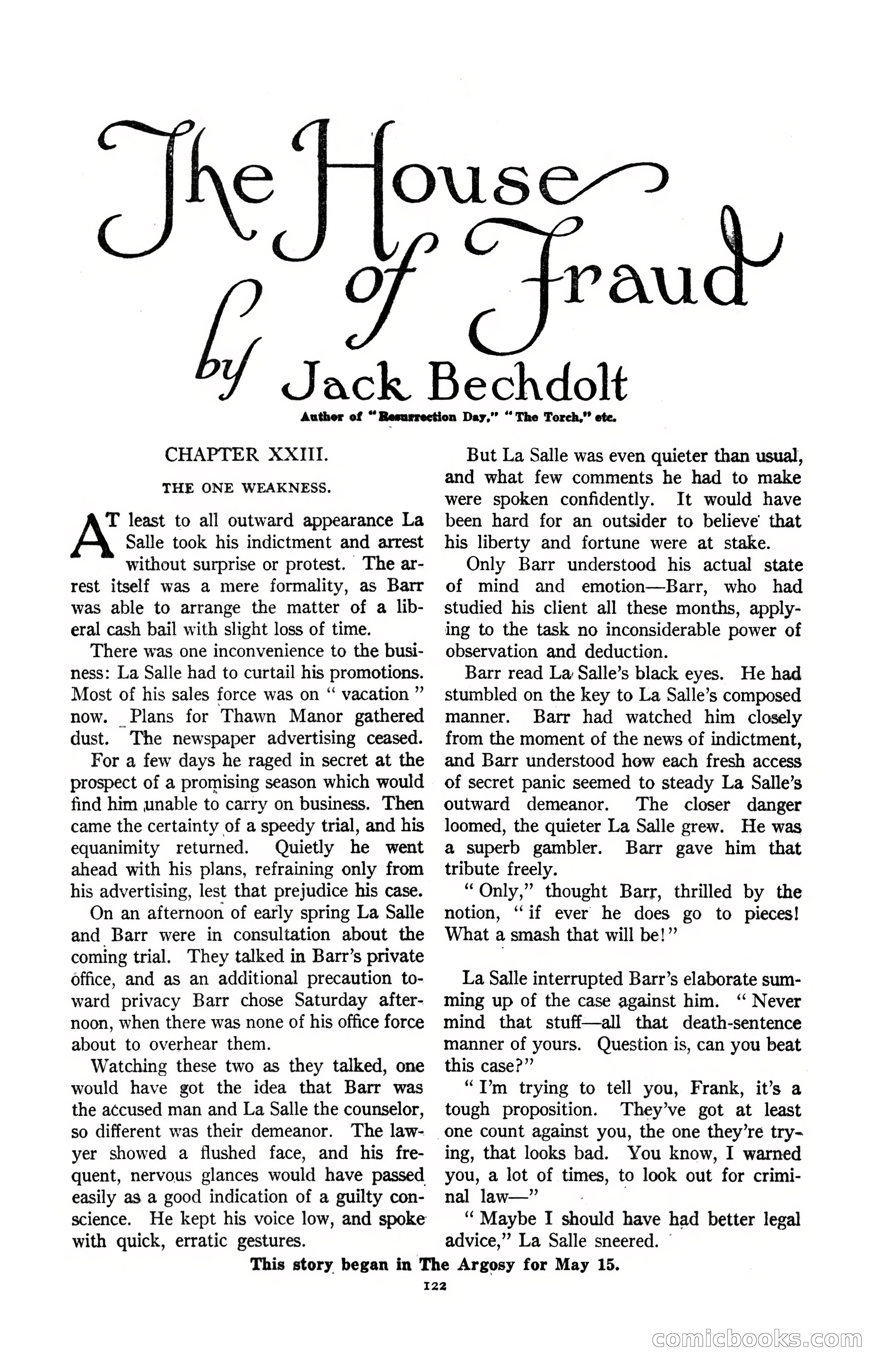
A restored page from Pulp Fiction, 1920. Page through the whole issue in the reader above.
📄 Transcribed text from this page (OCR, searchable)
Machine-transcribed from the original scan — historical spelling and the odd misread are preserved.
if “frau ly Jack Bechdolt q Author of “ Resurrection Day,”” “‘ The Torch,” ete. CHAPTER XXIII. THE ONE WEAKNESS. T least to all outward appearance La Salle took his indictment and arrest without surprise or protest. The ar- rest itself was a mere formality, as Barr was able to arrange the matter of a lib- eral cash bail with slight loss of time. There was one inconvenience to the busi- ness: La Salle had to curtail his promotions. Most of his sales force was on “ vacation ”’ now. Plans for Thawn Manor gathered dust. The newspaper advertising ceased. For a few days he raged in secret at the prospect of a promising season which would find him unable to carry on business. Then came the certainty of a speedy trial, and his equanimity returned. Quietly he went ahead with his plans, refraining only from his advertising, lest that prejudice his case. On an afternoon of early spring La Salle and Barr were in consultation about the coming trial. They talked in Barr’s private office, and as an additional precaution to- ward privacy Barr chose Saturday after- noon, when there was none of his office force about to overhear them. Watching these two as they talked, one would have got the idea that Barr was the accused man and La Salle the counselor, so different was their demeanor. The law- yer showed a flushed face, and his fre- quent, nervous glances would have passed easily as a good indication of a guilty con- science. He kept his voice low, and spoke with quick, erratic gestures. But La Salle was even quieter than usual, and what few comments he had to make were spoken confidently. It would have been hard for an outsider to believe that his liberty and fortune were at stake. Only Barr understood his actual state of mind and emotion—Barr, who had studied his client all these months, apply- ing to the task no inconsiderable power of observation and deduction. Barr read La Salle’s black eyes. He had stumbled on the key to La Salle’s composed manner. Barr had watched him closely from the moment of the news of indictment, and Barr understood how each fresh access of secret panic seemed to steady La Salle’s outward demeanor. The closer danger loomed, the quieter La Salle grew. He was a superb gambler. Barr gave him that tribute freely. “Only,” thought Barr, thrilled by the notion, ‘‘if ever he does go to pieces! What a smash that will be!” La Salle interrupted Barr’s elaborate sum- ming up of the case against him. ‘“ Never mind that stuff—all that death-sentence manner of yours. Question is, can you beat this case?” “I’m trying to tell you, Frank, it’s a tough proposition. They’ve got at least one count against you, the one they’re try- ing, that looks bad. You know, I warned you, a lot of times, to look out for crimi- nal law—” | ‘“ Maybe I should have had better legal advice,”’ La Salle sneered. © This story began in The Argosy for May 15. I22 cComiclbooks.com