
Pulp Fiction, 1920 · page 18 of 164
Argosy, Vol. 122, No. 1 — page 18: what you’re looking at
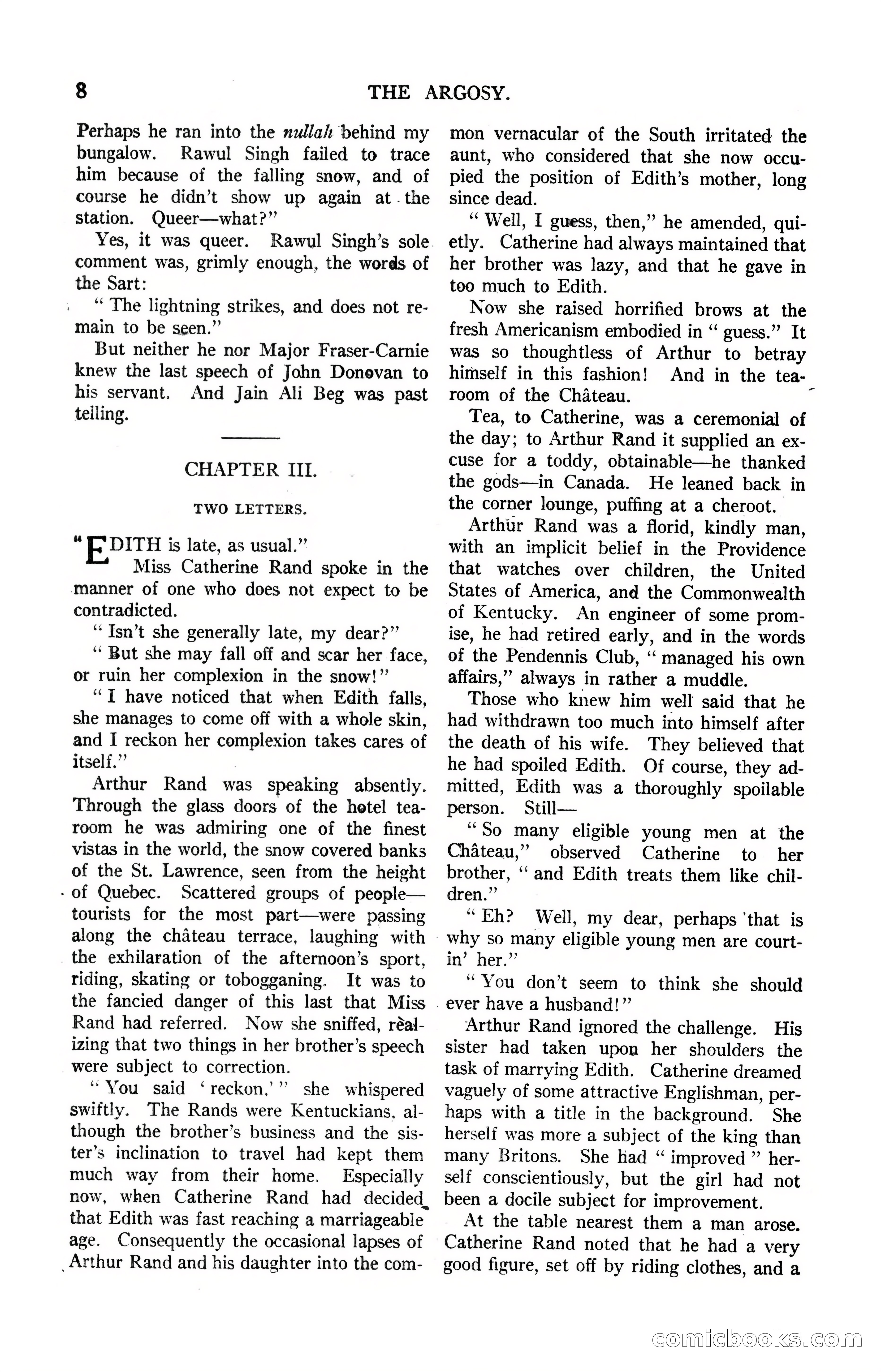
A restored page from Pulp Fiction, 1920. Page through the whole issue in the reader above.
📄 Transcribed text from this page (OCR, searchable)
Machine-transcribed from the original scan — historical spelling and the odd misread are preserved.
8 THE ARGOSY. Perhaps he ran into the nullah behind my bungalow. Rawul Singh failed to trace him because of the falling snow, and of course he didn’t show up again at.the Station. Queer—what?’’ Yes, it was queer. Rawul Singh’s sole comment was, grimly enough, the words of the Sart: ‘The lightning strikes, and does not re- main to be seen.” But neither he nor Major Fraser-Carnie knew the last speech of John Donovan to his servant. And Jain Ali Beg was past telling. CHAPTER III. TWO LETTERS. DITH is late, as usual.” Miss Catherine Rand spoke in the manner of one who does not expect to be contradicted. ‘‘ Isn’t she generally late, my dear?” ‘But she may fall off and scar her face, or ruin her complexion in the snow!’ ‘““T have noticed that when Edith falls, she manages to come off with a whole skin, and I reckon her complexion takes cares of itself.” Arthur Rand was speaking absently. Through the glass doors of the hetel tea- room he was admiring one of the finest vistas in the world, the snow covered banks of the St. Lawrence, seen from the height - of Quebec. Scattered groups of people— tourists for the most part—were passing along the chateau terrace, laughing with the exhilaration of the afternoon’s sport, riding, skating or tobogganing. It was to the fancied danger of this last that Miss Rand had referred. Now she sniffed, réal- izing that two things in her brother’s speech were subject to correction. ‘You said ‘reckon,’” she whispered swiftly. The Rands were Kentuckians, al- though the brother’s business and the sis- ter’s inclination to travel had kept them much way from their home. Especially now, when Catherine Rand had decided, that Edith was fast reaching a marriageable age. Consequently the occasional lapses of _Arthur Rand and his daughter into the com- mon vernacular of the South irritated the aunt, who considered that she now occu- pied the position of Edith’s mother, long since dead. ‘Well, I guess, then,” he amended, qui- etly. Catherine had always maintained that her brother was lazy, and that he gave in too much to Edith. Now she raised horrified brows at the fresh Americanism embodied in “ guess.” It was so thoughtless of Arthur to betray himself in this fashion! And in the tea- room of the Chateau. ” Tea, to Catherine, was a ceremonial of the day; to Arthur Rand it supplied an ex- cuse for a toddy, obtainable—he thanked the gods—in Canada. He leaned back in the corner lounge, puffing at a cheroot. Arthur Rand was a florid, kindly man, with an implicit belief in the Providence that watches over children, the United States of America, and the Commonwealth of Kentucky. An engineer of some prom- ise, he had retired early, and in the words of the Pendennis Club, “ managed his own affairs,” always in rather a muddle. Those who knew him well said that he had withdrawn too much into himself after the death of his wife. They believed that he had spoiled Edith. Of course, they ad- mitted, Edith was a thoroughly spoilable person. Still— ‘“So many eligible young men at the Chateau,” observed Catherine to her brother, ‘“‘ and Edith treats them like chil- dren.”’ “Eh? Well, my dear, perhaps ‘that is Sy so many eligible young men are court- ’ her.”’ “You don’t seem to think she should _ ever have a husband!’’ Arthur Rand ignored the challenge. His sister had taken upon her shoulders the task of marrying Edith. Catherine dreamed vaguely of some attractive Englishman, per- haps with a title in the background. She herself was more a subject of the king than many Britons. She had “ improved ”’ her- self conscientiously, but the girl had not been a docile subject for improvement. At the table nearest them a man arose. Catherine Rand noted that he had a very good figure, set off by riding clothes, and a cComiclbooks.com