
Pulp Fiction, 1920 · page 30 of 164
Argosy, Vol. 122, No. 1 — page 30: what you’re looking at
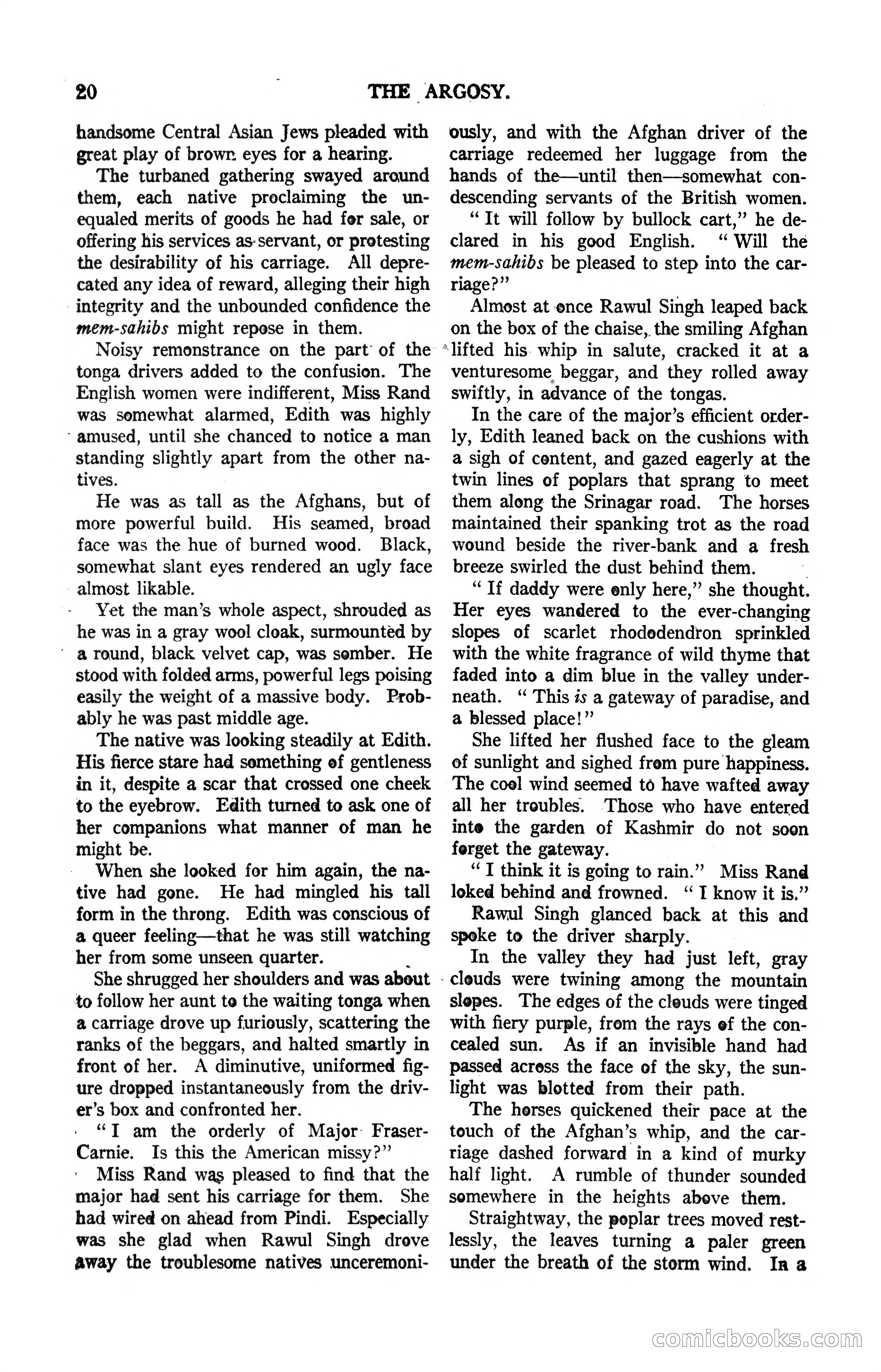
A restored page from Pulp Fiction, 1920. Page through the whole issue in the reader above.
📄 Transcribed text from this page (OCR, searchable)
Machine-transcribed from the original scan — historical spelling and the odd misread are preserved.
20 handsome Central Asian Jews pleaded with great play of browr. eyes for a hearing. The turbaned gathering swayed around them, each native proclaiming the un- equaled merits of goods he had for sale, or offering his services as-Servant, or protesting the desirability of his carriage. All depre- cated any idea of reward, alleging their high integrity and the unbounded confidence the mem-sahibs might repose in them. Noisy remonstrance on the part of the tonga drivers added to the confusion. The English women were indifferent, Miss Rand was somewhat alarmed, Edith was highly ‘amused, until she chanced to notice a man standing slightly apart from the other na- tives. He was as tall as the Afghans, but of more powerful build. His seamed, broad face was the hue of burned wood. Black, somewhat slant eyes rendered an ugly face almost likable. Yet the man’s whole aspect, shrouded as he was in a gray wool cloak, surmounted by ' a round, black velvet cap, was sember. He stood with folded arms, powerful legs poising easily the weight of a massive body. Prob- ably he was past middle age. The native was looking steadily at Edith. His fierce stare had something of gentleness in it, despite a scar that crossed one cheek to the eyebrow. Edith turned to ask one of her companions what manner of man he might be. When she looked for him again, the na- tive had gone. He had mingled his tall form in the throng. Edith was conscious of a queer feeling—that he was still watching her from some unseen quarter. . She shrugged her shoulders and was about to follow her aunt to the waiting tonga when a carriage drove up furiously, scattering the ranks of the beggars, and halted smartly in front of her. A diminutive, uniformed fig- ure dropped instantaneously from the driv- er’s box and confronted her. “T am the orderly of Major: Fraser- Carnie. Is this the American missy?”’ Miss Rand was pleased to find that the major had sent his carriage for them. She had wired on ahead from Pindi. Especially was she glad when Rawul Singh drove away the troublesome natives unceremoni- THE ARGOSY. ously, and with the Afghan driver of the carriage redeemed her luggage from the hands of the—until then—somewhat con- descending servants of the British women. “Tt will follow by bullock cart,” he de- clared in his good English. “ Will the mem-sahibs be pleased to step into the car- riage?”’ Almost at ence Rawul Singh leaped back on the box of the chaise, the smiling Afghan ‘lifted his. whip in salute, cracked it at a venturesome beggar, and they rolled away swiftly, in advance of the tongas. In the care of the major’s efficient order- ly, Edith leaned back on the cushions with a sigh of content, and gazed eagerly at the twin lines of poplars that sprang to meet them along the Srinagar road. The horses maintained their spanking trot as the road wound beside the river-bank and a fresh breeze swirled the dust behind them. ‘‘ If daddy were enly here,” she thought. Her eyes wandered to the ever-changing slopes of scarlet rhodedendron sprinkled with the white fragrance of wild thyme that faded into a dim blue in the valley under- neath. ‘“ This is a gateway of paradise, and a blessed place!”’ She lifted her flushed face to the gleam of sunlight and sighed frem pure happiness. The coel wind seemed to have wafted away all her troubles. -Those who have entered inte the garden of Kashmir do not soon forget the gateway. “T think it is going to rain.” Miss Rand loked behind and frowned. “TI know it is.” Rawul Singh glanced back at this and spoke to the driver sharply. In the valley they had just left, gray -cleuds were twining among the mountain slopes. The edges of the cleuds were tinged with fiery purple, from the rays ef the con- cealed sun. As if an invisible hand had passed acress the face of the sky, the sun- light was blotted from their path. The horses quickened their pace at the touch of the Afghan’s whip, and the car- riage dashed forward in a kind of murky half light. A rumble of thunder sounded somewhere in the heights above them. Straightway, the poplar trees moved rest- lessly, the leaves turning a paler green under the breath of the storm wind. Ina cComiclbooks.com