
Pulp Fiction, 1920 · page 43 of 164
Argosy, Vol. 122, No. 1 — page 43: what you’re looking at
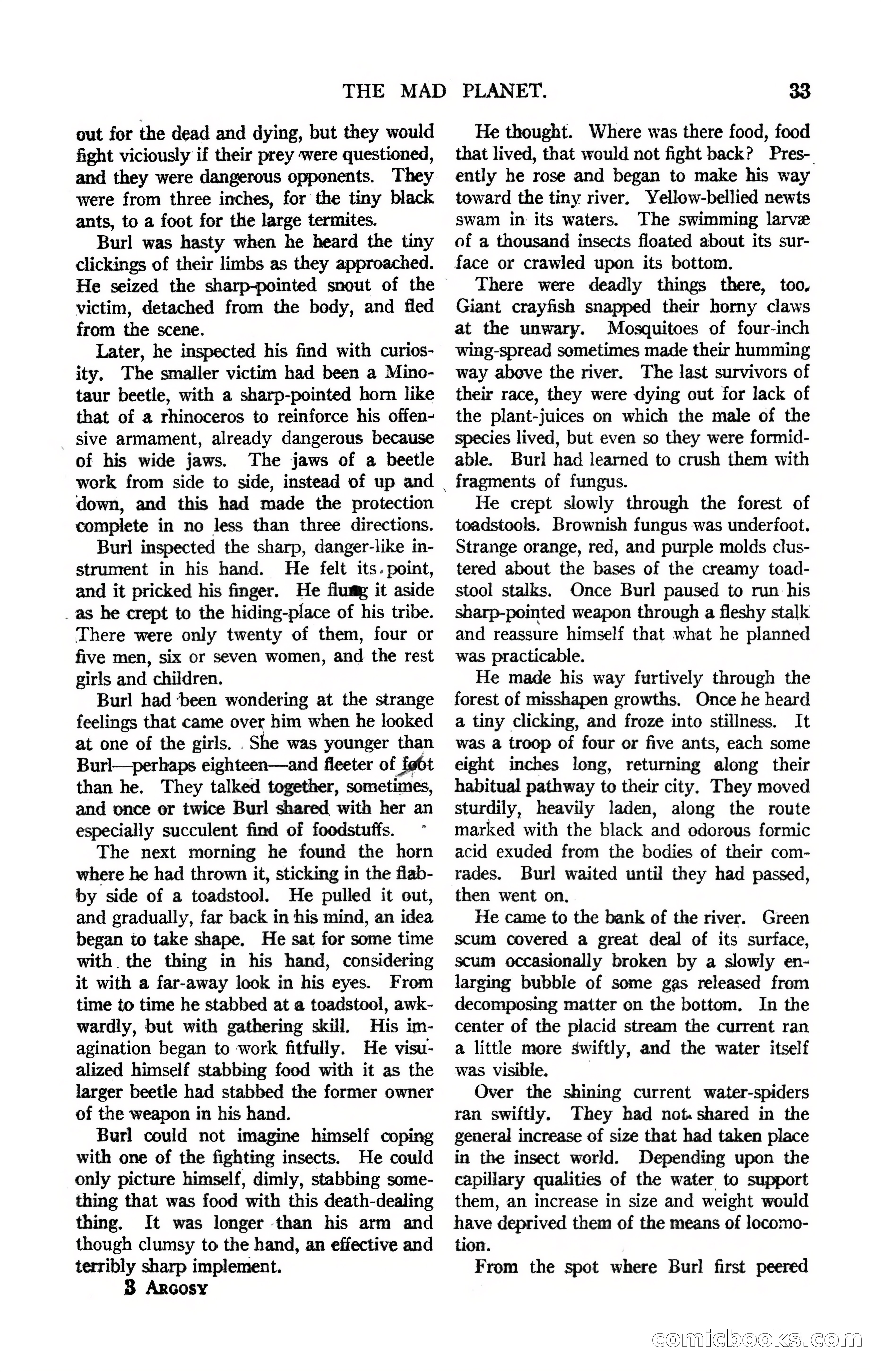
A restored page from Pulp Fiction, 1920. Page through the whole issue in the reader above.
📄 Transcribed text from this page (OCR, searchable)
Machine-transcribed from the original scan — historical spelling and the odd misread are preserved.
THE MAD PLANET. out for the dead and dying, but they would fight viciously if their prey were questioned, and they were dangerous opponents. They were from three inches, for the tiny black ants, to a foot for the large termites. Burl was hasty when he heard the tiny clickings of their limbs as they approached. He seized the sharp-pointed snout of the victim, detached from the body, and fled from the scene. Later, he inspected his find with curios- ity. The smaller victim had been a Mino- taur beetle, with a sharp-pointed horn like that of a rhinoceros to reinforce his offen- _ sive armament, already dangerous because of his wide jaws. The jaws of a beetle work from side to side, instead of up and | down, and this had made the protection complete in no less than three directions. Burl inspected the sharp, danger-like in- strument in his hand. He felt its. point, and it pricked his finger. He flump it aside _as he crept to the hiding-place of his tribe. There were only twenty of them, four or five men, six or seven women, and the rest girls and children. Burl had ‘been wondering at the strange feelings that came over him when he looked at one of the girls. She was younger than Burl—perhaps eighteen—and fleeter of fobt than he. They talked together, sometimes, and once or twice Burl shared with her an especially succulent find of foodstuffs. ~ The next morning he found the horn where he had thrown it, sticking in the flab- by side of a toadstool. He pulled it out, and gradually, far back in his mind, an idea began to take shape. He sat for some time with the thing in his hand, considering it with a far-away look in his eyes. From time to time he stabbed at a toadstool, awk- wardly, but with gathering skill, His im- agination began to work fitfully. He visu- alized himself stabbing food with it as the larger beetle had stabbed the former owner of the weapon in his hand. Burl could not imagine himself coping with one of the fighting insects. He could only picture himself, dimly, stabbing some- thing that was food with this death-dealing thing. It was longer than his arm and though clumsy to the hand, an effective and terribly sharp implement. 3 Arcosy 33 He thought. Where was there food, food that lived, that would not fight back? Pres-. ently he rose and began to make his way toward the tiny river. Yellow-bellied newts swam in its waters. The swimming larve of a thousand insects floated about its sur- face or crawled upon its bottom. There were deadly things there, too. Giant crayfish snapped their horny claws at the unwary. Mosquitoes of four-inch wing-spread sometimes made their humming way above the river. The last survivors of their race, they were dying out for lack of the plant-juices on which the male of the species lived, but even so they were formid- able. Burl had learned to crush them with fragments of fungus. He crept slowly through the forest of toadstools. Brownish fungus was underfoot. Strange orange, red, and purple molds clus- tered about the bases of the creamy toad- stool stalks. Once Burl paused to run his sharp-pointed weapon through a fleshy stalk and reassure himself that what he planned was practicable. He made his way furtively through the forest of misshapen growths. Once he heard a tiny clicking, and froze into stillness. It was a troop of four or five ants, each some eight inches long, returning along their habitual pathway to their city. They moved sturdily, heavily laden, along the route marked with the black and odorous formic acid exuded from the bodies of their com- rades. Burl waited until they had passed, then went on. He came to the bank of the river. Green scum covered a great deal of its surface, scum occasionally broken by a slowly en- larging bubble of some gas released from decomposing matter on the bottom. In the center of the placid stream the current ran a little more swiftly, and the water itself was visible. Over the shining current water-spiders ran swiftly. They had not. shared in the general increase of size that had taken place in the insect world. Depending upon the capillary qualities of the water to support them, an increase in size and weight would have deprived them of the means of locomo- tion. From the spot where Burl first peered cComiclbooks.com