
Pulp Fiction, 1920 · page 53 of 164
Argosy, Vol. 122, No. 1 — page 53: what you’re looking at
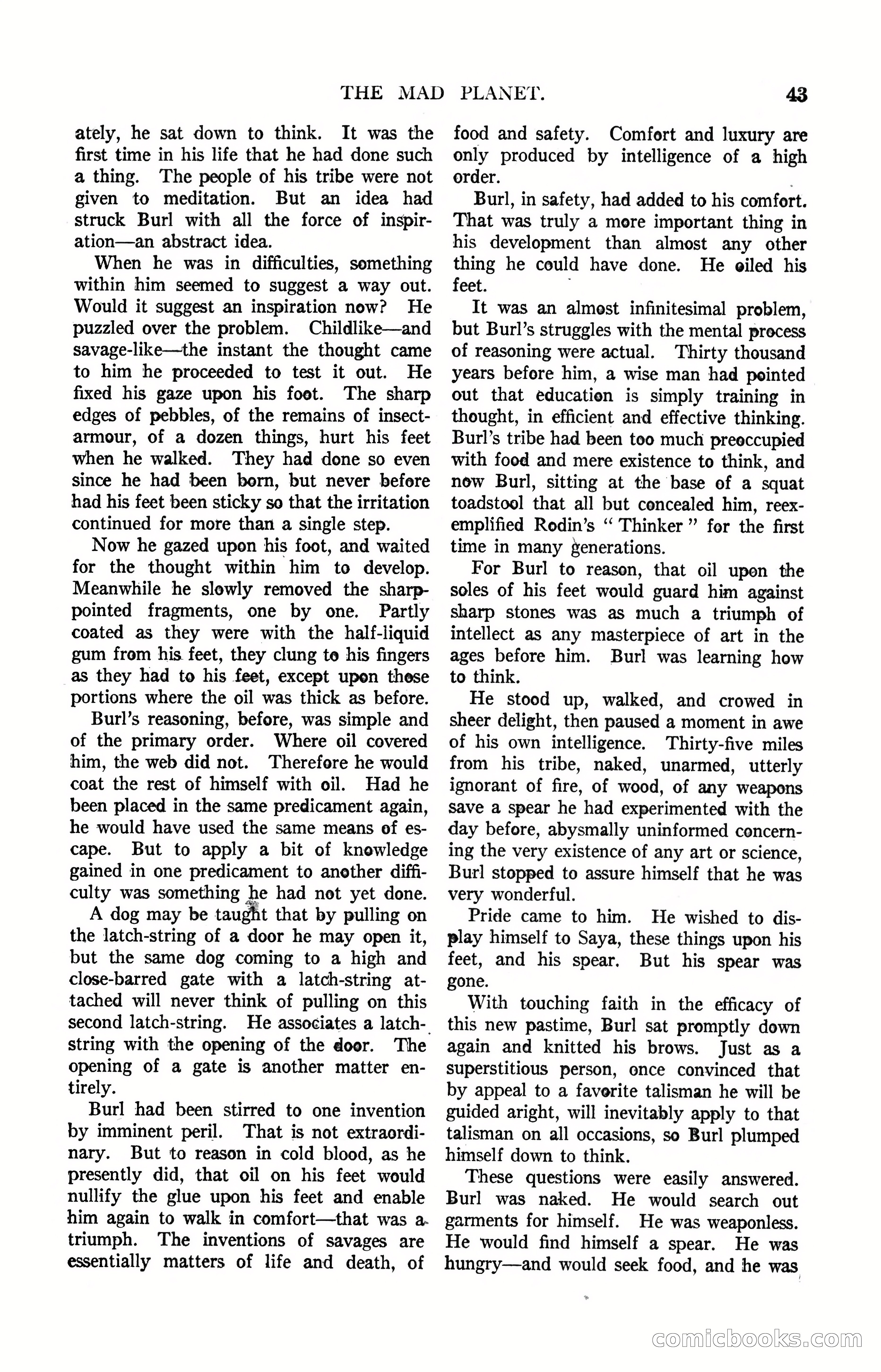
A restored page from Pulp Fiction, 1920. Page through the whole issue in the reader above.
📄 Transcribed text from this page (OCR, searchable)
Machine-transcribed from the original scan — historical spelling and the odd misread are preserved.
THE ately, he sat down to think. It was the first time in his life that he had done such a thing. The people of his tribe were not given to meditation. But an idea had struck Burl with all the force of inspir- ation—an abstract idea. When he was in difficulties, something within him seemed to suggest a way out. Would it suggest an inspiration now? He puzzled over the problem. Childlike—and savage-like—the instant the thought came to him he proceeded to test it out. He fixed his gaze upon his foet. The sharp edges of pebbles, of the remains of insect- armour, of a dozen things, hurt his feet when he walked. They had done so even since he had been born, but never befere had his feet been sticky so that the irritation continued for more than a single step. Now he gazed upon his foot, and waited for the thought within him to develop. Meanwhile he slowly removed the sharp- pointed fragments, one by one. Partly coated as they were with the half-liquid gum from his feet, they clung te his fingers as they had to his feet, except upon these portions where the oil was thick as before. Burl’s reasoning, before, was simple and of the primary order. Where oil covered him, the web did not. Therefore he would coat the rest of himself with oil. Had he been placed in the same predicament again, he would have used the same means of es- cape. But to apply a bit of knowledge gained in one predicament to another diffi- culty was something he had not yet done. A dog may be taught that by pulling on the latch-string of a door he may open it, but the same dog coming to a high and close-barred gate with a latch-string at- tached will never think of pulling on this second latch-string. string with the opening of the door. The opening of a gate is another matter en- tirely. Burl had been stirred to one invention by imminent peril. That is not extraordi- nary. But to reason in cold blood, as he presently did, that oil on his feet would nullify the glue upon his feet and enable him again to walk in comfort—that was a. triumph. The inventions of savages are essentially matters of life and death, of MAD PLANET. He associates a latch- 4s food and safety. Comfort and luxury are only produced by intelligence of a high order. ; Burl, in safety, had added to his comfort. That was truly a more important thing in his development than almost any other thing he could have done. He giled his feet. It was an almost infinitesimal problem, but Burl’s struggles with the mental process of reasoning were actual. Thirty thousand years before him, a wise man had pointed out that education is simply training in thought, in efficient and effective thinking. Burl’s tribe had been too much preeccupied with food and mere existence to think, and new Burl, sitting at the base of a squat toadstool that all but concealed him, reex- emplified Rodin’s ‘“ Thinker ” for the first time in many generations. For Burl to reason, that oil upon the soles of his feet would guard him against sharp stones was as much a triumph of intellect as any masterpiece of art in the ages before him. Burl was learning how to think. He stood up, walked, and crowed in sheer delight, then paused a moment in awe of his own intelligence. Thirty-five miles from his tribe, naked, unarmed, utterly ignorant of fire, of wood, of any weapons save a spear he had experimented with the day before, abysmally uninformed concern- ing the very existence of any art or science, Burl stopped to assure himself that he was very wonderful. Pride came to him. He wished to dis- play himself to Saya, these things upon his feet, and his spear. But his spear was gone. With touching faith in the efficacy of this new pastime, Burl sat promptly down again and knitted his brows. Just as a superstitious person, once convinced that by appeal to a favorite talisman he will be guided aright, will inevitably apply to that talisman on all occasions, so Burl plumped himself down to think. These questions were easily answered. Burl was naked. He would search out garments for himself. He was weaponless. He would find himself a spear. He was hungry—and would seek food, and he was cComiclbooks.com