
Pulp Fiction, 1920 · page 99 of 164
Argosy, Vol. 122, No. 1 — page 99: what you’re looking at
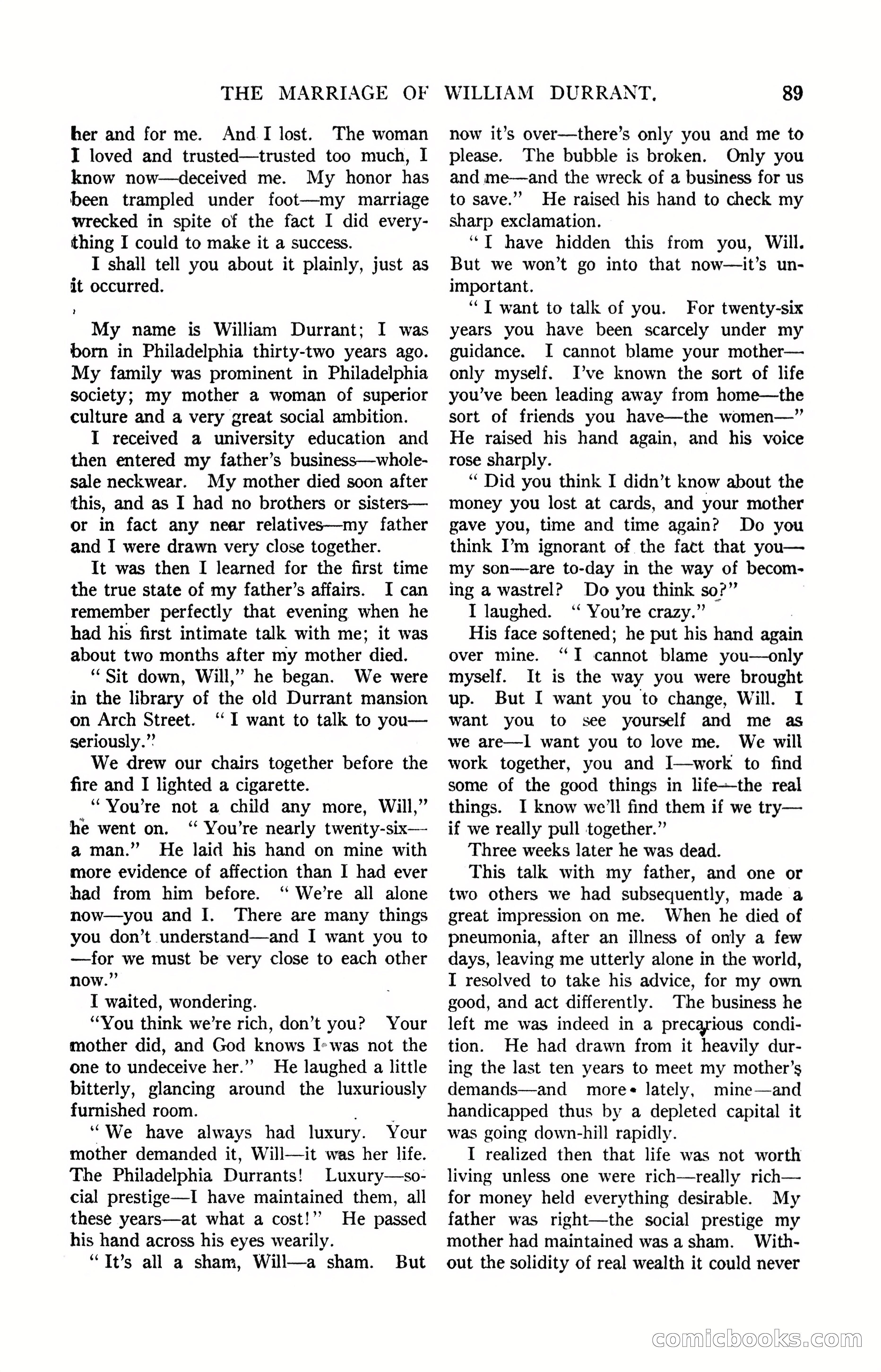
A restored page from Pulp Fiction, 1920. Page through the whole issue in the reader above.
📄 Transcribed text from this page (OCR, searchable)
Machine-transcribed from the original scan — historical spelling and the odd misread are preserved.
THE MARRIAGE OF her and for me. And I lost. The woman I loved and trusted—trusted too much, I know now—deceived me. My honor has been trampled under foot—my marriage wrecked in spite of the fact I did every- thing I could to make it a success. I shall tell you about it plainly, just as it occurred. My name is William Durrant; I was born in Philadelphia thirty-two years ago. My family was prominent in Philadelphia society; my mother a woman of superior culture and a very great social ambition. I received a university education and then entered my father’s business—whole- sale neckwear. My mother died soon after this, and as I had no brothers or sisters— or in fact any near relatives—my father and I were drawn very close together. It was then I learned for the first time the true state of my father’s affairs. I can remember perfectly that evening when he had his first intimate talk with me; it was about two months after my mother died. ‘Sit down, Will,” he began. We were in the library of the old Durrant mansion on Arch Street. ‘‘ I want to talk to you— seriously.”’ We drew our chairs together before the fire and I lighted a cigarette. “You're not a child any more, Will,” he went on. “ You’re nearly twenty-six— a man.” He laid his hand on mine with more evidence of affection than I had ever had from him before. ‘ We’re all alone now—you and I. There are many things you don’t understand—and I want you to —for we must be very close to each other now.” I waited, wondering. “You think we’re rich, don’t you? Your mother did, and God knows I*was not the one to undeceive her.’”’ He laughed a little bitterly, glancing around the luxuriously furnished room. ee ‘“We have always had luxury. Your mother demanded it, Will—it was her life. The Philadelphia Durrants! Luxury—so- cial prestige—I have maintained them, all these years—at what a cost!”” He passed his hand across his eyes wearily. “It’s all a sham, Will—a sham. But WILLIAM DURRANT, 89 now it’s over—there’s only you and me to please. The bubble is broken. Only you and me—and the wreck of a business for us to save.”” He raised his hand to check my sharp exclamation. “T have hidden this from you, Will. But we won’t go into that now— it’s un- important. ‘““T want to talk of you. For twenty-six years you have been scarcely under my guidance. I cannot blame your mother— only myself. I’ve known the sort of life you’ve been leading away from home—the sort of friends you have—the women—”’ He raised his hand again, and his voice rose sharply. “Did you think I didn’t know about the money you lost at cards, and your mother gave you, time and time again? Do you think I’m ignorant of the fact that you— my son—are to-day in the way of becom- ing a wastrel? Do you think so?” I laughed. ‘ You’re crazy.” His face softened; he put his hand again over mine. “I cannot blame you—only myself. It is the way you were brought up. But I want you to change, Will. I want you to see yourself and me as we are—Il want you to love me. We will work together, you and I—work to find some of the good things in life—the real things. I know we'll find them if we try— if we really pull together.” Three weeks later he was dead. This talk with my father, and one or two others we had subsequently, made a great impression on me. When he died of pneumonia, after an illness of only a few days, leaving me utterly alone in the world, I resolved to take his advice, for my own good, and act differently. The business he left me was indeed in a precarious condi- tion. He had drawn from it heavily dur- ing the last ten years to meet my mother’s demands—and mores lately, mine—and handicapped thus by a depleted capital it was going down-hill rapidly. I realized then that life was not worth living unless one were rich—really rich— for money held everything desirable. My father was right—the social prestige my mother had maintained was a sham. With- out the solidity of real wealth it could never cComiclbooks.com