
Pulp Fiction, 1920 · page 119 of 156
Argosy, Vol. 123, No. 1 — page 119: what you’re looking at
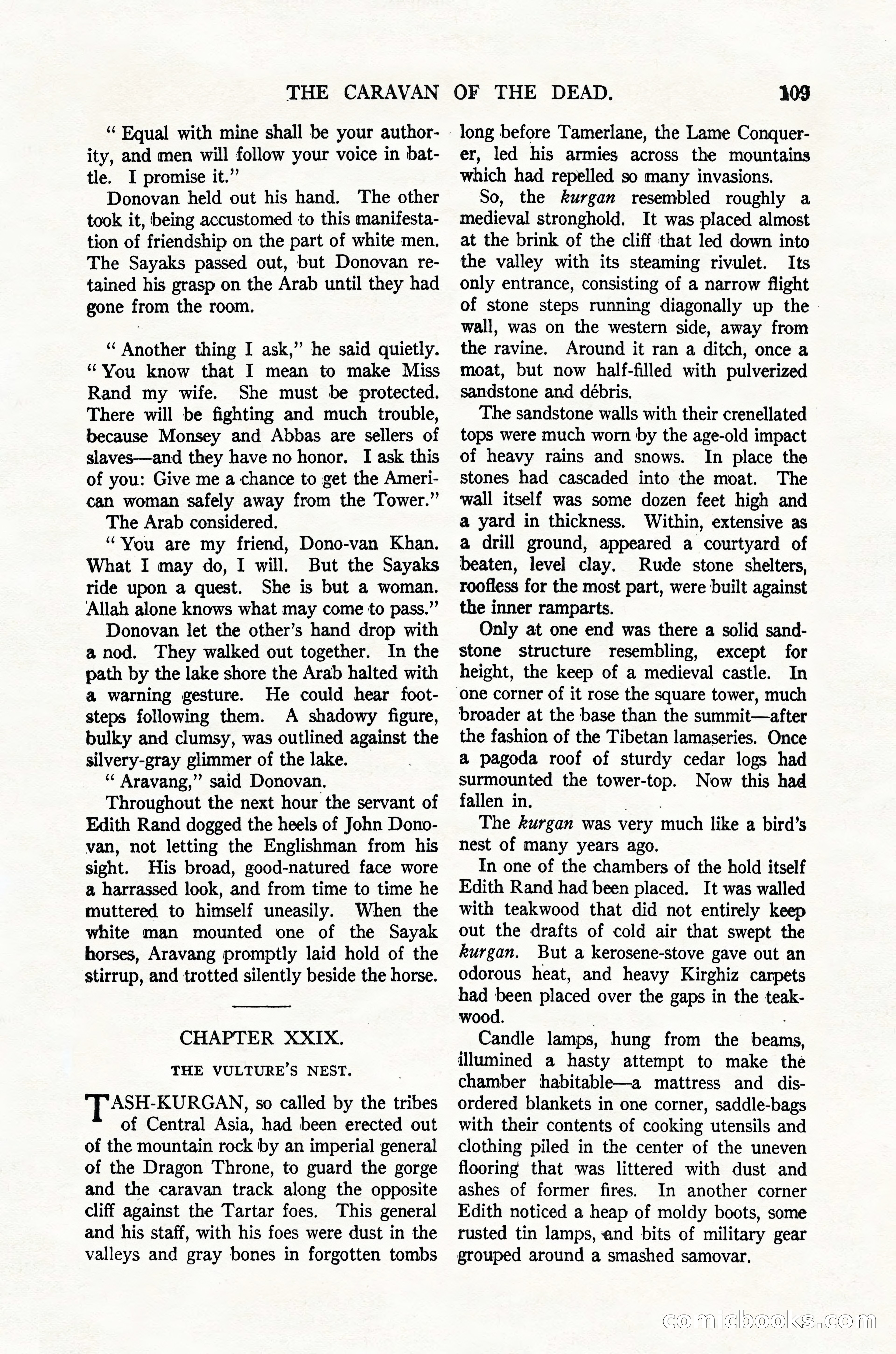
A restored page from Pulp Fiction, 1920. Page through the whole issue in the reader above.
📄 Transcribed text from this page (OCR, searchable)
Machine-transcribed from the original scan — historical spelling and the odd misread are preserved.
THE CARAVAN ‘“ Equal with mine shall be your author- ity, and men will follow your voice in bat- tle. I promise it.” Donovan held out his hand. The other took it, being accustomed to this manifesta- tion of friendship on the part of white men. The Sayaks passed out, but Donovan re- tained his grasp on the Arab until they had gone from the room. “ Another thing I ask,” he said quietly. “You know that I mean to make Miss Rand my wife. She must be protected. There will be fighting and much trouble, because Monsey and Abbas are sellers of slaves—and they have no honor. I ask this of you: Give me a chance to get the Ameri- can woman safely away from the Tower.” The Arab considered. “You are my friend, Dono-van Khan. What I may do, I will. But the Sayaks ride upon a quest, She is but a woman. Allah alone knows what may come to pass.” Donovan let the other’s hand drop with a nod. They walked out together. In the path by the lake shore the Arab halted with a warning gesture. He could hear foot- steps following them. A shadowy figure, bulky and clumsy, was outlined against the silvery-gray glimmer of the lake. ‘ Aravang,” said Donovan. Throughout the next hour the servant of Edith Rand dogged the heels of John Dono- van, not letting the Englishman from his sight. His broad, good-natured face wore a harrassed look, and from time to time he muttered to himself uneasily. When the white man mounted one of the Sayak horses, Aravang promptly laid hold of the stirrup, and trotted silently beside the horse. CHAPTER XXIX. THE VULTURE’S NEST. "TASH-KURGAN, so called by the tribes of Central Asia, had been erected out of the mountain rock by an imperial general of the Dragon Throne, to guard the gorge and the caravan track along the opposite cliff against the Tartar foes. This general and his staff, with his foes were dust in the valleys and gray bones in forgotten tombs OF THE DEAD. 109 - long before Tamerlane, the Lame Conquer- er, led his armies across the mountains which had repelled so many invasions. So, the kurgan resembled roughly a medieval stronghold. It was placed almost at the brink of the cliff that led down into the valley with its steaming rivulet. Its only entrance, consisting of a narrow flight of stone steps running diagonally up the - wall, was on the western side, away from the ravine. Around it ran a ditch, once a moat, but now half-filled with pulverized sandstone and deébris. The sandstone walls with their crenellated — tops were much worn by the age-old impact of heavy rains and snows. In place the stones had cascaded into the moat. The wall itself was some dozen feet high and a yard in thickness. Within, extensive as a drill ground, appeared a courtyard of beaten, level clay. Rude stone shelters, roofless for the most part, were built against the inner ramparts. Only at one end was there a solid sand- stone structure resembling, except for height, the keep of a medieval castle. In one corner of it rose the square tower, much broader at the base than the summit—after the fashion of the Tibetan lamaseries. Once a pagoda roof of sturdy cedar logs had surmounted the tower-top. Now this had fallen in. ee The kurgan was very much like a bird’s nest of many years ago. In one of the chambers of the hold itself Edith Rand had been placed. It was walled with teakwood that did not entirely keep out the drafts of cold air that swept the kurgan. But a kerosene-stove gave out an odorous heat, and heavy Kirghiz carpets had been placed over the gaps in the teak- wood. | | Candle lamps, hung from the beams, illumined a hasty attempt to make the chamber habitable—a mattress and dis- ordered blankets in one corner, saddle-bags with their contents of cooking utensils and clothing piled in the center of the uneven flooring that was littered with dust and ashes of former fires. In another corner Edith noticed a heap of moldy boots, some rusted tin lamps, and bits of military gear grouped around a smashed samovar. comicloool C©