
Pulp Fiction, 1920 · page 12 of 156
Argosy, Vol. 123, No. 1 — page 12: what you’re looking at
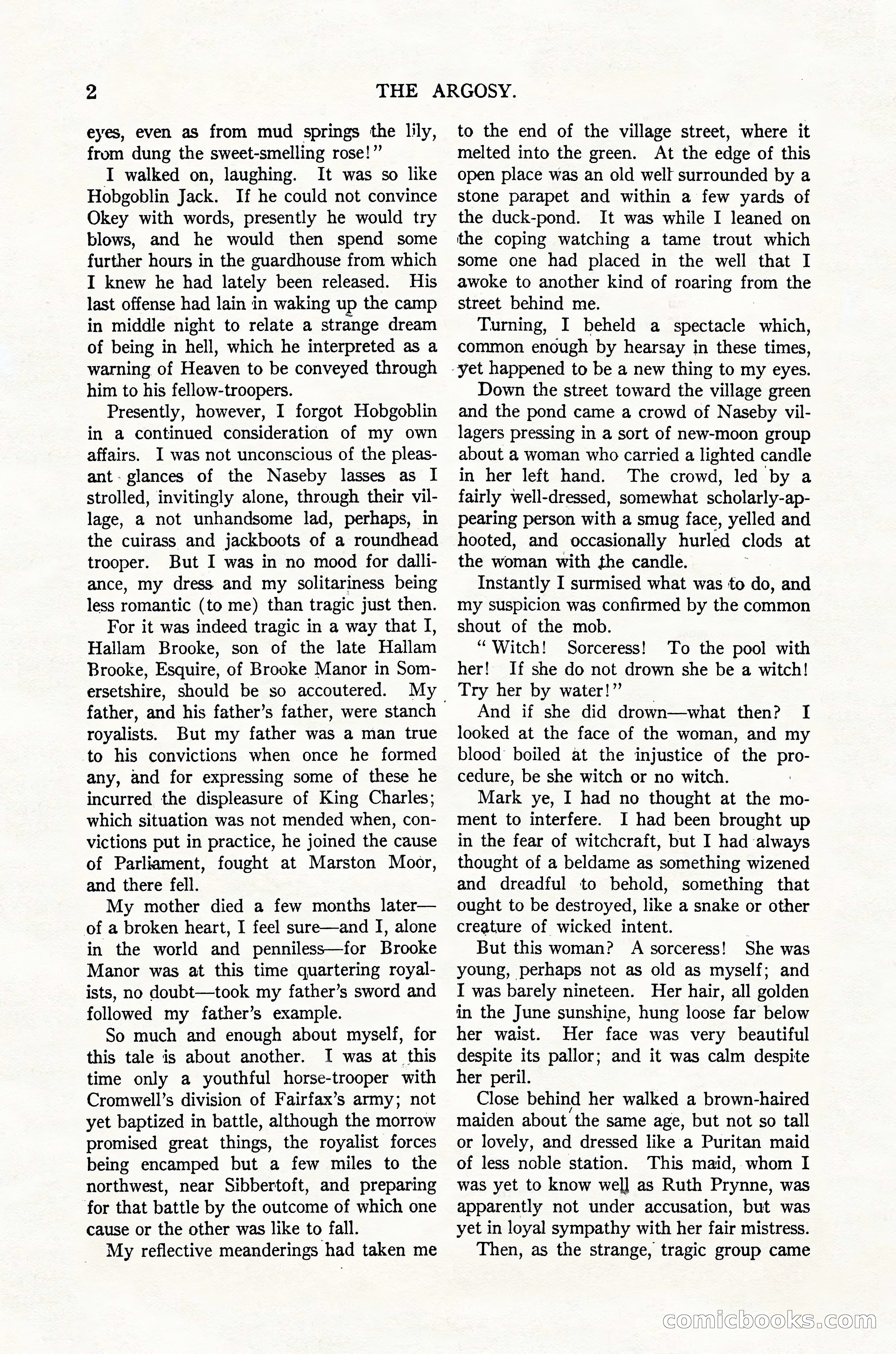
A restored page from Pulp Fiction, 1920. Page through the whole issue in the reader above.
📄 Transcribed text from this page (OCR, searchable)
Machine-transcribed from the original scan — historical spelling and the odd misread are preserved.
2 THE ARGOSY. eyes, even as from mud springs the lily, from dung the sweet-smelling rose!” I walked on, laughing. It was so like Hobgoblin Jack. If he could not convince Okey with words, presently he would try blows, and he would then spend some further hours in the guardhouse from which I knew he had lately been released. His last offense had lain in waking up the camp in middle night to relate a strange dream of being in hell, which he interpreted as a warning of Heaven to be conveyed through him to his fellow-troopers. Presently, however, I forgot Hobgoblin in a continued consideration of my own affairs. I was not unconscious of the pleas- ant- glances of the Naseby lasses as I strolled, invitingly alone, through their vil- lage, a not unhandsome lad, perhaps, in the cuirass and jackboots of a roundhead trooper. But I was in no mood for dalli- ance, my dress and my solitariness being less romantic (to me) than tragic just then. For it was indeed tragic in a way that I, Hallam Brooke, son of the late Hallam Brooke, Esquire, of Brooke Manor in Som- ersetshire, should be so accoutered. My father, and his father’s father, were stanch royalists. But my father was a man true to his convictions when once he formed any, and for expressing some of these he incurred the displeasure of King Charles; which situation was not mended when, con- victions put in practice, he joined the cause of Parliament, fought at Marston Moor, and there fell. My mother died a few months later— of a broken heart, I feel sure—and I, alone in the world and penniless—for Brooke Manor was at this time quartering royal- ists, no doubt—took my father’s sword and followed my father’s example. So much and enough about myself, for this tale is about another. I was at this time only a youthful horse-trooper with Cromwell’s division of Fairfax’s army; not yet baptized in battle, although the morrow promised great things, the royalist forces being encamped but a few miles to the northwest, near Sibbertoft, and preparing for that battle by the outcome of which one cause or the other was like to fall. My reflective meanderings had taken me to the end of the village street, where it melted into the green. At the edge of this open place was an old well surrounded by a stone parapet and within a few yards of the duck-pond. It was while I leaned on the coping watching a tame trout which some one had placed in the well that I awoke to another kind of roaring uae the street behind me. Turning, I beheld a spectacle which, common enough by hearsay in these times, -yet happened to be a new thing to my eyes. Down the street toward the village green and the pond came a crowd of Naseby vil- lagers pressing in a sort of new-moon group about a woman who carried a lighted candle in her left hand. The crowd, led by a fairly well-dressed, somewhat scholarly-ap- pearing person with a smug face, yelled and hooted, and occasionally hurled clods at the woman with the candle. Instantly I surmised what was to do, and my suspicion was confirmed by the common shout of the mob. “Witch! Sorceress! To the pool with her! If she do not drown she be a witch! Try her by water!” And if she did drown—what then? I looked at the face of the woman, and my blood’ boiled at the injustice of the Pre, cedure, be she witch or no witch. Mark ye, I had no thought at the mo- ment to interfere. I had been brought up in the fear of witchcraft, but I had ‘always thought of a beldame as something wizened and dreadful to behold, something that ought to be destroyed, like a snake or other creature of wicked intent. But this woman? A sorceress! She was young, perhaps not as old as myself; and I was barely nineteen. Her hair, all golden in the June sunshine, hung loose far below her waist. Her face was very beautiful despite its pallor; and it was calm despite her peril. Close behind her walked a brown-haired maiden about the same age, but not so tall or lovely, and dressed like a Puritan maid of less noble station. This maid, whom I was yet to know well as Ruth Prynne, was apparently not under accusation, but was yet in loyal sympathy with her fair mistress. Then, as the strange, tragic group came Gomiicovook C@