
Pulp Fiction, 1920 · page 125 of 156
Argosy, Vol. 123, No. 1 — page 125: what you’re looking at
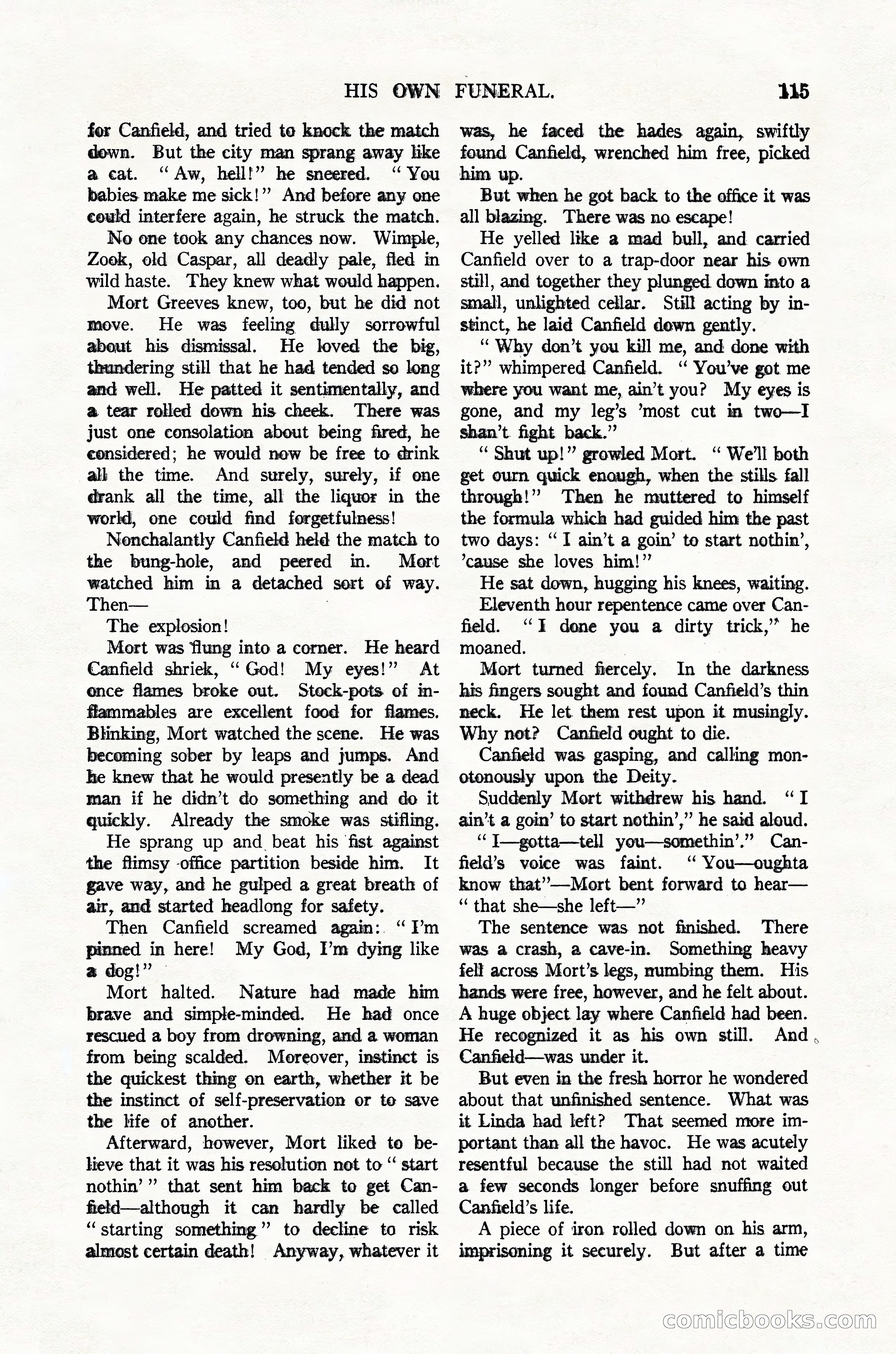
A restored page from Pulp Fiction, 1920. Page through the whole issue in the reader above.
📄 Transcribed text from this page (OCR, searchable)
Machine-transcribed from the original scan — historical spelling and the odd misread are preserved.
HIS OWN for Canfield, and tried te knock the match down. But the city man sprang away like a cat. ‘‘ Aw, hell!” he sneered. ‘ You babies make me sick!” And before any one could interfere again, he struck the match. No one took any chances now. Wimple, Zook, old Caspar, all deadly pale, fled in wild haste. They knew what would happen. Mort Greeves knew, too, but he did not move. He was feeling dully sorrewful about his dismissal. He loved the big, thundering still that he had tended so long and well. He patted it sentimentally, and a tear rolled down his cheek. There was just one consolation about being fired, he eonsidered; he would new be free to drink all the time. And surely, surely, if one drank all the time, all the liquor in the world, one could find forgetfulness! Nonchalantly Canfield held the match to the bung-hole, and peered in. Mort watched him in a detached sort of way. Then— The explosion! Mort was flung into a corner. He heard Canfield shriek, ‘God! My eyes!” At ence flames broke out. Stock-pots of in- flammables are excellent food for flames. Blinking, Mort watched the scene. He was becoming sober by leaps and jumps. And he knew that he would presently be a dead man if he didn’t do something and do it quickly. Already the smoke was stifling. He sprang up and beat his fist against the flimsy -office partition beside him. It gave way, and he gulped a great breath of air, and started headlong for safety. Then Canfield screamed again:. “ I’m pinned in here! My God, I’m dying like a dog!” — Mort halted. Nature had made him brave and simple-minded. He had once rescued a boy from drowning, and a woman from being scalded. Moreover, instinct is the quickest thing on earth, whether it be the instinct of self-preservation or te save the hfe of another. Afterward, however, Mort liked to be- hteve that it was his resolution not to “ start nothin’”’ that sent him back to get Can- held—although it can hardly be called “starting something” to decline to risk almost certain death! Anyway, whatever it FUNERAL. 3145 was, he faced the hades again, swiftly found Canfield, wrenched him free, picked him up. But when he got back to the office it was all blazing. There was no escape! He yelled ltke a mad bull, and carried Canfield over to a trap-door near his own still, and together they plunged down into a small, unlighted cellar. Still acting by in- stinct, he laid Canfield down gently. ‘Why don’t you kill me, and done with it?” whimpered Canfield. ‘‘ You’ve got me where you want me, ain’t your My eyes is gone, and my leg’s ’most cut in two—lI shan’t. fight back.” : “ Shut up!” growled Mort. ‘“ We'll both get ourn quick enough, when the stills fall through!” Then he muttered to himself the formula which had guided him the past two days: “I ain’t a goin’ to start nothin’, ‘cause she loves him!” He sat down, hugging his knees, waiting. Eleventh hour repentence came over Can- field. “I done you a dirty trick,” he moaned. : 7 Mort turned fiercely. In the darkness his fingers sought and found Canfield’s thin neck. He let them rest upon it musingly. Why not? Canfield ought to die. Canfield was gasping, and calling mon- otonously upon the Deity. Suddenly Mort withdrew his hand. “I ain’t a goin’ to start nothin’,” he said aloud. ‘“‘I—gotta—tell you—somethin’.” Can- field’s voice was faint. ‘ You—oughta know that’’—Mort bent forward to hear— “that she—she left—”’ The sentence was not finished. There was a crash, a cave-in. Something heavy fell across Mort’s legs, numbing them. His hands were free, however, and he felt about. A huge object lay where Canfield had been. He recognized it as his own still. And, Canfield—was under it. But even in the fresh horror he wondered about that unfinished sentence. What was it Linda had left? That seemed more im- portant than all the havoc. He was acutely resentful because the still had not waited a few seconds longer before snuffing out Canfield’s life. A piece of iron rolled down on his arm, imprisoning it securely. But after a time COmiclbooks C© 5}