
Pulp Fiction, 1920 · page 140 of 156
Argosy, Vol. 123, No. 1 — page 140: what you’re looking at
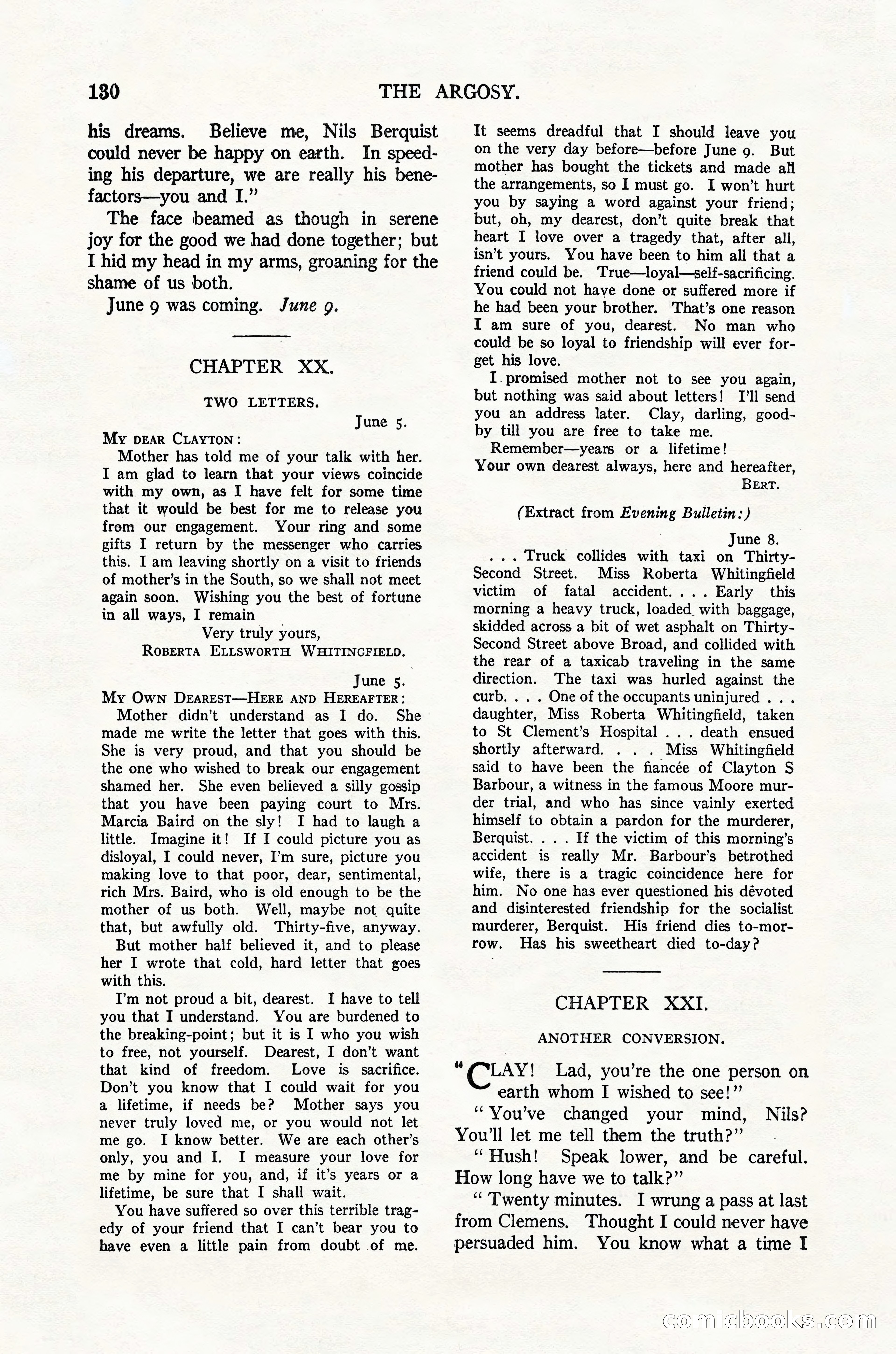
A restored page from Pulp Fiction, 1920. Page through the whole issue in the reader above.
📄 Transcribed text from this page (OCR, searchable)
Machine-transcribed from the original scan — historical spelling and the odd misread are preserved.
130 THE ARGOSY. his dreams. Believe me, Nils Berquist could never be happy on earth. In speed- ing his departure, we are really his bene- factors—you and I.” The face beamed as though in serene joy for the good we had done together; but I hid my head in my arms, groaning for the shame of us both. June 9 was coming. June 9. CHAPTER XxX. TWO LETTERS. June 5. My pear Crayton: Mother has told me of your talk with her. I am glad to learn that your views coincide with my own, as I have felt for some time that it would be best for me to release you from our engagement. Your ring and some gifts I return by the messenger who carries this. I am leaving shortly on a visit to friends of mother’s in the South, so we shall not meet again soon. Wishing you the best of fortune in all ways, I remain Very truly yours, ROBERTA ELLSwWoRTH WHITINGFIELD. June 5s. My Own DEArREST—HERE AND HEREAFTER: Mother didn’t understand as I do. She made me write the letter that goes with this. She is very proud, and that you should be the one who wished to break our engagement shamed her. She even believed a silly gossip that you have been paying court to Mrs. Marcia Baird on the sly! I had to laugh a little. Imagine it! If I could picture you as disloyal, I could never, I’m sure, picture you making love to that poor, dear, sentimental, rich Mrs. Baird, who is old enough to be the mother of us both. Well, maybe not quite that, but awfully old. Thirty-five, anyway. But mother half believed it, and to please her I wrote that cold, hard letter that goes with this. I’m not proud a bit, dearest. I have to tell you that I understand. You are burdened to the breaking-point; but it is I who you wish to free, not yourself. Dearest, I don’t want that kind of freedom. Love is sacrifice. Don’t you know that I could wait for you a lifetime, if needs be? Mother says you never truly loved me, or you would not let me go. I know better. We are each other’s only, you and I. I measure your love for me by mine for you, and, if it’s years or a lifetime, be sure that I shall wait. 3 You have suffered so over this terrible trag- edy of your friend that I can’t bear you to have even a little pain from doubt of me. “CLAY! It seems dreadful that I should leave you on the very day before—before June 9. But mother has bought the tickets and made all the arrangements, so I must go. I won’t hurt you by saying a word against your friend; but, oh, my dearest, don’t quite break that heart I love over a tragedy that, after all, isn’t yours. You have been to him all that a friend could be. True—loyal—self-sacrificing. You could not have done or suffered more if he had been your brother. That’s one reason [I am sure of you, dearest. No man who could be so loyal to friendship will ever for- get his love. I. promised mother not to see you again, but nothing was said about letters! I’ll send you an address later. Clay, darling, good- by till you are free to take me. Remember—years or a lifetime! Your own dearest always, here and hereafter, BERT. (Extract from Evening Bulletin: ) June 8. ... Truck collides with taxi on Thirty- Second Street. Miss Roberta Whitingfield victim of fatal accident. ... Early this morning a heavy truck, loaded with baggage, skidded across a bit of wet asphalt on Thirty- Second Street above Broad, and collided with the rear of a taxicab traveling in the same direction. The taxi was hurled against the curb. . . . One of the occupants uninjured .. . daughter, Miss Roberta Whitingfield, taken to St Clement’s Hospital . .. death ensued shortly afterward. . . . Miss Whitingfield said to have been the fiancée of Clayton S Barbour, a witness in the famous Moore mur- der trial, and who has since vainly exerted himself to obtain a pardon for the murderer, Berquist. . . . If the victim of this morning’s accident is really Mr. Barbour’s betrothed wife, there is a tragic coincidence here for him. No one has ever questioned his dévoted and disinterested friendship for the socialist murderer, Berquist. His friend dies to-mor- row. Has his sweetheart died to-day? CHAPTER XXI. ANOTHER CONVERSION. earth whom I wished to see!’”’ Lad, you’re the one person on ‘““You’ve changed your mind, Nils? Youll let me tell them the truth?”’ “Hush! Speak lower, and be careful. How long have we to talk?”’ ‘Twenty minutes. I wrung a pass at last comicloool from Clemens. Thought I could never have persuaded him. You know what a time I C©