
Pulp Fiction, 1920 · page 143 of 156
Argosy, Vol. 123, No. 1 — page 143: what you’re looking at
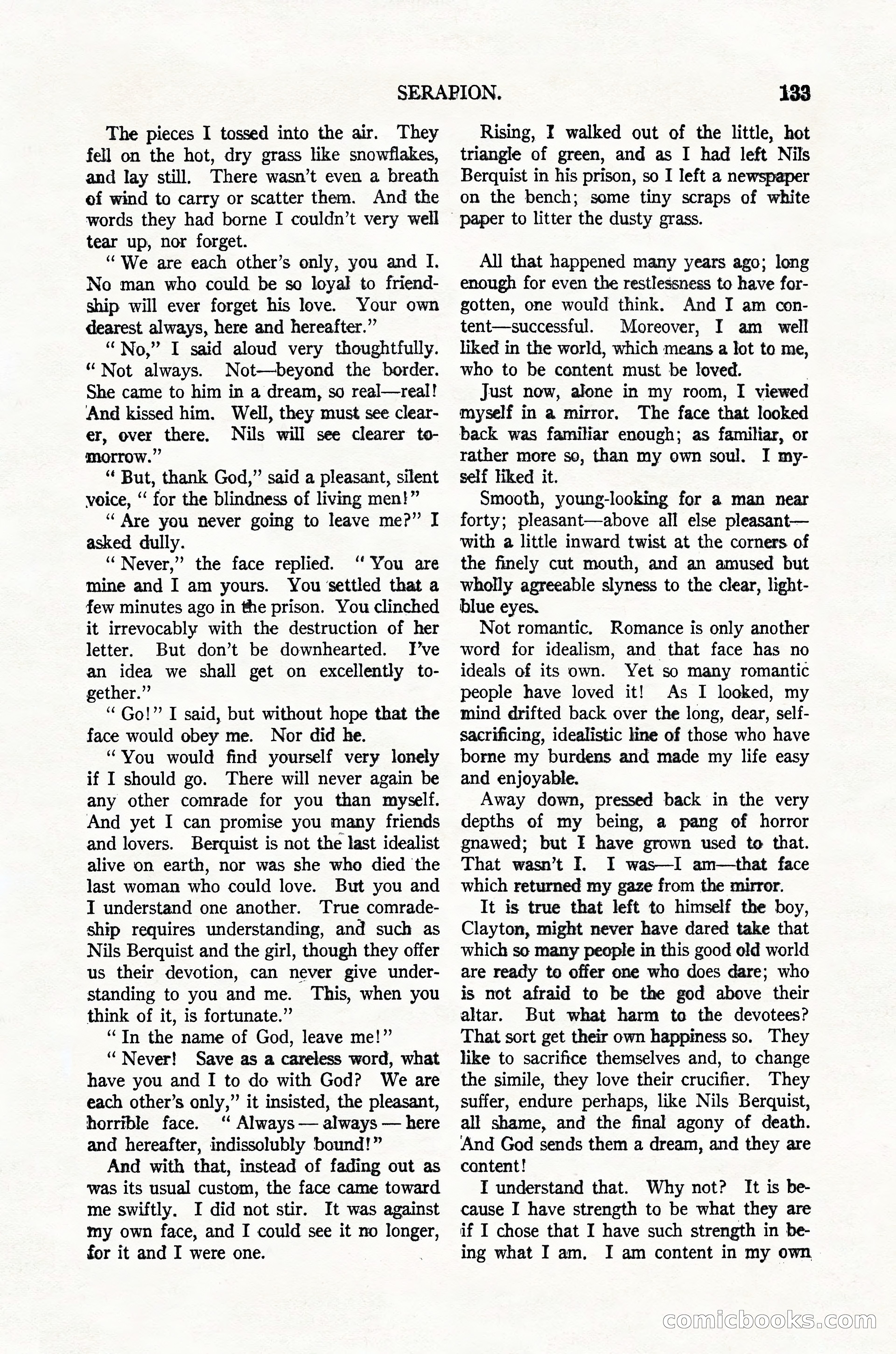
A restored page from Pulp Fiction, 1920. Page through the whole issue in the reader above.
📄 Transcribed text from this page (OCR, searchable)
Machine-transcribed from the original scan — historical spelling and the odd misread are preserved.
SERAPION. The pieces I tossed into the air. They fell on the hot, dry grass like snowflakes, and lay still, There wasn’t even a breath ef wind to carry or scatter them. And the words they had borne I couldn’t very well tear up, nor forget. “We are each other’s only, you and I. No man who could be so loyal to friend- ship will ever forget his love. Your own dearest always, here and hereafter.”’ “No,” I said aloud very thoughtfully. “ Not always. Not—beyond the border. She came to him in a dream, so real—real! ‘And kissed him. Well, they must see clear- er, over there. Nils will see clearer to- morrow.” “ But, thank God,” said a pleasant, silent voice, ‘‘ for the blindness of living men!” “Are you never going to leave me?” I asked dully. ‘“‘ Never,” the face replied. ‘‘ You are mine and I am yours. You settled that a few minutes ago in the prison. You clinched it irrevocably with the destruction of her letter. But don’t be downhearted. I’ve an idea we shall get on excellently to- gether.” “Go!” I said, but without hope that the face would obey me. Nor did he. “You would find yourself very lonely if I should go. There will never again be any other comrade for you than myself. And yet I can promise you many friends and lovers. Berquist is not the last idealist alive on earth, nor was she who died the last woman who could love. But you and IT understand one another. True comrade- ship requires understanding, and such as Nils Berquist and the girl, though they offer us their devotion, can never give under- standing to you and me. This, when you think of it, is fortunate.” “In the name of God, leave me!” “Never! Save as a careless word, what have you and I to do with God? We are each other’s only,” it insisted, the pleasant, horrible face. ‘ Always — always — here and hereafter, indissolubly bound!” And with that, instead of fading out as was its usual custom, the face came toward me swiftly. I did not stir. It was against my own face, and I could see it no longer, for it and I were one. 133 Rising, I walked out of the little, hot triangle of green, and as I had left Nils Berquist in his prison, so I left a newspaper on the bench; some tiny scraps of white paper to litter the dusty grass. All that happened many years ago; long enough for even the restlessness to have for- gotten, one would think. And I am con- tent—successful. Moreover, I am_ well liked in the world, which means a lot to me, who to be content must be loved. 3 Just now, alone in my room, I viewed myself in a mirror. The face that looked back was familiar enough; as familiar, or rather more so, than my own soul. I my- self liked it. Smooth, young-looking for a man near forty; pleasant—above all else pleasant— with a little inward twist at the corners of the finely cut mouth, and an amused but wholly agreeable slyness to the clear, light- blue eyes. Not romantic. Romance is only another word for idealism, and that face has no ideals of its own. Yet so many romantic people have loved it! As I looked, my mind drifted back over the long, dear, self- sacrificing, idealistic line of those who have borne my burdens and made my life easy and enjoyable. Away down, pressed back in the very depths of my being, a pang of horror gnawed; but I have grown used to that. That wasn’t I. I was—I am—that face which returned my gaze from the mirror. It is true that left to himself the boy, Clayton, might never have dared take that which so many people in this good old world are ready to offer one who does dare; who is not afraid to be the god above their altar. But what harm to the devotees? That sort get their own happiness so. They like to sacrifice themselves and, to change the simile, they love their crucifier. They suffer, endure perhaps, like Nils Berquist, all shame, and the final agony of death. And God sends them a dream, and they are content! I understand that. Why not? It is be- cause I have strength to be what they are if I chose that I have such strength in be- ing what I am. I am content in my own COMICLOO© S C©