
Pulp Fiction, 1920 · page 20 of 156
Argosy, Vol. 123, No. 1 — page 20: what you’re looking at
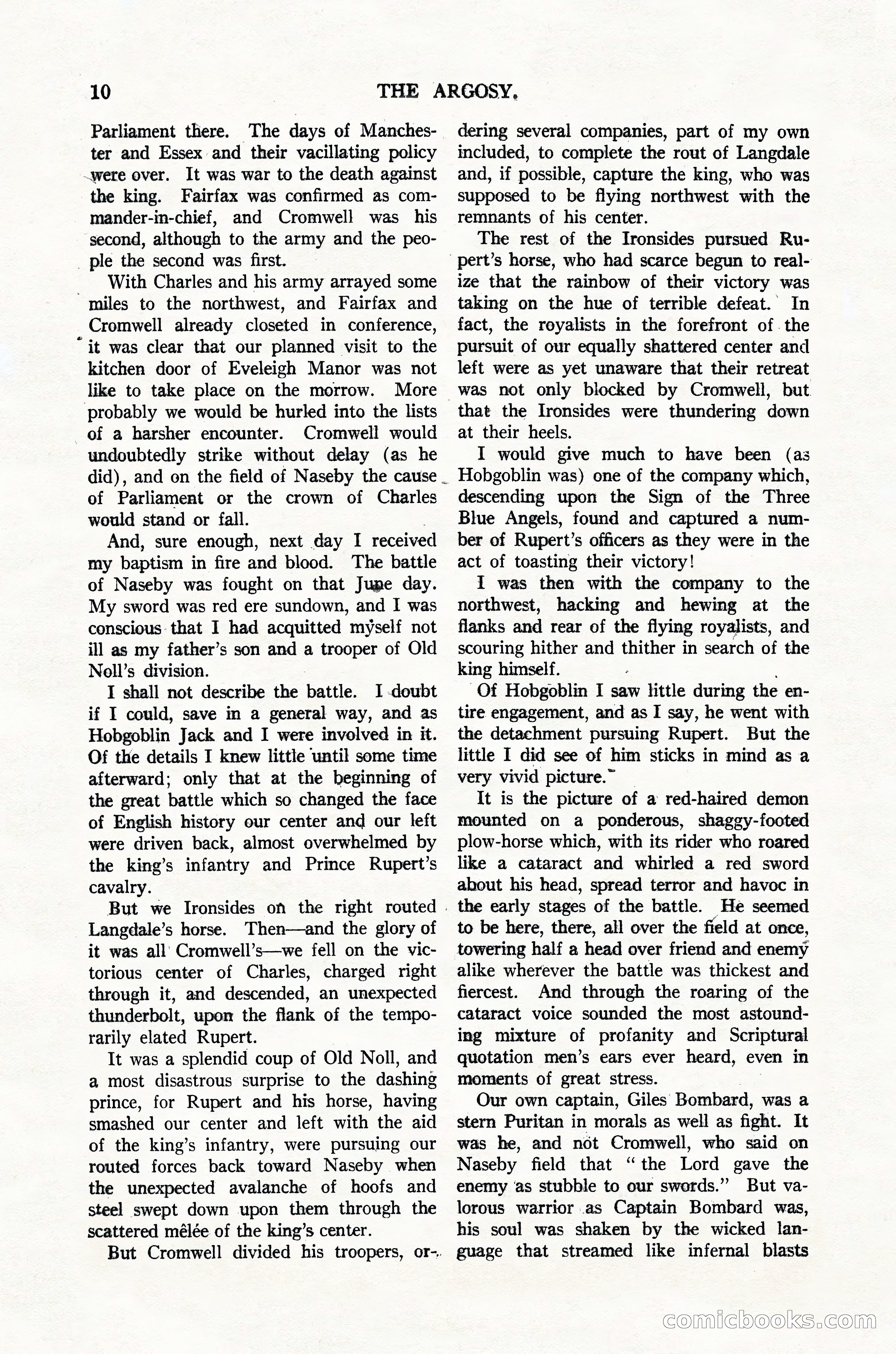
A restored page from Pulp Fiction, 1920. Page through the whole issue in the reader above.
📄 Transcribed text from this page (OCR, searchable)
Machine-transcribed from the original scan — historical spelling and the odd misread are preserved.
10 Parliament there. The days of Manches- ter and Essex and their vacillating policy were over. It was war to the death against the king. Fairfax was confirmed as com- mander-in-chief, and Cromwell was his ‘second, although to the army and the peo- _ ple the second was first. With Charles and his army arrayed some miles to the northwest, and Fairfax and Cromwell already closeted in conference, “it was clear that our planned visit to the kitchen door of Eveleigh Manor was not like to take place on the morrow. More probably we would be hurled into the lists of a harsher encounter. Cromwell would undoubtedly strike without delay (as he did), and on the field of Naseby the cause _ of Parliament or the crown of Charles would stand or fall. And, sure enough, next day I received my baptism in fire and blood. The battle of Naseby was fought on that Jume day. My sword was red ere sundown, and I was conscious that I had acquitted myself not ill as my father’s son and a trooper of Old Noll’s division. I shall not describe the atle I doubt if ; could, save in a general way, and as Hobgoblin Jack and I were involved in it. Of the details I knew little until some time afterward; only that at the beginning of the great battle which so changed the face of English history our center and our left were driven back, almost overwhelmed by the king’s infantry and Prince Rupert’s cavalry. But we Ironsides on the right routed . Langdale’s horse. Then—and the glory of it was all’ Cromwell’s—we fell on the vic- torious center of Charles, charged right through it, and descended, an unexpected thunderbolt, upon the flank of the tempo- rarily elated Rupert. It was a splendid coup of Old Noll, and a most disastrous surprise to the dashing prince, for Rupert and his horse, having smashed our center and left with the aid of the king’s infantry, were pursuing our routed forces back toward Naseby when the unexpected avalanche of hoofs and steel swept down upon them through the scattered mélée of the king’s center. But Cromwell divided his troopers, or-. THE ARGOSY., dering several companies, part of my own included, to complete the rout of Langdale and, if possible, capture the king, who was supposed to be flying northwest with the remnants of his center. The rest of the Ironsides pursued Ru- -pert’s horse, who had scarce begun to real- ize that the rainbow of their victory was taking on the hue of terrible defeat. In fact, the royalists in the forefront of. the pursuit of our equally shattered center and left were as yet unaware that their retreat was not only blocked by Cromwell, but. that the Ironsides were thundering down at their heels. I would give much to have been (as Hobgoblin was) one of the company which, descending upon the Sign of the Three Blue Angels, found and captured a num- ber of Rupert’s officers as they were in the act of toasting their victory! I was then with the company to the northwest, hacking and hewing at the flanks and rear of the flying royalists, and scouring hither and thither in search of the king himself. Of Hobgoblin I saw little during the en- tire engagement, and as I say, he went with the detachment pursuing Rupert. But the little I did see of him sticks in mind as a very vivid picture.” It is the picture of a red-haired demon mounted on a ponderous, shaggy-footed plow-horse which, with its rider who roared like a cataract and whirled a red sword about his head, spread terror and havoc in the early stages of the battle. He seemed to be here, there, all over the field at once, towering half a head over friend and enemy alike wherever the battle was thickest and fiercest. And through the roaring of the cataract voice sounded the most astound- ing mixture of profanity and Scriptural quotation men’s ears ever heard, even in moments of great stress. Our own captain, Giles Bombard, was a stern Puritan in morals as well as fight. It was he, and not Cromwell, who said on Naseby field that “the Lord gave the enemy as stubble to our swords.” But va- lorous warrior as Captain Bombard was, his soul was shaken by the wicked lan- guage that streamed like infernal blasts cCoOmicboooks C@