
Pulp Fiction, 1920 · page 42 of 156
Argosy, Vol. 123, No. 1 — page 42: what you’re looking at
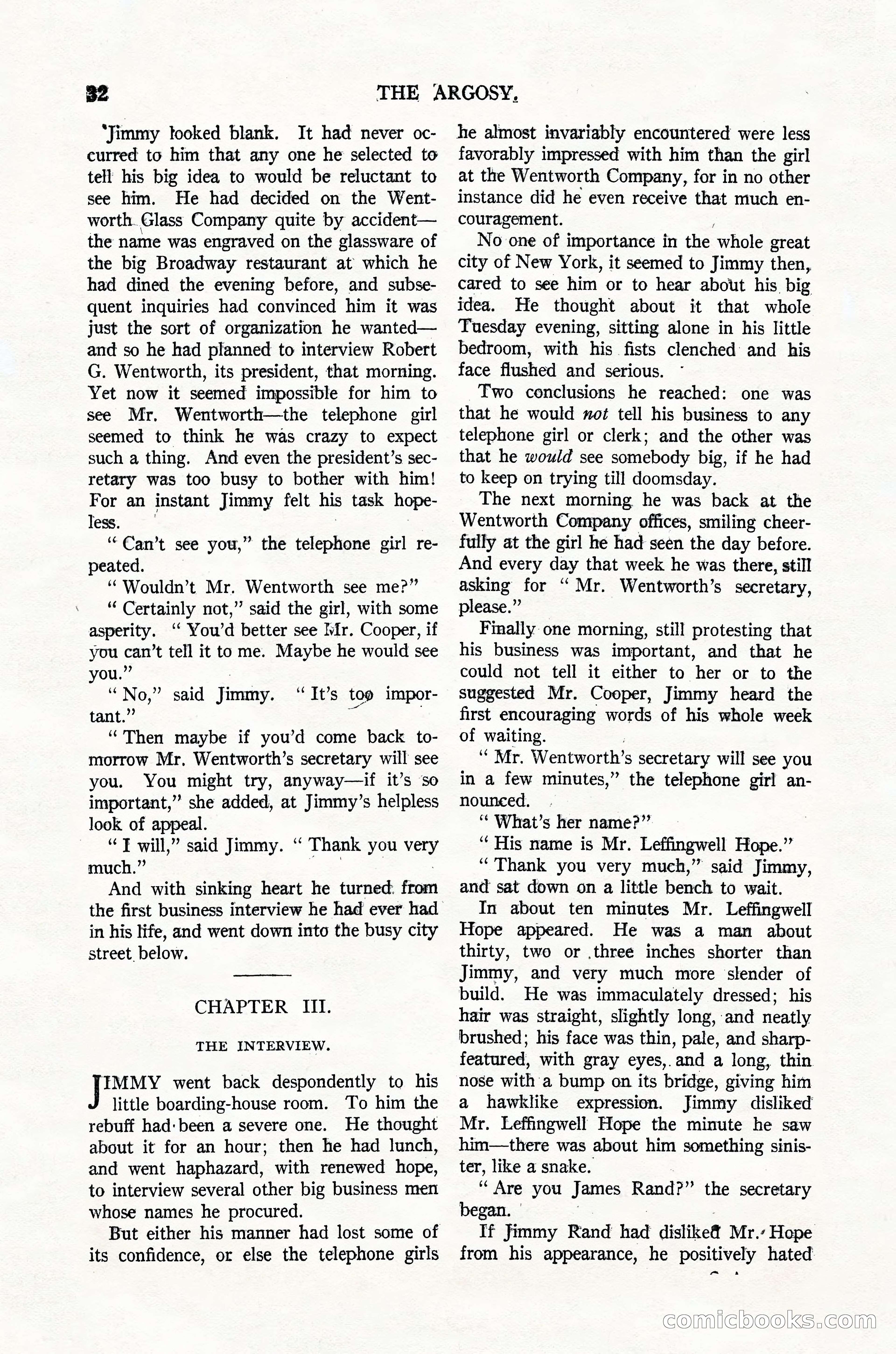
A restored page from Pulp Fiction, 1920. Page through the whole issue in the reader above.
📄 Transcribed text from this page (OCR, searchable)
Machine-transcribed from the original scan — historical spelling and the odd misread are preserved.
Bz ‘Jimmy tooked blank. It had never oc- curred to him that any one he selected to tell his big idea to would be reluctant to see him. He had decided on the Went- worth. Glass Company quite by accident— the name was engraved on the glassware of the big Broadway restaurant at which he had dined the evening before, and subse- quent inquiries had convinced him it was just the sort of organization he wanted— and so he had planned to interview Robert G. Wentworth, its president, that morning. Yet now it seemed impossible for him to see Mr. Wentworth—the telephone girl seemed to think he was crazy to expect such a thing. And even the president’s sec- retary was too busy to bother with him! For an instant Jimmy felt AE task hope- less. ‘““Can’t see you,” the telephone girl re- peated. ‘“Wouldn’t Mr. Wentworth see me?” “ Certainly not,” said the girl, with some asperity. ‘‘ You’d better see Ir. Cooper, if you eee tell it to me. Maybe he would see you.” “No,” said jimmy. ‘It’s tog impor- tant.” =< “Then maybe if you’d come back to- morrow Mr. Wentworth’s secretary will see you. You might try, anyway—if it’s ‘so important,” she added, at Jimmy’s helpless look of appeal. “J will,” said Jimmy. “ Thank you very much.” And with sinking heart he turned. from the first business interview he had ever had in his life, and went down into the busy city street below. CHAPTER III. THE INTERVIEW. IMMY went back despondently to his little boarding-house room. To him the rebuff had: been a severe one. He thought about it for an hour; then he had lunch, and went haphazard, with renewed hope, to interview several other big business men whose names he procured. But either his manner had lost some of its confidence, or else the telephone girls THE ARGOSY. he almost invariably encountered were less favorably impressed with him than the girl at the Wentworth Company, for in no other instance did he even receive that much en- couragement. / No one of importance in the whole great city of New York, it seemed to Jimmy then, cared to see him or to hear about his big idea. He thought about it that whole Tuesday evening, sitting alone in his little bedroom, with his fists clenched and his face flushed and serious. Two conclusions he reached: one was that he would oz tell his business to any telephone girl or clerk; and the other was that he would see somebody big, if he had to keep on trying till doomsday. The next morning he was back at the Wentworth Company offices, smiling cheer- fully at the girl he had seen the day before. And every day that week he was there, still asking for “Mr. Wentworth’s secretary, please.” Finally one morning, still protesting that his business was important, and that he could not tell it either to her or to the suggested Mr. Cooper, Jimmy heard the first encouraging words of his whole week of waiting. ‘* Mr. Wentworth’: secretary will see you in a few minutes,” the telephone girl an- nounced. | ‘“ What’s her name?” ‘‘ His name is Mr. Leffingwell Hope.’ ‘Thank you very much,” said Jimmy, and sat down on a little bench to wait. In about ten minutes Mr. Leffingwell Hope appeared. He was a man about thirty, two or .three inches shorter than Jimmy, and very much more stender of build. He was immaculately dressed; his hair was straight, slightly long, and neatly brushed; his face was thin, pale, and sharp- featured, with gray eyes,.and a long, thin nose with a bump on its bridge, giving him a hawklike expression. Jimmy disliked Mr. Leffingwell Hope the minute he saw him—there was about him something sinis- ter, like a snake. ‘Are you James Rand?” the secretary began. | : If Jimmy Rand had dislikett Mr.- Hope from his appearance, he positively hated: COMmiCclooo S (©