
Pulp Fiction, 1920 · page 62 of 156
Argosy, Vol. 123, No. 1 — page 62: what you’re looking at
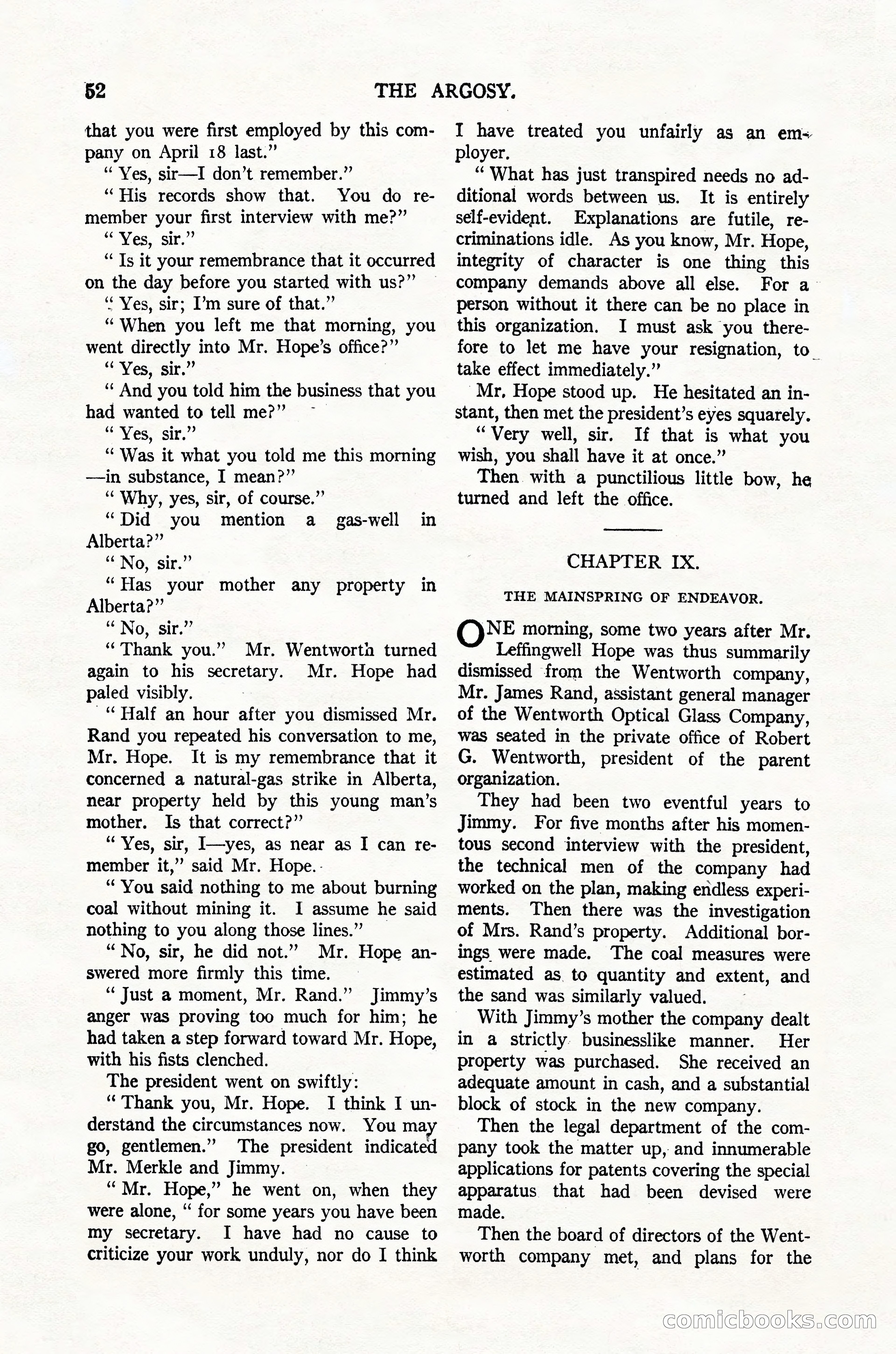
A restored page from Pulp Fiction, 1920. Page through the whole issue in the reader above.
📄 Transcribed text from this page (OCR, searchable)
Machine-transcribed from the original scan — historical spelling and the odd misread are preserved.
52 that you were first employed by this com- pany on April 18 last.” “Yes, sir—I don’t remember.” “His records show that. You do re- member your first interview with me?” “Yes, sir.” “Ts it your remembrance that it occurred on the day before you started with us?” “Yes, sir; I’m sure of that.” “When you left me that morning, you went directly into Mr. Hope’s office?” “Yes, sir.” ‘‘ And you told him the business that you had wanted to tell me?” ; “Yes, sir.” “Was it what you told me this morning —in substance, I mean?”’ ‘Why, yes, sir, of course.” “Did you mention a_ gas-well Alberta?” ‘No, sir.” “Has your mother any property in Alberta?”’ “No, sir.” “Thank you.” Mr. Wentworth turned again to his secretary. Mr. Hope had paled visibly. ~“Walf an hour after you dismissed Mr. Rand you repeated his conversation to me, Mr. Hope. It is my remembrance that it concerned a natural-gas strike in Alberta, near property held by this young man’s mother. Is that correct?” “Yes, sir, I—yes, as near as I can re- member it,” said Mr. Hope. - “You said nothing to me about burning coal without mining it. I assume he said nothing to you along those lines.”’ “No, sir, he did not.” Mr. Hope an- swered more firmly this time. ‘“ Just a moment, Mr. Rand.” Jimmy’s anger was proving too much for him; he had taken a step forward toward Mr. Hope, with his fists clenched. The president went on swiftly: ‘Thank you, Mr. Hope. I think I un- derstand the circumstances now. You ma go, gentlemen.” The president indicated Mr. Merkle and Jimmy. ‘““Mr. Hope,” he went on, when they were alone, “ for some years you have been my secretary. I have had no cause to criticize your work unduly, nor do I think in THE ARGOSY. I have treated you unfairly as an ems ployer. “What has just transpired needs no ad- ditional words between us. It is entirely self-evident. Explanations are futile, re- criminations idle. As you know, Mr. Hope, integrity of character is one thing this company demands above all else. person without it there can be no place in this organization. I must ask you there- fore to let me have your resignation, to_ take effect immediately.” Mr, Hope stood up. He hesitated an in- stant, then met the president’s eyes squarely. “Very well, sir. If that is what you wish, you shall have it at once.” Then with a punctilious little bow, he turned and left the office. CHAPTER IX. THE MAINSPRING OF ENDEAVOR. ONE morning, some two years after Mr. Leffingwell Hope was thus summarily dismissed from the Wentworth company, Mr. James Rand, assistant general manager of the Wentworth Optical Glass Company, was seated in the private office of Robert G. Wentworth, president of the parent organization. They had been two eventful years to Jimmy. For five months after his momen- tous second interview with the president, the technical men of the company had worked on the plan, making endless experi- ments. Then there was the investigation of Mrs. Rand’s property. Additional bor- ings were made. The coal measures were estimated as to quantity and extent, and the sand was similarly valued. With Jimmy’s mother the company dealt in a strictly: businesslike manner. Her property was purchased. She received an adequate amount in cash, and a substantial block of stock in the new company. Then the legal department of the com- pany took the matter up, and innumerable applications for patents covering the special apparatus that had been devised were made. Then the board of directors of the Went- worth company met, and plans for the COMmiclboo SS For a~ C@