
Pulp Fiction, 1920 · page 96 of 156
Argosy, Vol. 123, No. 1 — page 96: what you’re looking at
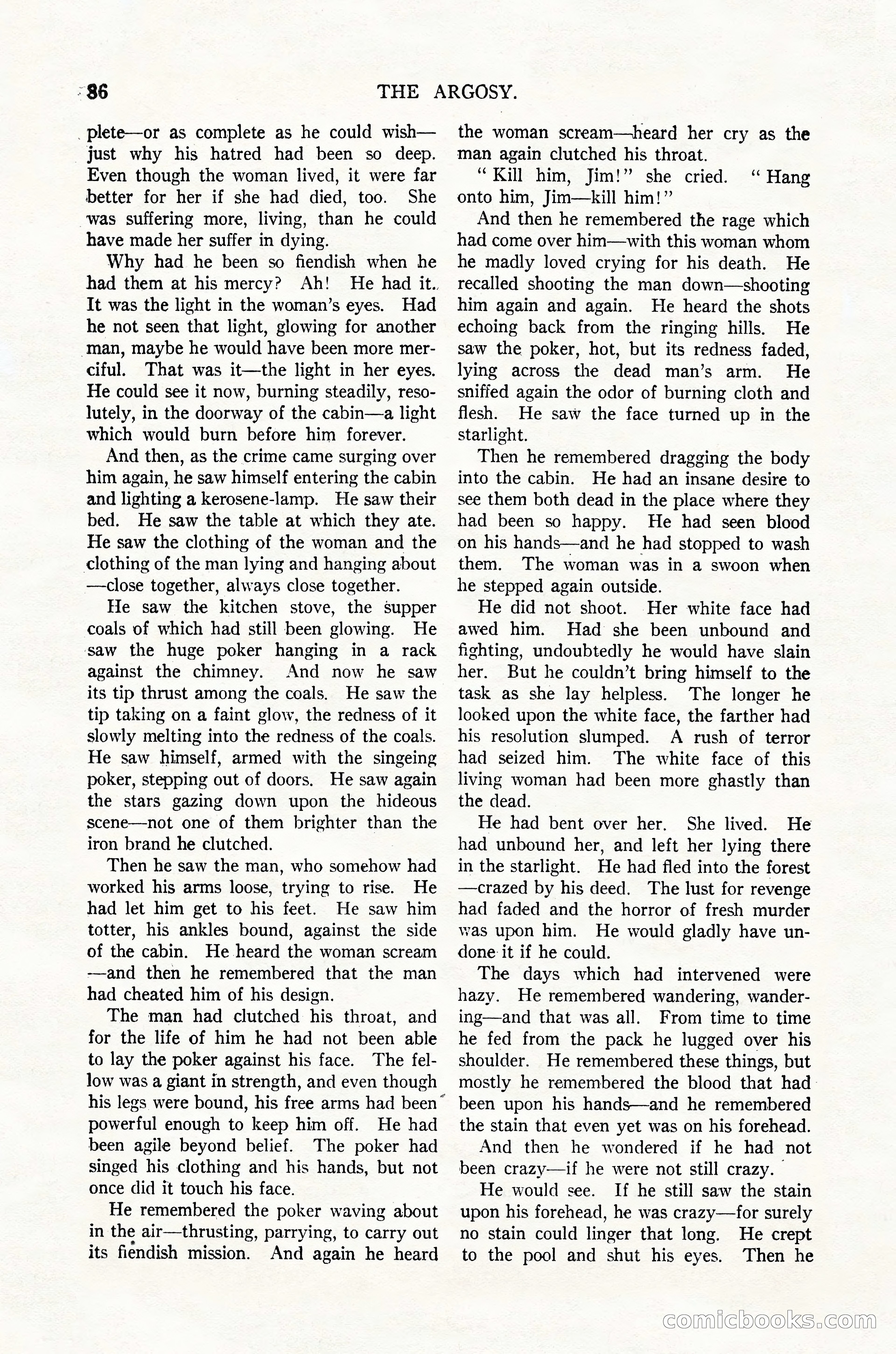
A restored page from Pulp Fiction, 1920. Page through the whole issue in the reader above.
📄 Transcribed text from this page (OCR, searchable)
Machine-transcribed from the original scan — historical spelling and the odd misread are preserved.
86 _plete—or as complete as he could wish— _ just why his hatred had been so deep. Even though the woman lived, it were far better for her if she had died, too. She was suffering more, living, than he could have made her suffer in dying. Why had he been so fiendish when he had them at his mercy? Ah! He had it.. It was the light in the woman’s eyes. Had he not seen that light, glowing for another man, maybe he would have been more mer- ciful. That was it—the light in her eyes. He could see it now, burning steadily, reso- lutely, in the doorway of the cabin—a light which would burn before him forever. And then, as the crime came surging over him again, he saw himself entering the cabin and lighting a kerosene-lamp. He saw their bed. He saw the table at which they ate. He saw the clothing of the woman and the clothing of the man lying and hanging about —close together, always close together. He saw the kitchen stove, the Supper coals of which had still been glowing. He saw the huge poker hanging in a rack against the chimney. And now he saw its tip thrust among the coals. He saw the tip taking on a faint glow, the redness of it slowly melting into the redness of the coals. He saw himself, armed with the singeing poker, stepping out of doors. He saw again the stars gazing down upon the hideous scene—not one of them brighter than the iron brand he clutched. Then he saw the man, who somehow had worked his arms loose, trying to rise. He had let him get to his feet. He saw him totter, his ankles bound, against the side of the cabin. He heard the woman scream —and then he remembered that the man had cheated him of his design. The man had clutched his throat, and for the life of him he had not been able to lay the poker against his face. The fel- low was a giant in strength, and even though his legs were bound, his free arms had been” powerful enough to keep him off. He had been agile beyond belief. The poker had singed his clothing and his hands, but not once did it touch his face. He remembered the poker waving about in the air—thrusting, parrying, to carry out its fiendish mission. And again he heard THE ARGOSY. the woman scream—heard her cry as the man again clutched his throat. ‘Kill him, Jim!” she cried. onto him, Jim—kill him!” And then he remembered the rage which had come over him—with this woman whom he madly loved crying for his death. He recalled shooting the man down—shooting him again and again. He heard the shots echoing back from the ringing hills. He saw the poker, hot, but its redness faded, lying across the dead man’s arm. He sniffed again the odor of burning cloth and flesh. He saw the face turned up in the starlight. Then he remembered dragging the body into the cabin. He had an insane desire to see them both dead in the place where they had been so happy. He had seen blood on his hands—and he had stopped to wash them. The woman was in a swoon when he stepped again outside. He did not shoot. Her white face had awed him. Had she been unbound and fighting, undoubtedly he would have slain her. But he couldn’t bring himself to the task as she lay helpless. The longer he looked upon the white face, the farther had his resolution slumped. A rush of terror had seized him. The white face of this living woman had been more ghastly than the dead. He had bent over her. She lived. He had unbound her, and left her lying there in the starlight. He had fled into the forest —crazed by his deed. The lust for revenge had faded and the horror of fresh murder was upon him. He would gladly have un- done it if he could. The days which had intervened were hazy. He remembered wandering, wander- ing—and that was all. From time to time he fed from the pack he lugged over his shoulder. He remembered these things, but Hang mostly he remembered the blood that had been upon his hands—and he remembered the stain that even yet was on his forehead. And then he wondered if he had not been crazy—if he were not still crazy. He would see. If he still saw the stain upon his forehead, he was crazy—for surely no stain could linger that long. He crept to the pool and shut his eyes. Then he COMICLOOkKS C@