
Pulp Fiction, 1920 · page 130 of 158
Argosy, Vol. 123, No. 2 — page 130: what you’re looking at
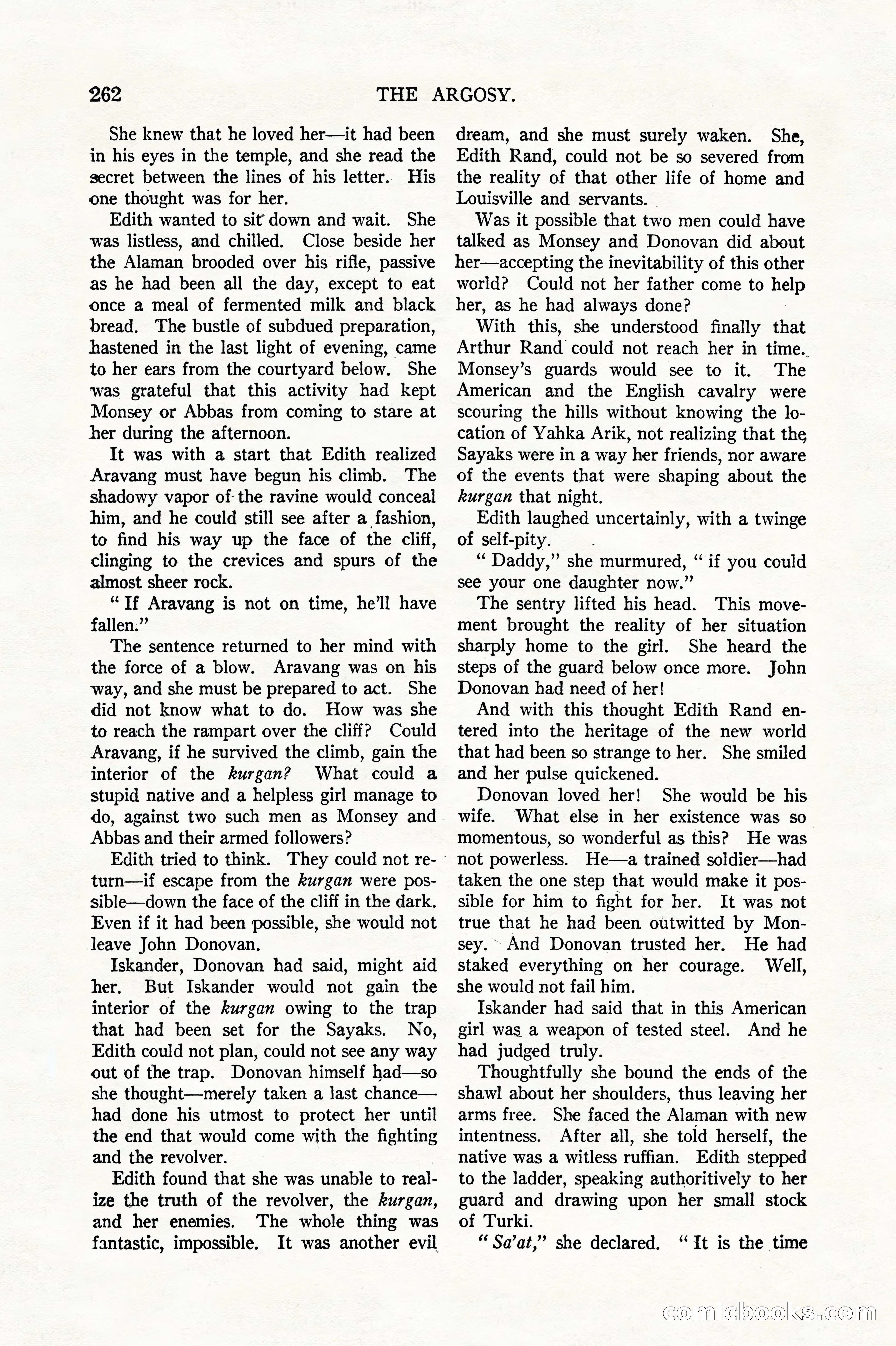
A restored page from Pulp Fiction, 1920. Page through the whole issue in the reader above.
📄 Transcribed text from this page (OCR, searchable)
Machine-transcribed from the original scan — historical spelling and the odd misread are preserved.
262 She knew that he loved her—it had been in his eyes in the temple, and she read the secret between the lines of his letter. His one thought was for her. Edith wanted to sit down and wait. She was listless, and chilled. Close beside her the Alaman brooded over his rifle, passive as he had been all the day, except to eat once a meal of fermented milk and black bread. The bustle of subdued preparation, hastened in the last light of evening, came to her ears from the courtyard below. She was grateful that this activity had kept Monsey or Abbas from coming to stare at her during the afternoon. It was with a start that Edith realized _Aravang must have begun his climb. The shadowy vapor of the ravine would conceal him, and he could still see after a fashion, to find his way up the face of the cliff, clinging to the crevices and spurs of the almost sheer rock. “Tf Aravang is not on time, he’ll have fallen.” The sentence returned to her mind with the force of a blow. Aravang was on his way, and she must be prepared to act. She did not know what to do. How was she to reach the rampart over the cliff? Could Aravang, if he survived the climb, gain the interior of the kurgan? What could a stupid native and a helpless girl manage to do, against two such men as Monsey and. Abbas and their armed followers? Edith tried to think. They could not re- © turn—if escape from the kurgan were pos- sible—down the face of the cliff in the dark. Even if it had been possible, she would not leave John Donovan. Iskander, Donovan had said, might aid her. But Iskander would not gain the interior of the kurgan owing to the trap that had been set for the Sayaks. No, Edith could not plan, could not see any way out of the trap. Donovan himself had—so she thought—merely taken a last chance— had done his utmost to protect her until the end that would come with the fighting and the revolver. Edith found that she was unable to real- ize the truth of the revolver, the kurgan, and her enemies. The whole thing was fantastic, impossible. It was another evil THE ARGOSY. dream, and she must surely waken. She, Edith Rand, could not be so severed from the reality of that other life of home and Louisville and servants. | Was it possible that two men could have talked as Monsey and Donovan did about her—accepting the inevitability of this other world? Could not her father come to pop her, as he had always done? With this, she understood finally that Arthur Rand could not reach her in time.. Monsey’s guards would see to it. The American and the English cavalry were scouring the hills without knowing the lo- cation of Yahka Arik, not realizing that the Sayaks were in a way her friends, nor aware of the events that were shaping about the kurgan that night. Edith laughed uncertainly, with a twinge of self-pity. “ Daddy,” she murmured, “ if you could see your one daughter now.” The sentry lifted his head. This move- ment brought the reality of her situation sharply home to the girl. She heard the steps of the guard below once more. John Donovan had need of her! And with this thought Edith Rand en- tered into the heritage of the new world that had been so strange to her. She smiled and her pulse quickened. Donovan loved her! She would be his wife. What else in her existence was so momentous, so wonderful as this? He was not powerless. He—a trained soldier—had taken the one step that would make it pos- sible for him to fight for her. It was not true that he had been outtwitted by Mon- sey. And Donovan trusted her. He had staked everything on her courage. Well, she would not fail him. Iskander had said that in this American girl was a weapon of tested steel. And he had judged truly. Thoughtfully she bound the ends of the shawl about her shoulders, thus leaving her arms free. She faced the Alaman with new intentness. After all, she told herself, the native was a witless ruffian. Edith stepped to the ladder, speaking authoritively to her guard and drawing upon her small stock of Turki. “ Sa’at,” she declared. “It is the time NOOK C©