
Pulp Fiction, 1920 · page 39 of 158
Argosy, Vol. 123, No. 2 — page 39: what you’re looking at
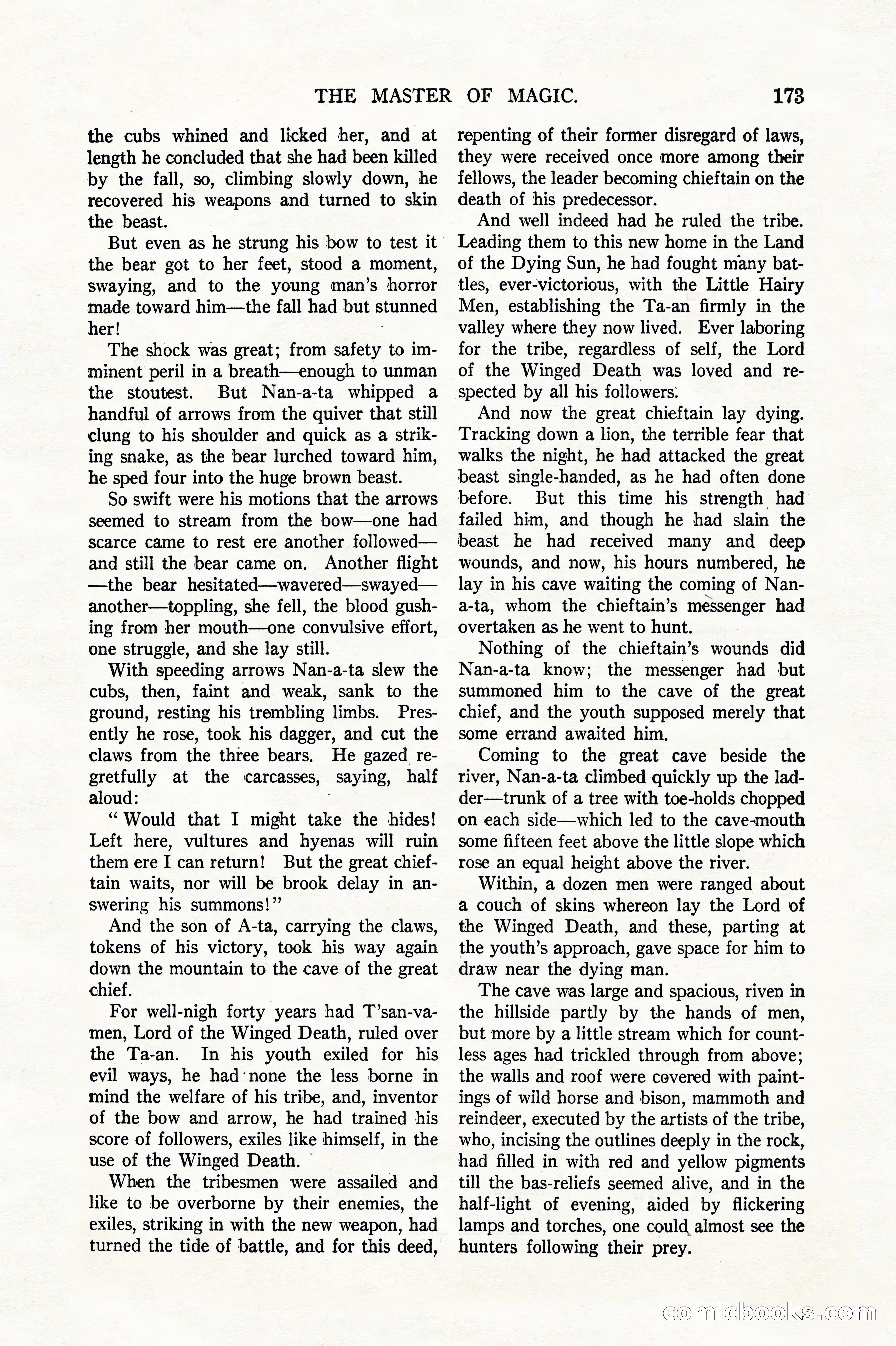
A restored page from Pulp Fiction, 1920. Page through the whole issue in the reader above.
📄 Transcribed text from this page (OCR, searchable)
Machine-transcribed from the original scan — historical spelling and the odd misread are preserved.
THE MASTER OF the cubs whined and licked her, and at length he concluded that she had been killed by the fall, so, climbing slowly down, he recovered his weapons and turned to skin the beast. But even as he strung his bow to test it the bear got to her feet, stood a moment, swaying, and to the young man’s horror made toward him—the fall had but stunned her! The shock was great; from safety to im- minent peril in a breath—enough to unman the stoutest. But Nan-a-ta whipped a handful of arrows from the quiver that still clung to his shoulder and quick as a strik- ing snake, as the bear lurched toward him, he sped four into the huge brown beast. So swift were his motions that the arrows seemed to stream from the bow—one had scarce came to rest ere another followed— and still the bear came on. Another flight —the bear hesitated—-wavered—swayed— another—toppling, she fell, the blood gush- ing from her mouth—one convulsive effort, one struggle, and she lay still. With speeding arrows Nan-a-ta slew the cubs, then, faint and weak, sank to the ground, resting his trembling limbs. Pres- ently he rose, took his dagger, and cut the claws from the three bears. He gazed re- gretfully at the carcasses, saying, half aloud: “Would that I might take the hides! Left here, vultures and hyenas will ruin them ere I can return! But the great chief- tain waits, nor will be brook delay in an- swering his summons!” And the son of A-ta, carrying the claws, tokens of his victory, took his way again down the mountain to the cave of the great chief. For well-nigh forty years had T’san-va- men, Lord of the Winged Death, ruled over the Ta-an. In his youth exiled for his evil ways, he had‘none the less borne in mind the welfare of his tribe, and, inventor of the bow and arrow, he had trained his score of followers, exiles like himself, in the use of the Winged Death. — When the tribesmen were assailed and like to be overborne by their enemies, the exiles, striking in with the new weapon, had turned the tide of battle, and for this deed, MAGIC. 173 repenting of their former disregard of laws, they were received once more among their fellows, the leader becoming chieftain on the death of his predecessor. And well indeed had he ruled the tribe. Leading them to this new home in the Land of the Dying Sun, he had fought many bat- tles, ever-victorious, with the Little Hairy Men, establishing the Ta-an firmly in the valley where they now lived. Ever laboring for the tribe, regardless of self, the Lord of the Winged Death was loved and re- spected by all his followers. And now the great chieftain lay dying. Tracking down a lion, the terrible fear that walks the night, he had attacked the great beast single-handed, as he had often done before. But this time his strength had failed him, and though he had slain the beast he had received many and deep wounds, and now, his hours numbered, he lay in his cave waiting the coming of Nan- a-ta, whom the chieftain’s messenger had overtaken as he went to hunt. Nothing of the chieftain’s wounds did Nan-a-ta know; the messenger had but summoned him to the cave of the great chief, and the youth supposed merely that some errand awaited him. Coming to the great cave beside the river, Nan-a-ta climbed quickly up the lad- der—trunk of a tree with toe-holds chopped on each side—which led to the cave-mouth some fifteen feet above the little slope which rose an equal height above the river. Within, a dozen men were ranged about a couch of skins whereon lay the Lord of the Winged Death, and these, parting at the youth’s approach, gave space for him to draw near the dying man. The cave was large and spacious, riven in the hillside partly by the hands of men, but more by a little stream which for count- less ages had trickled through from above; the walls and roof were cevered with paint- ings of wild horse and bison, mammoth and reindeer, executed by the artists of the tribe, who, incising the outlines deeply in the rock, had filled in with red and yellow pigments till the bas-reliefs seemed alive, and in the half-light of evening, aided by flickering lamps and torches, one could almost see the hunters following their prey. Co DOOK (C@