
Pulp Fiction, 1920 · page 70 of 158
Argosy, Vol. 123, No. 2 — page 70: what you’re looking at
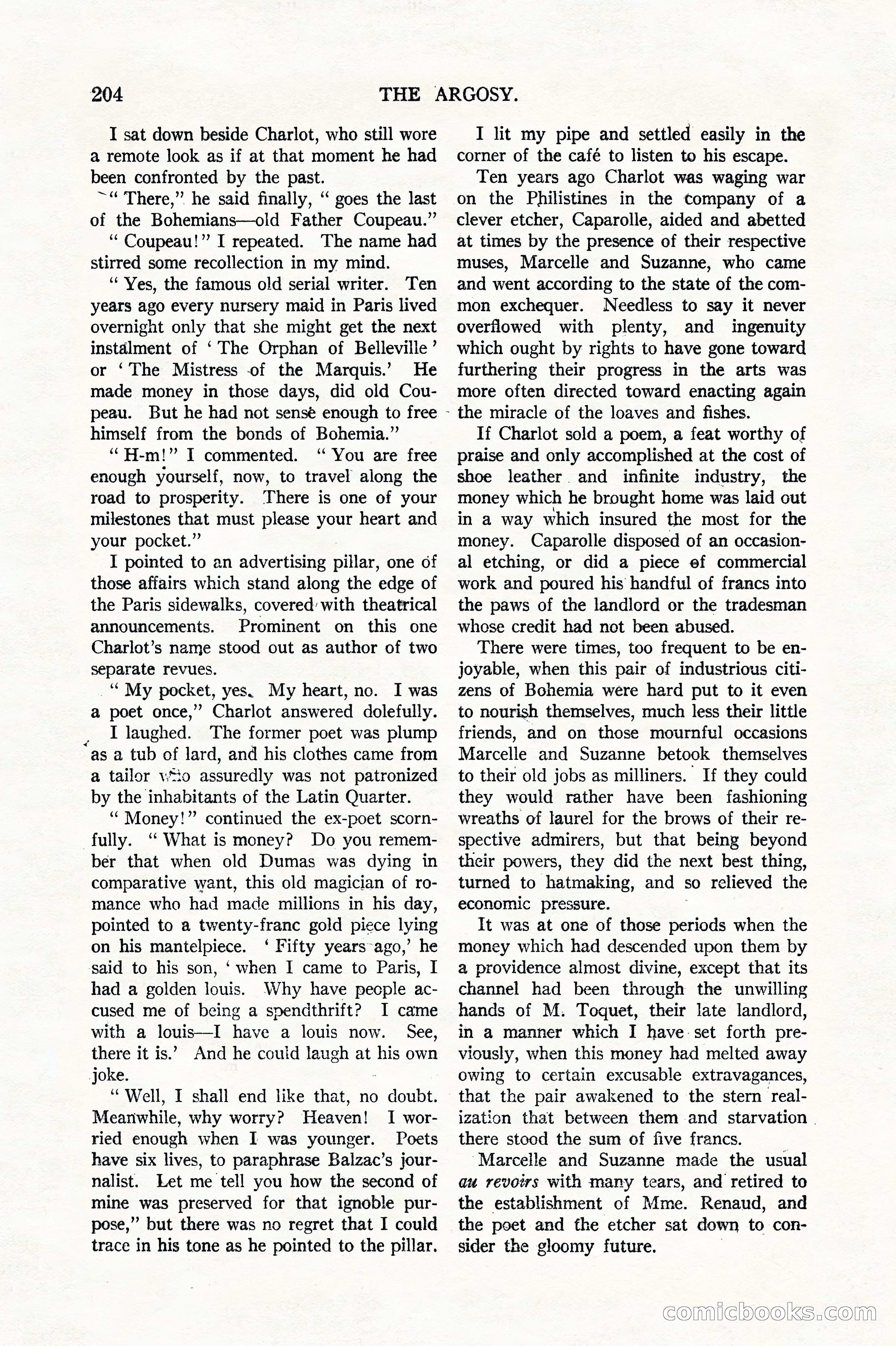
A restored page from Pulp Fiction, 1920. Page through the whole issue in the reader above.
📄 Transcribed text from this page (OCR, searchable)
Machine-transcribed from the original scan — historical spelling and the odd misread are preserved.
204 I sat down beside Charlot, who still wore a remote look as if at that moment he had been confronted by the past. ~“ There,” he said finally, “ goes the last of the Bohemians—old Father Coupeau.”’ ‘“‘ Coupeau!’’ I repeated. The name had stirred some recollection in my mind. “Yes, the famous old serial writer. Ten years ago every nursery maid in Paris lived overnight only that she might get the next instalment of ‘ The Orphan of Belleville’ or ‘The Mistress -of the Marquis.’ He made money in those days, did old Cou- peau. But he had not sensé enough to free himself from the bonds of Bohemia.”’ ‘““H-m!”? I commented. ‘“‘ You are free enough yourself, now, to travel along the road to prosperity. There is one of your milestones that must please your heart and your pocket.” I pointed to an advertising pillar, one of those affairs which stand along the edge of the Paris sidewalks, covered’ with theatrical announcements. Prominent on this one Charlot’s name stood out as author of two separate revues. _“ My pocket, yes. My heart, no. I was a poet once,’’ Charlot answered dolefully. _ I laughed. The former poet was plump “as a tub of lard, and his clothes came from a tailor vio assuredly was not patronized by the inhabitants of the Latin Quarter. “Money!” continued the ex-poet scorn- fully. “ What is money? Do you remem- ber that when old Dumas was dying in comparative want, this old magician of ro- mance who had made millions in his day, pointed to a twenty-franc gold piece lying on his mantelpiece. ‘ Fifty years ago,’ he said to his son, ‘when I came to Paris, I had a golden louis. Why have pecple ac- cused me of being a spendthrift? I came with a louis—I have a louis now. See, there it is.’ And he couid laugh at his own joke. - ‘Well, I shall end like that, no doubt. Meanwhile, why worry? Heaven! I wor- ried enough when I was younger. Poets have six lives, to paraphrase Balzac’s jour- nalist. Let me tell you how the second of mine was preserved for that ignoble pur- pose,”’ but there was no regret that I could trace in his tone as he pointed to the pillar. THE ARGOSY. I lit my pipe and settled easily in the corner of the café to listen to his escape. Ten years ago Charlot was waging war on the Philistines in the company of a clever etcher, Caparolle, aided and abetted at times by the presence of their respective muses, Marcelle and Suzanne, who came and went according to the state of the com- mon exchequer. Needless to say it never overflowed with plenty, and ingenuity which ought by rights to have gone toward furthering their progress in the arts was more often directed toward enacting again - the miracle of the loaves and fishes. If Charlot sold a poem, a feat worthy of praise and only accomplished at the cost of shoe leather. and infinite industry, the money which he brought home was laid out in a way which insured the most for the money. Caparolle disposed of an occasion- al etching, or did a piece ef commercial work and poured his handful of francs into the paws of the landlord or the tradesman whose credit had net been abused. There were times, too frequent to be en- joyable, when this pair of industrious citi- zens of Bohemia were hard put to it even to nourish themselves, much less their little friends, and on those mournful occasions Marcelle and Suzanne betook themselves to their old jobs as milliners. If they could they would rather have been fashioning wreaths of laurel for the brows of their re- spective admirers, but that being beyond their powers, they did the next best thing, turned to hatmaking, and so relieved the economic pressure. 7 It was at one of those periods when the money which had descended upon them by a providence almost divine, except that its channel had been through the unwilling hands of M. Toquet, their late landlord, in a manner which I have set forth pre- viously, when this money had melted away owing to certain excusable extravagances, that the pair awakened to the stern real- ization that between them and starvation - there stood the sum of five francs. ‘Marcelle and Suzanne made the usual au revoirs with many tears, and retired to the establishment of Mme. Renaud, and the poet and fhe etcher sat down to con- sider the gloomy future. : MICLOOOK C@