
Pulp Fiction, 1920 · page 115 of 164
Argosy All-Story Weekly, November 13, 1920 — page 115: what you’re looking at
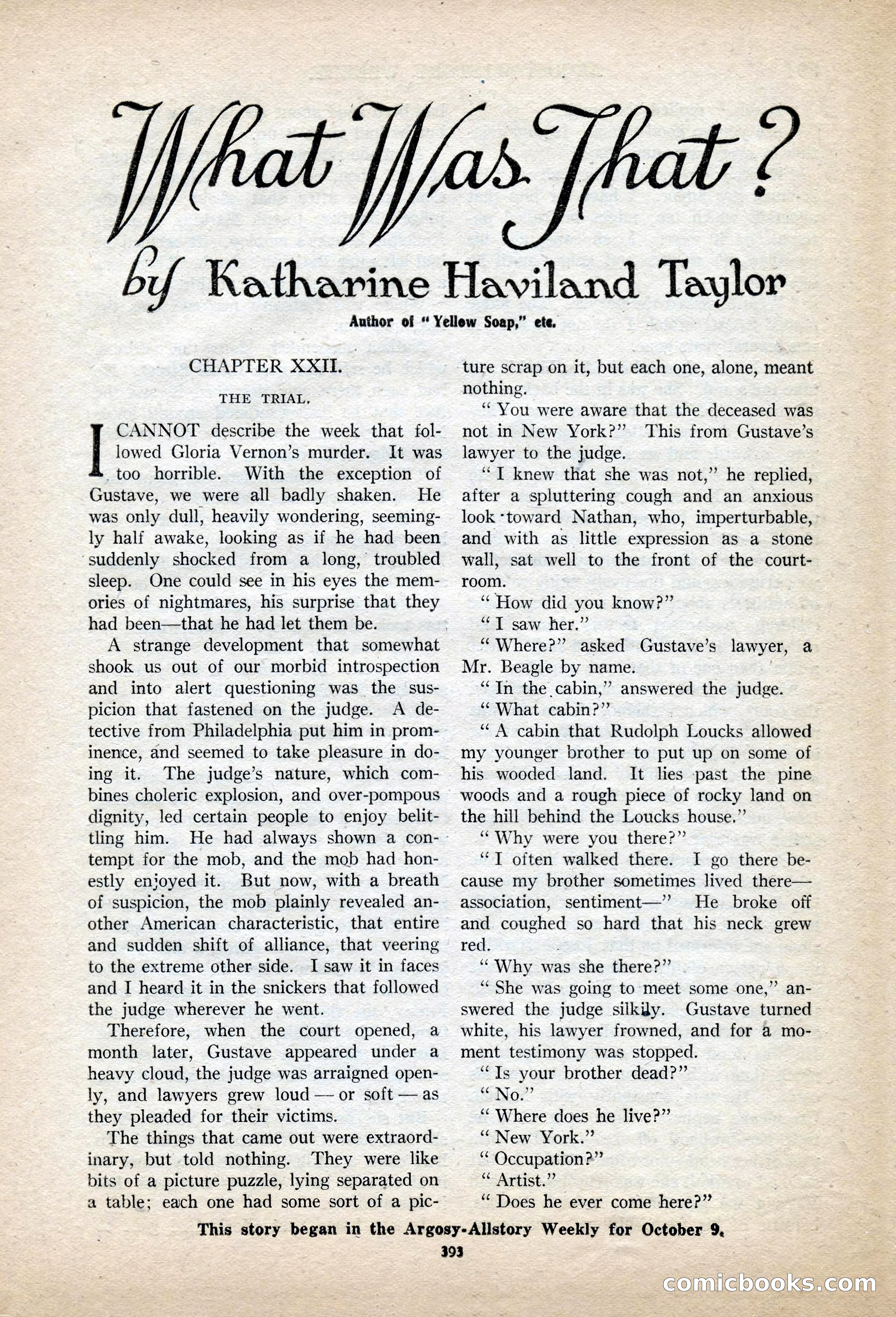
A restored page from Pulp Fiction, 1920. Page through the whole issue in the reader above.
📄 Transcribed text from this page (OCR, searchable)
Machine-transcribed from the original scan — historical spelling and the odd misread are preserved.
_ if fae? by Katharine Haviland Taylor Author of “ Yellew Soap,” ete. CHAPTER XXII. THE TRIAL, CANNOT describe the week that fol- | lowed Gloria Vernon’s murder. It was _too horrible. With the exception of Gustave, we were all badly shaken. He was only dull, heavily wondering, seeming- ly half awake, looking as if he had been ‘suddenly shocked from a long, troubled sleep. One could see in his eyes the mem- ories of nightmares, his surprise that they had been—that he had let them be. A strange development that somewhat shook us out of our morbid introspection and into alert questioning was the sus- picion that fastened on the judge. A de- tective from Philadelphia put him in prom- inence, and seemed to take pleasure in do- ing it. The judge’s nature, which com- bines choleric explosion, and over-pompous dignity, led certain people to enjoy belit- tling him. He had always shown a con-- tempt for the mob, and the mob had hon- estly enioyed it. But now, with a breath of suspicion, the mob plainly revealed an- other American characteristic, that entire and sudden shift of alliance, that veering to the extreme other side. I saw it in faces and I heard it in the snickers that followed the judge wherever he went. Therefore, when the court opened, a month later, Gustave appeared under a heavy cloud, the judge was arraigned open- ly, and lawyers grew loud — or soft —as they pleaded for their victims. The things that came out were extraord- inary, but told nothing. They were like bits of a picture puzzle, lying separated on a table; each one had some sort of a pic- ture scrap on it, but each one, alone, meant nothing. ‘You were aware that the deceased was not in New York?” This from Gustave’s lawyer to the judge. ‘I knew that she was not,” he replied, after a spluttering cough and an anxious look ‘toward Nathan, who, imperturbable, and with as little expression as a stone wall, sat well to the front of the court- room. “How did you know?” “TI saw her.” “Where?” asked Gustave’s lawyer, a Mr. Beagle by name. : “In the cabin,” answered the judge. ‘“ What cabin?” | “A cabin that Rudolph Loucks allowed my younger brother to put up on some of his wooded land. It lies past the pine woods and a rough piece of rocky land on the hill behind the Loucks house.”’ “Why were you there?” ‘“T often walked there. I go there be- cause my brother sometimes lived there— association, sentiment—”’ He broke off and coughed so hard that his neck grew red. “Why was she there?”’ ‘““ She was going to meet some one,” an- swered the judge silkily. Gustave turned white, his lawyer frowned, and for a mo- ment testimony was stopped. ‘““Is your brother dead?” ee No.” ‘“‘ Where does he live?” “New York.” “’ Occupation?” ** Artist.” “Does he ever come here?” This story began in the Argosy-Allstory Weekly for October 9. 393 GEomichooks (EO)