
Pulp Fiction, 1920 · page 125 of 164
Argosy All-Story Weekly, November 13, 1920 — page 125: what you’re looking at
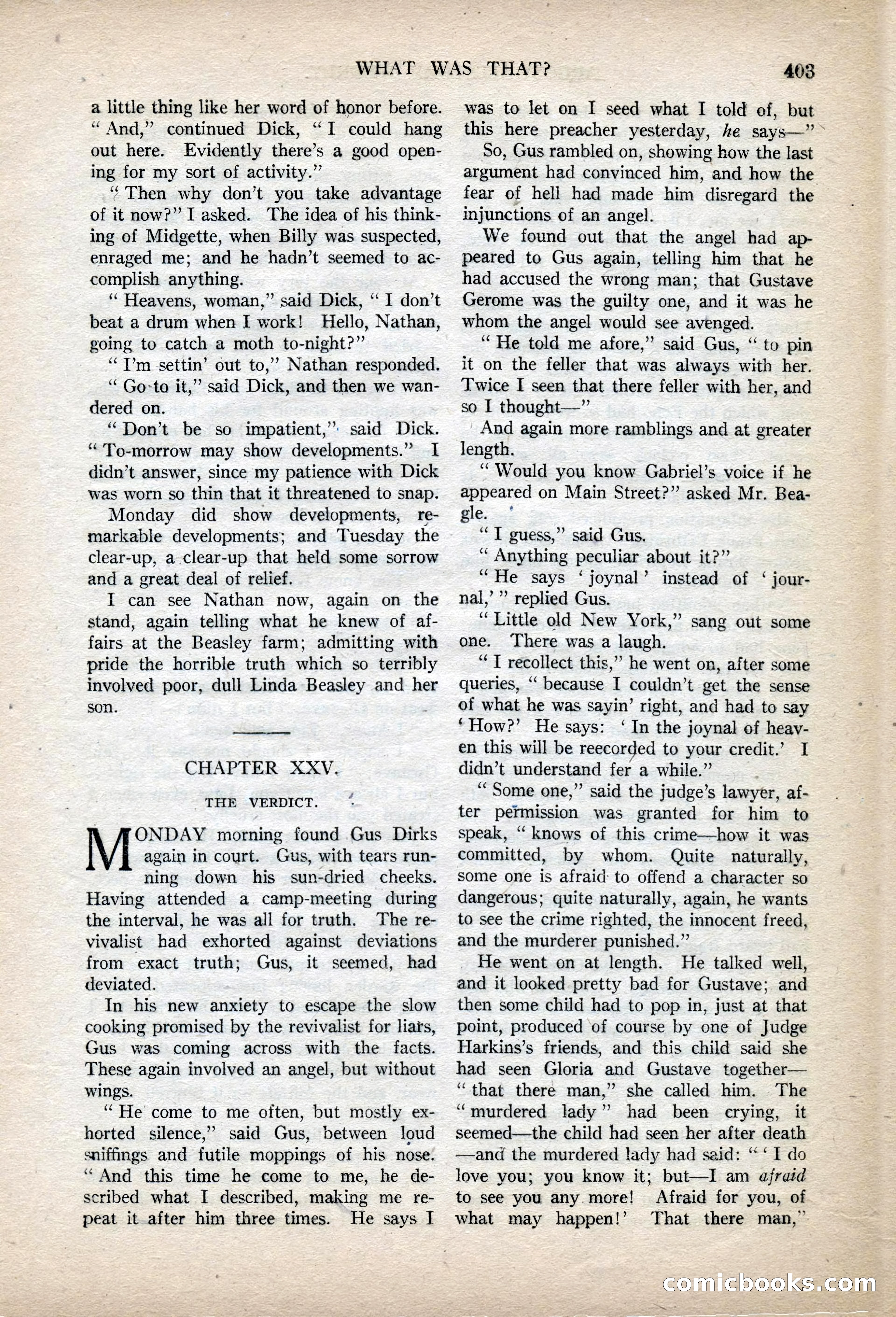
A restored page from Pulp Fiction, 1920. Page through the whole issue in the reader above.
📄 Transcribed text from this page (OCR, searchable)
Machine-transcribed from the original scan — historical spelling and the odd misread are preserved.
WHAT WAS a little thing like her word of honor before. “And,” continued Dick, “I could hang out here. Evidently there’s a good open- ing for my sort of activity.” ‘’Then why don’t you take advantage of it now?” I asked. The idea of his think- ing of Midgette, when Billy was suspected, enraged me; and he hadn’t seemed to ac- complish anything. ‘‘ Heavens, woman,” said Dick, “ I don’t beat a drum yehen I work! Hello, Nathan, going to catch a moth to-night?” ‘“T’m settin’ out to,’’ Nathan responded. ‘““ Go-to it,” said Dick, and then we wan- dered on. ‘Don’t be so impatient,” said Dick. “To-morrow may show developments.” I didn’t answer, since my patience with Dick was worn so thin that it threatened to snap. Monday did show developments, re- markable developments; and Tuesday the clear-up, a clear-up that held some sorrow and a great deal of relief. I can see Nathan now, again on the stand, again telling what he knew of af- fairs at the Beasley farm; admitting with pride the horrible truth which so terribly involved poor, dull Linda Beasley and her son. ae ee ee CHAPTER XXV. THE VERDICT. ONDAY morning found Gus Dirks again in court. Gus, with tears run- ning down his sun-dried cheeks. Having attended a camp-meeting during the interval, he was all for truth. The re- vivalist had exhorted against deviations from exact truth; Gus, it seemed, had deviated. In his new anxiety to escape the slow cooking promised by the revivalist for liars, Gus was coming across with the facts. These again involved an angel, but without wings. “He come to me often, but mostly ex- horted silence,” said Gus, between loud sniffngs and futile moppings of his nose. “And this time he come to me, he de- scribed what I described, making me re- peat it after him three times. He says I THAT? 403 was to let on I seed what I told of, but this here preacher yesterday, he says—” So, Gus rambled on, showing how the last argument had convinced him, and how the fear of hell had made him disregard the injunctions of an angel. We found out that the angel had ap- peared to Gus again, telling him that he had accused the wrong man; that Gustave Gerome was the guilty one, and it was he whom the angel would see avenged. ‘He told me afore,” said Gus, “ to pin it on the feller that was always with her. Twice I seen that there feller with her, and so I thought—”’ And again more ramblings and at greater length. ‘Would you know Gabriel’s voice if he appeared on Main Street?” asked Mr. Bea- gle. =" ‘1 guess,” said Gus. ‘“ Anything peculiar about it?” ‘He says ‘joynal’ instead of ‘ jour- nal,’ ” replied Gus. ‘ Little old New York,” sang out some one. There was a laugh. “TI recollect this,” he went on, after some queries, “ because I couldn’t get the sense of what he was sayin’ right, and had to say ‘How?’ He says: ‘ In the joynal of heay- en this will be reecorded to your credit.’ I didn’t understand fer a while.” ‘Some one,” said the judge’s lawyer, af- ter permission was granted for him to speak, “ knows of this crime—how it was committed, by whom. Quite naturally, some one is afraid: to offend a character so dangerous; quite naturally, again, he wants to see the crime righted, the innocent freed, and the murderer punished.” He went on at length. He talked well, and it looked pretty bad for Gustave; and then some child had to pop in, just at that point, produced of course by one of Judge Harkins’s friends, and this child said she had seen Gloria and Gustave together— “that there man,” she called him. The “murdered lady” had been crying, it seemed—the child had seen her after death —and the murdered lady had said: “ ‘ I do love you; you know it; but—I am ajratd to see you any more! Afraid for you, of what may happen!’ That there man,” Gomichbooks (eo) a?