
Pulp Fiction, 1920 · page 51 of 164
Argosy All-Story Weekly, November 13, 1920 — page 51: what you’re looking at
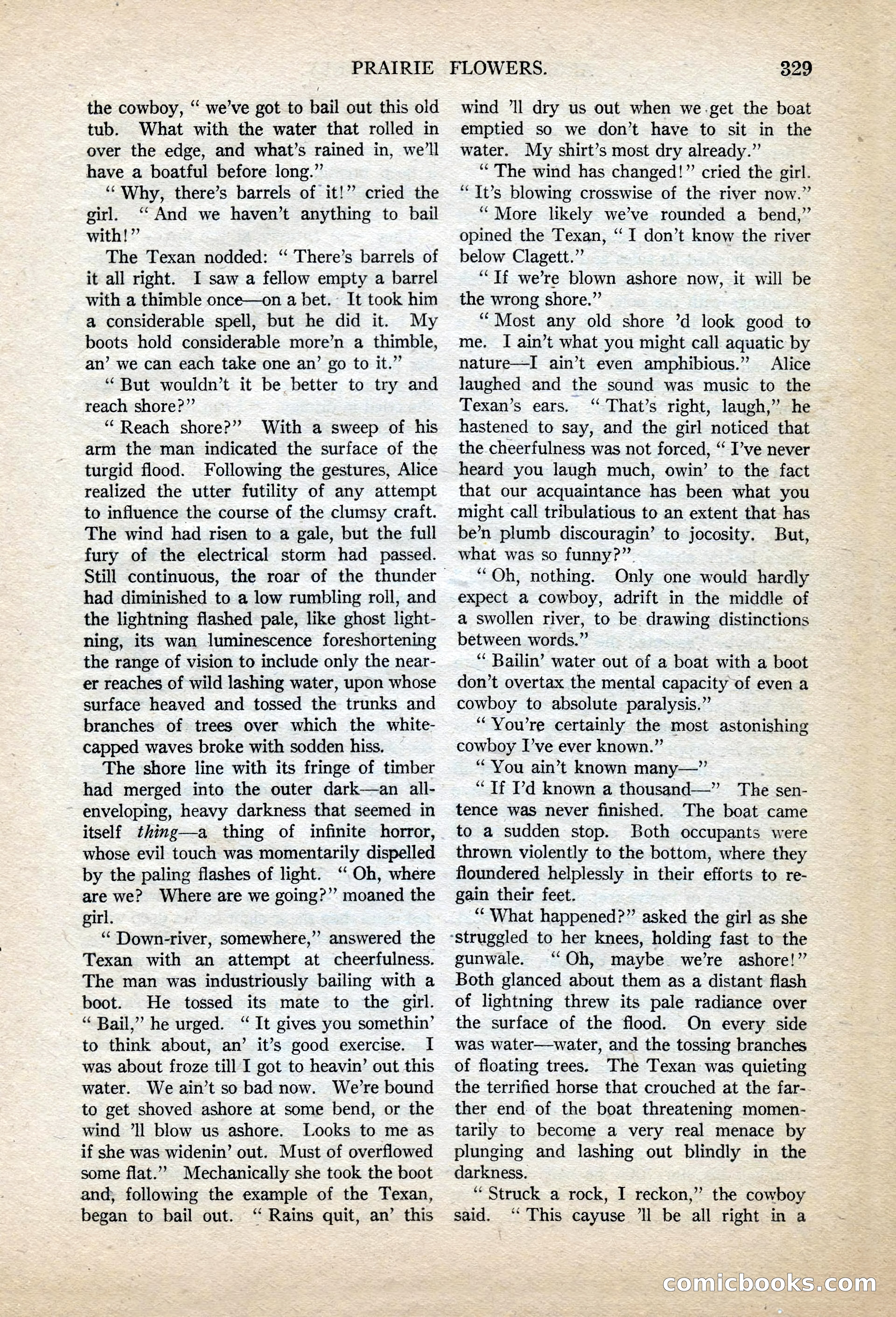
A restored page from Pulp Fiction, 1920. Page through the whole issue in the reader above.
📄 Transcribed text from this page (OCR, searchable)
Machine-transcribed from the original scan — historical spelling and the odd misread are preserved.
PRAIRIE FLOWERS. the cowboy, “ we’ve got to bail out this old tub. What with the water that rolled in over the edge, and what’s rained in, we’ll have a boatful before long.”’ ‘“‘'Why, there’s barrels of it!” cried the girl. ‘“‘ And we haven’t anything to bail with!” The Texan nodded: ‘“ There’s barrels of it all right. I saw a fellow empty a barrel with a thimble once—on a bet. It took him a considerable spell, but he did it. My boots hold considerable more’n a thimble, an’ we can each take one an’ go to it.”’ ‘But wouldn’t it be better to try and reach shore?” “Reach shore?” With a sweep of his arm the man indicated the surface of the turgid flood. Following the gestures, Alice realized the utter futility of any attempt to influence the course of the clumsy craft. The wind had risen to a gale, but the full fury of the electrical storm had passed. Still continuous, the roar of the thunder had diminished to a low rumbling roll, and the lightning flashed pale, like ghost light- ning, its wan luminescence foreshortening the range of vision to include only the near- er reaches of wild lashing water, upon whose surface heaved and tossed the trunks and branches of trees over which the white- capped waves broke with sodden hiss. The shore line with its fringe of timber had merged into the outer dark—an all- enveloping, heavy darkness that seemed in itself thing—a thing of infinite horror, whose evil touch was momentarily dispelled by the paling flashes of light. “ Oh, where are we? Where are we going?” moaned the girl. ‘“Down-river, somewhere,”’ answered the Texan with an attempt at cheerfulness. The man was industriously bailing with a boot. He tossed its mate to the girl. “ Bail,” he urged. “ It gives you somethin’ to think about, an’ it’s good exercise. I was about froze till I got to heavin’ out this water. We ain’t so bad now. We're bound to get shoved ashore at some bend, or the wind ’ll blow us ashore. Looks to me as if she was widenin’ out. Must of overflowed some flat.”” Mechanically she took the boot and, following the example of the Texan, began to bail out. “ Rains quit, an’ this a29 wind ‘Il dry us out when we.get the boat emptied so we don’t have to sit in the water. My shirt’s most dry already.” “The wind has changed!” cried the girl. ‘“Tt’s blowing crosswise of the river now.” “More likely we’ve rounded a bend,” opined the Texan, “‘ I don’t know the river below Clagett.”’ ‘““Tf we’re blown ashore now, it will be the wrong shore,” “Most any old shore ’d look good to me. I ain’t what you might call aquatic by nature—I ain’t even amphibious.” Alice laughed and the sound was music to the Texan’s ears. ‘“ That’s right, laugh,” he hastened to say, and the girl noticed that the cheerfulness was not forced, “ I’ve never heard you laugh much, owin’ to the fact that our acquaintance has been what you might call tribulatious to an extent that has be’n plumb discouragin’ to jocosity, But, what was so funny?” “Oh, nothing. Only one would hardly expect a cowboy, adrift in the middle of a swollen river, to be drawing distinctions between words.” “ Bailin’ water out of a boat with a boot don’t overtax the mental capacity of even a cowboy to absolute paralysis.” ‘“You’re certainly the most astonishing cowboy I’ve ever known.”’ “You ain’t known many—”’ “Tf ’d known a thousand—” The sen- tence was never finished. The boat came to a sudden stop. Both occupants were thrown violently to the bottom, where they floundered helplessly in their efforts to re- gain their feet. ‘What happened?” asked the girl as she ‘struggled to her knees, holding fast to the gunwale. “Oh, maybe we're ashore!” Both glanced about them as a distant flash of lightning threw its pale radiance over the surface of the flood. On every side was water—water, and the tossing branches of floating trees. The Texan was quieting the terrified horse that crouched at the far- ther end. of the boat threatening momen- tarily to become a very real menace by plunging and lashing out blindly in the darkness. ‘Struck a rock, I reckon,” the cowboy said. ‘‘ This cayuse ’ll be all right in a (Eo) Gomichooks