
Pulp Fiction, 1920 · page 62 of 164
Argosy All-Story Weekly, November 13, 1920 — page 62: what you’re looking at
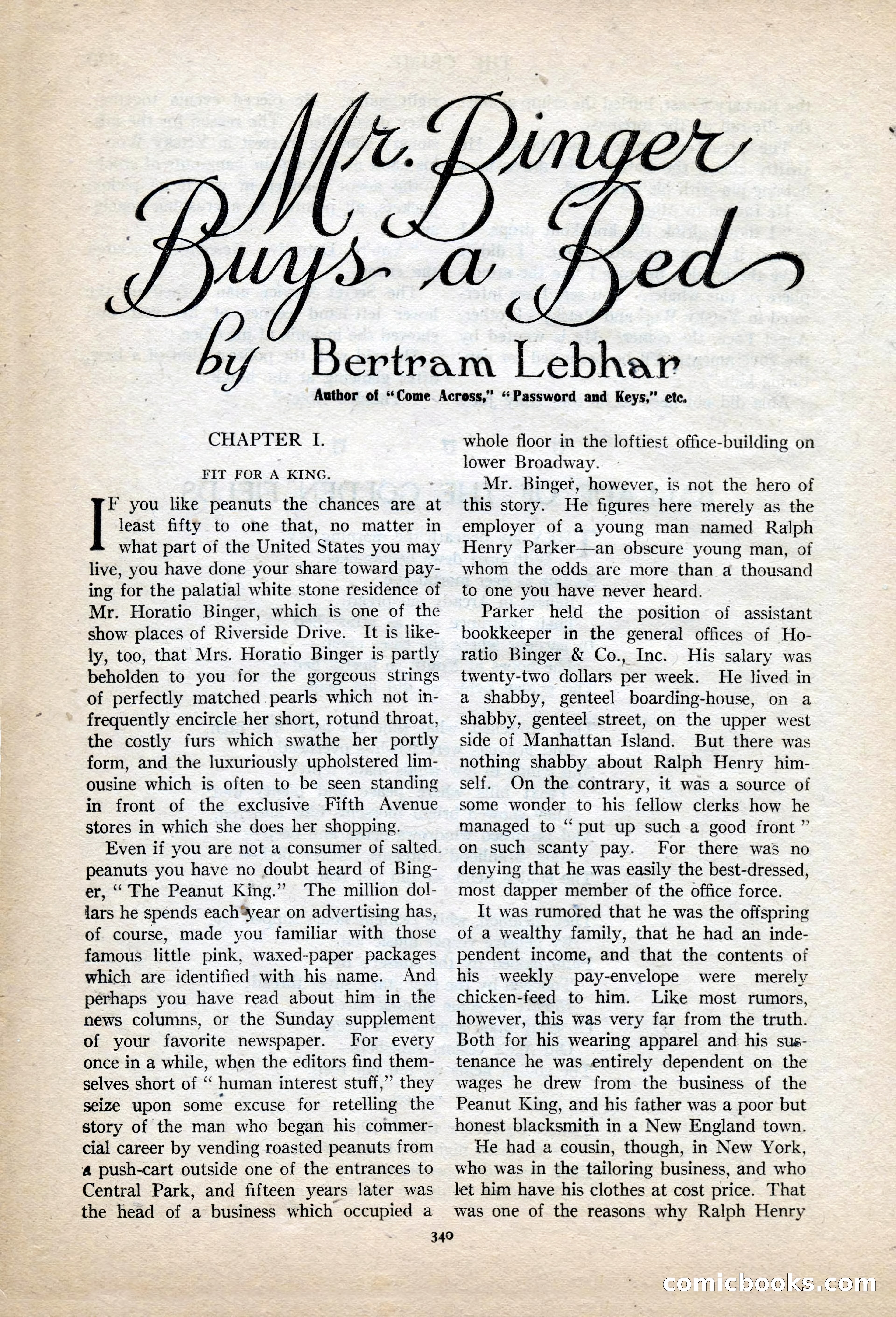
A restored page from Pulp Fiction, 1920. Page through the whole issue in the reader above.
📄 Transcribed text from this page (OCR, searchable)
Machine-transcribed from the original scan — historical spelling and the odd misread are preserved.
by Bertram Cobham Author of “Come Across,” “Password and Keys,” etc, CHAPTER I. FIT FOR A KING. least fifty to one that, no matter in what part of the United States you may live, you have done your share toward pay- ing for the palatial white stone residence of Mr. Horatio Binger, which is one of the show places of Riverside Drive. It is like- ly, too, that Mrs. Horatio Binger is partly beholden to you for the gorgeous strings of perfectly matched pearls which not in- frequently encircle her short, rotund throat, the costly furs which swathe her portly form, and the luxuriously upholstered lim- ousine which is often to be seen standing in front of the exclusive Fifth Avenue stores in which she does her shopping. r you like peanuts the chances are at Even if you are not a consumer of salted. peanuts you have no doubt heard of Bing- er, ‘“ The Peanut King.” The million dol- lars he spends each®year on advertising has, of course, made you familiar with those famous little pink, waxed-paper packages which are identified with his name. And perhaps you have read about him in the news columns, or the Sunday supplement of your favorite newspaper. For every once in a while, when the editors find them- selves short of “‘ human interest stuff,” they seize upon some excuse for retelling the story of the man who began his commer- cial career by vending roasted peanuts from 4@ push-cart outside one of the entrances to Central Park, and fifteen years later was the head of a business which occupied a whole floor in the loftiest office-building on lower Broadway. Mr. Binger, however, is not the hero of this story. He figures here merely as the employer of a young man named Ralph Henry Parker—an obscure young man, of whom the odds are more than a thousand to one you have never heard. Parker held the position of assistant bookkeeper in the general offices of Ho- ratio Binger & Co., Inc. His salary was twenty-two dollars per week. He lived in a shabby, genteel boarding-house, on a shabby, genteel street, on the upper west side of Manhattan Island. But there was nothing shabby about Ralph Henry him- self. On the contrary, it was a source of some wonder to his fellow clerks how he managed to “ put up such a good front ” on such scanty pay. For there was no denying that he was easily the best-dressed, most dapper member of the office force. It was rumored that he was the offspring of a wealthy family, that he had an inde- pendent income, and that the contents of his weekly pay-envelope were merely chicken-feed to him. Like most rumors, however, this was very far from the truth. Both for his wearing apparel and his sus- tenance he was entirely dependent on the wages he drew from the business of the Peanut King, and his father was a poor but honest blacksmith in a New England town. He had a cousin, though, in New York, who was in the tailoring business, and who let him have his clothes at cost price. That was one of the reasons why Ralph Henry 340 Eomichbooks (E()