
Pulp Fiction, 1920 · page 65 of 164
Argosy All-Story Weekly, November 13, 1920 — page 65: what you’re looking at
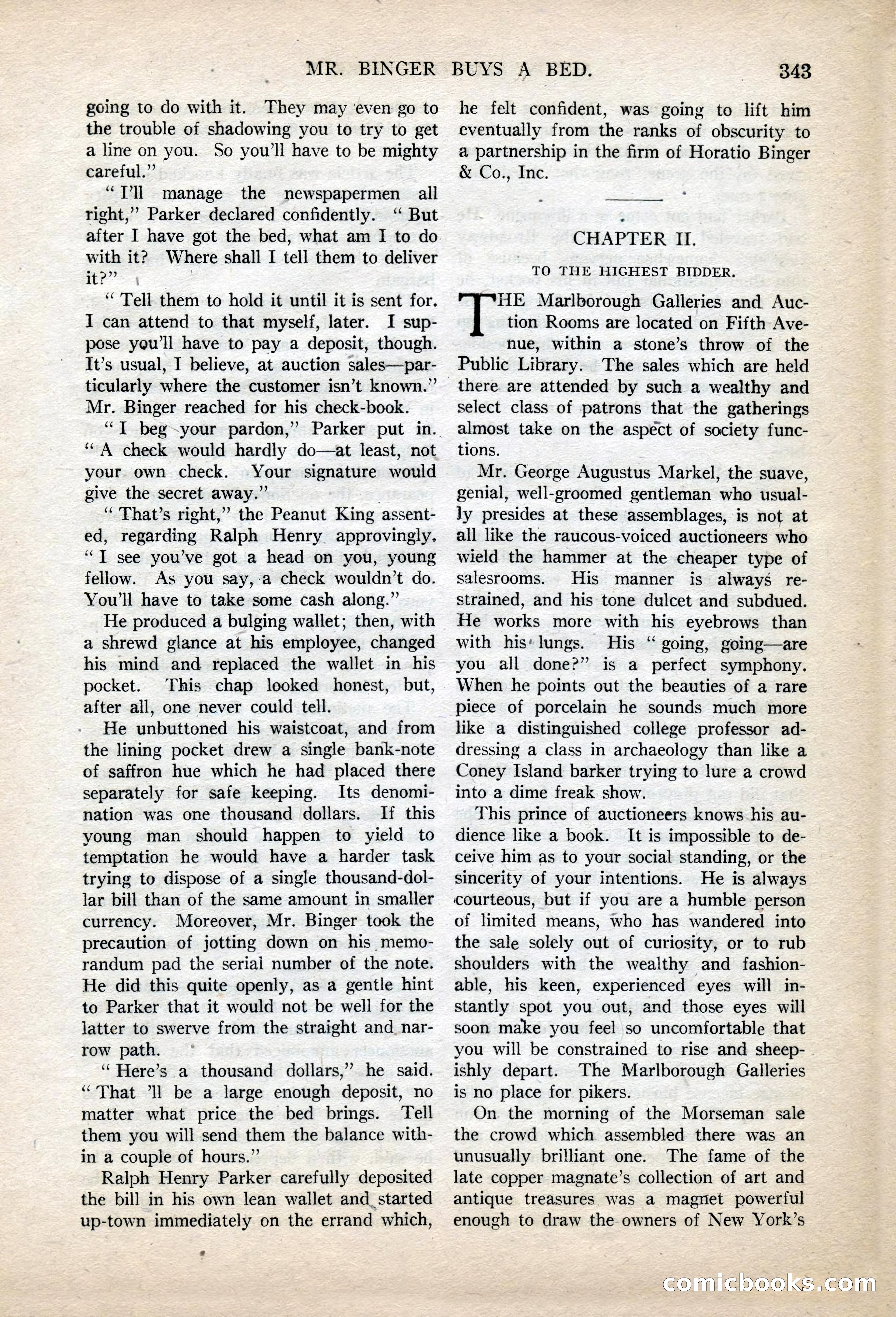
A restored page from Pulp Fiction, 1920. Page through the whole issue in the reader above.
📄 Transcribed text from this page (OCR, searchable)
Machine-transcribed from the original scan — historical spelling and the odd misread are preserved.
MR. BINGER going to do with it. They may ‘even go to the trouble of shadowing you to try to get a line on you. So you'll have to be mighty careful.”’ “T’ll manage the newspapermen all right,’’ Parker declared confidently. ‘ But after I have got the bed, what am I to do with it? Where shall I tell them to deliver : a oe : “Tell them to hold it until it is sent for. I can attend to that myself, later. I sup- pose you'll have to pay a deposit, though. It’s usual, I believe, at auction sales—par- ticularly where the customer isn’t known.” Mr. Binger reached for his check-book. ‘“T beg~your pardon,” Parker put in.. ‘“ A check would hardly do—at least, not your own check. Your signature would give the secret away.” 7 “ That’s right,” the Peanut King assent- ed, regarding Ralph Henry approvingly. ‘““T see you’ve got a head on you, young fellow. As you say,:a check wouldn’t do. Yow'll have to take some cash along.”’ He produced a bulging wallet; then, with a shrewd glance at his employee, changed his mind and replaced the wallet in his pocket. This chap looked honest, but, after all, one never could tell. He unbuttoned his waistcoat, and from the lining pocket drew a single bank-note of saffron hue which he had placed there separately for safe keeping. Its denomi- nation was one thousand dollars. If this young man should happen to yield to temptation he would have a harder task trying to dispose of a single thousand-dol- lar bill than of the same amount in smaller currency. Moreover, Mr. Binger took the precaution of jotting down on his memo- randum pad the seriai number of the note. He did this quite openly, as a gentle hint to Parker that it would not be well for the latter to swerve from the straight and_nar- row path. ‘“ Here’s a thousand dollars,” he said. “That ‘ll be a large enough deposit, no matter what price the bed brings. Tell them you will send them the balance with- in a couple of hours.” Ralph Henry Parker carefully deposited the bill in his own lean wallet and_started up-town immediately on the errand which, BUYS A BED. 343 he felt confident, was going to lift him eventually from the ranks of obscurity to a partnership in the firm of Horatio Binger & Co., Inc. —_—___ CHAPTER II. TO THE HIGHEST BIDDER. HE Marlborough Galleries and Auc- tion Rooms are located on Fifth Ave- nue, within a stone’s throw of the Public Library. The sales which are held there are attended by such a wealthy and select class of patrons that the gatherings almost take on the aspect of society func- tions. Mr. George Augustus Markel, the suave, genial, well-groomed gentleman who usual- ly presides at these assemblages, is not at all like the raucous-voiced auctioneers who wield the hammer at the cheaper type of salesrooms. His manner is always re- strained, and his tone dulcet and subdued. He works more with his eyebrows than with his‘ lungs. His “ going, going—are you all done?” is a perfect symphony. When he points out the beauties of a rare piece of porcelain he sounds much more like a distinguished college professor ad- dressing a class in archaeology than like a Coney Island barker trying to lure a crowd into a dime freak show. This prince of auctioneers knows his au- dience like a book. It is impossible to de- ceive him as to your social standing, or the sincerity of your intentions. He is always courteous, but if you are a humble person of limited means, who has wandered into the sale solely out of curiosity, or to rub shoulders with the wealthy and fashion- able, his keen, experienced eyes will in- stantly spot you out, and those eyes will soon make you feel so uncomfortable that you will be constrained to rise and sheep- . ishly depart. The Marlborough Galleries is no place for pikers. On the morning of the Morseman sale the crowd which assembled there was an unusually brilliant one. The fame of the late copper magnate’s collection of art and antique treasures was a magnet powerful enough to draw the owners of New York’s Eomichbooks (eo)