
Pulp Fiction, 1920 · page 84 of 164
Argosy All-Story Weekly, November 13, 1920 — page 84: what you’re looking at
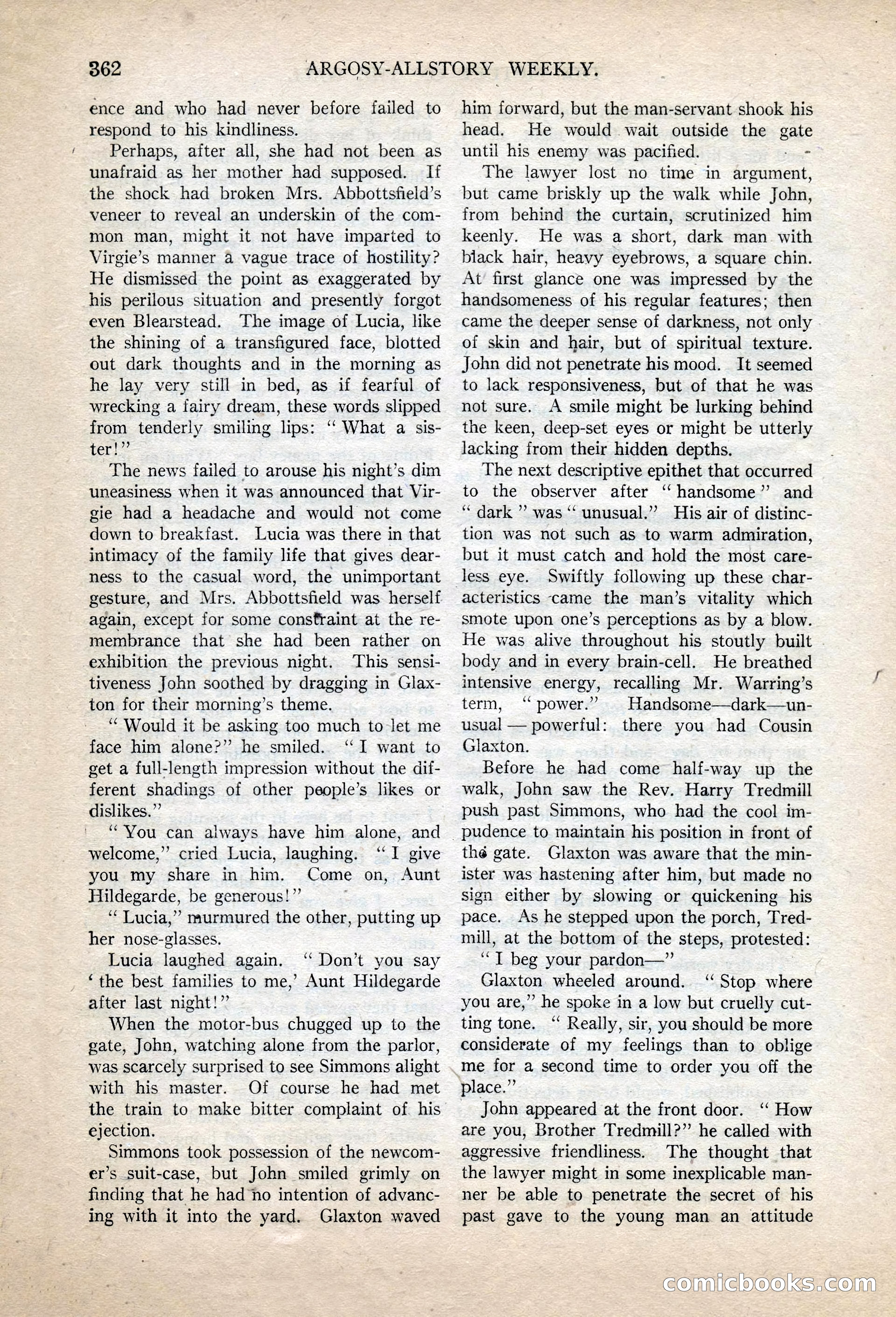
A restored page from Pulp Fiction, 1920. Page through the whole issue in the reader above.
📄 Transcribed text from this page (OCR, searchable)
Machine-transcribed from the original scan — historical spelling and the odd misread are preserved.
362 ence and who had never before failed to respond to his kindliness. Perhaps, aiter all, she had not been as unafraid as her mother had supposed. If the shock had broken Mrs. Abbottsfield’s veneer to reveal an underskin of the com- mon man, might it not have imparted to Virgie’s manner a vague trace of hostility? He dismissed the point as exaggerated by his perilous situation and presently forgot even Blearstead. The image of Lucia, like the shining of a transfigured face, blotted out dark thoughts and in the morning as he lay very still in bed, as if fearful of wrecking a fairy dream, these words slipped from tenderly smiling lips: ‘‘ What a sis- ter!”’ The news failed to arouse his night’s dim uneasiness when it was announced that Vir- vie had a headache and would not come down to breakfast. Lucia was there in that intimacy of the family life that gives dear- ness to the casual word, the unimportant gesture, and Mrs, Abbottsfield was. herself again, except for some consfraint at the re- membrance that she had been rather on exhibition the previous night. This sensi- tiveness John soothed by dragging in Glax- ton for their morning’s theme. “Would it be asking too much to let me face him alone?” he smiled. ‘‘ I want to get a full-length impression without the dif- ferent shadings of other people’s likes or dislikes.”’ “You can always have him alone, and welcome,” cried Lucia, laughing. ‘I give you my share in him. Come on, Aunt Hildegarde, be generous!”’ “Lucia,” murmured the other, putting up her nose-glasses. Lucia laughed again. ‘‘ Don’t you say ‘the best families to me,’ Aunt Hildegarde after last night!” When the motor-bus chugged up to the gate, John, watching alone from the parlor, was scarcely surprised to see Simmons alight with his master. Of course he had met the train to make bitter complaint of. his ejection. Simmons took possession of the newcom- er’s suit-case, but John smiled grimly on finding that he had no intention of advanc- ing with it into the yard. Glaxton waved less eye. ARGOSY-ALLSTORY WEEKLY. him forward, but the man-servant shook his head. He would wait outside the gate until his enemy was pacified. fnne The lawyer lost no time in argument, but came briskly up the walk while John, from behind the curtain, scrutinized him keenly. He was a short, dark man with black hair, heavy eyebrows, a square chin. At first glance one was impressed by the handsomeness of his regular features; then came the deeper sense of darkness, not only of skin and hair, but of spiritual texture. John did not penetrate his mood. It seemed to lack responsiveness, but of that he was not sure. A smile might be lurking behind the keen, deep-set eyes or might be utterly lacking from their hidden depths. The next descriptive epithet that occurred to the observer after ‘‘ handsome” and ‘dark ” was “unusual.” His air of distinc- tion was not such as to warm admiration, but it must catch and hold the most care- Swiftly following up these char- acteristics came the man’s vitality which smote upon one’s perceptions as by a blow. He was alive throughout his stoutly built body and in every brain-cell. He breathed intensive energy, recalling Mr. Warring’s term, ‘“ power.” |§Handsome—dark—un- usual — powerful: there you had Cousin Glaxton. Before he had come half-way up the walk, John saw the Rev. Harry Tredmill push past Simmons, who had the cool im- _pudence to maintain his position in front of thé gate. Glaxton was aware that the min- ister was hastening after him, but made no sign either by slowing or quickening his pace. As he stepped upon the porch, Tred- mill, at the bottom of the steps, protested: “I beg your pardon—”’ Glaxton wheeled around. ‘‘ Stop where you are,” he spoke in a low but cruelly cut- ting tone. ‘ Really, sir, you should be more considerate of my feelings than to oblige me for a second time to order you off the place.” John appeared at the front door. ‘‘ How are you, Brother Tredmill?” he called with aggressive friendliness. The thought that the lawyer might in some inexplicable man- ner be able to penetrate the secret of his past gave to the young man an attitude Gomichoo -) Ss (EC)