
Pulp Fiction, 1921 · page 113 of 157
Argosy All-Story Weekly, April 16, 1921 — page 113: what you’re looking at
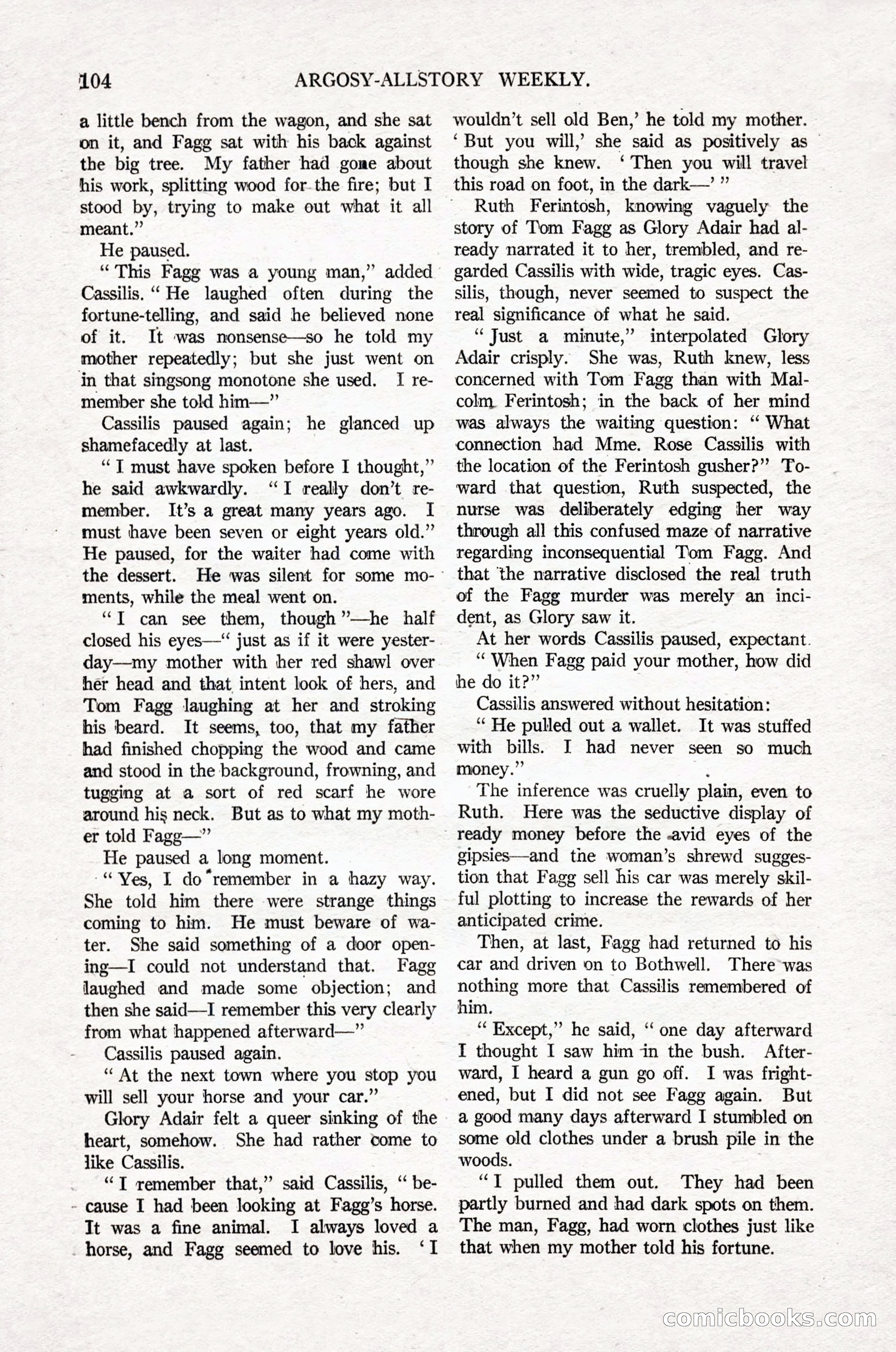
A restored page from Pulp Fiction, 1921. Page through the whole issue in the reader above.
📄 Transcribed text from this page (OCR, searchable)
Machine-transcribed from the original scan — historical spelling and the odd misread are preserved.
104 a little bench from the wagon, and she sat on it, and Fagg sat with his back against the big tree. My father had gome about his work, splitting wood for-the fire; but I stood by, trying to make out what it all meant.” He paused. “This Fagg was a young man,” added Cassilis. “He laughed often during the fortune-telling, and said he believed none of it. It was nonsense—so he told my mother repeatedly; but she just went on in that singsong monotone she used. I re- member she told him—”’ Cassilis paused again; he glanced up shamefacedly at last. ‘““T must have spoken before I thought,” he said awkwardly. “TI really don’t re- member. It’s a great many years ago. I must have been seven or eight years old.” He paused, for the waiter had come with the dessert. ments, while the meal went on. “T can see them, though ”—he half closed his eyes—‘“‘ just as if it were yester- day—my mother with her red shawl over her head and that intent look of hers, and Tom Fagg laughing at her and stroking his beard. It seems, too, that my father had finished chopping the wood and came and stood in the background, frowning, and tugging at a sort of red scarf he wore around his neck. But as to what my moth- er told Fagg—” He paused a long moment. “Ves, I do“remember in a hazy way. She told him there were strange things coming to him. He must beware of wa- ter. She said something of a door open- ing—I could not understand that. Fagg laughed and made some objection; and then she said—I remember this very clearly from what happened afterward—”’ Cassilis paused again. “At the next town where you stop you will sell your horse and your car.” Glory Adair felt a queer sinking of the heart, somehow. She had rather come to like Cassilis. “T remember that,” said Cassilis, ‘“ be- - cause I had been looking at Fagg’s horse. Tt was a fine animal. I always loved a horse, and Fagg seemed to love his. ‘I He was silent for some mo- ~ ARGOSY-ALLSTORY WEEKLY. wouldn’t sell old Ben,’ he told my mother. ‘But you will,’ she said as positively as © though she knew. ‘ Then you will travel this road on foot, in the dark—’ ” Ruth Ferintosh, knowing vaguely the story of Tom Fagg as Glory Adair had al- ready narrated it to her, trembled, and re- garded Cassilis with wide, tragic eyes. Cas- silis, though, never seemed to suspect the real significance of what he said. “Just a minute,” interpolated Glory Adair crisply. She was, Ruth knew, less concerned with Tom Fagg than with Mal- colm. Ferintosh; in the back of her mind was always the waiting question: “‘ What connection had Mme. Rose Cassilis with the location of the Ferintosh gusher?” To- ward that question, Ruth suspected, the nurse was deliberately edging her way through all this confused maze of narrative regarding inconsequential Tom Fagg. And that ‘the narrative disclosed the real truth of the Fagg murder was merely an inci- dent, as Glory saw it. At her words Cassilis paused, expectant. “When Fagg paid your mother, how did lhe do it?” Cassilis answered without hesitation: “He pulled out a wallet. It was stuffed with bills. I had never seen so much money.” ; The inference was cruelly plain, even to Ruth. Here was the seductive display of ready money before the .avid eyes of the gipsies—and the woman’s shrewd sugges- tion that Fagg sell his car was merely skil- ful plotting to increase the rewards of her anticipated crime. Then, at last, Fagg had returned to his car and driven on to Bothwell. There was nothing more that Cassilis remembered of him. ‘“ Except,” he said, ‘“‘ one day afterward IT thought I saw him in the bush. After- ward, I heard a gun go off. I was fright- ened, but I did not see Fagg again. But a good many days afterward I stumbled on some old clothes under a brush pile in the woods. “IT pulled them out. They had been partly burned and had dark spots on them. The man, Fagg, had worn clothes just like that when my mother told his fortune. Go DOOLK (C@ S|