
Pulp Fiction, 1921 · page 126 of 157
Argosy All-Story Weekly, April 16, 1921 — page 126: what you’re looking at
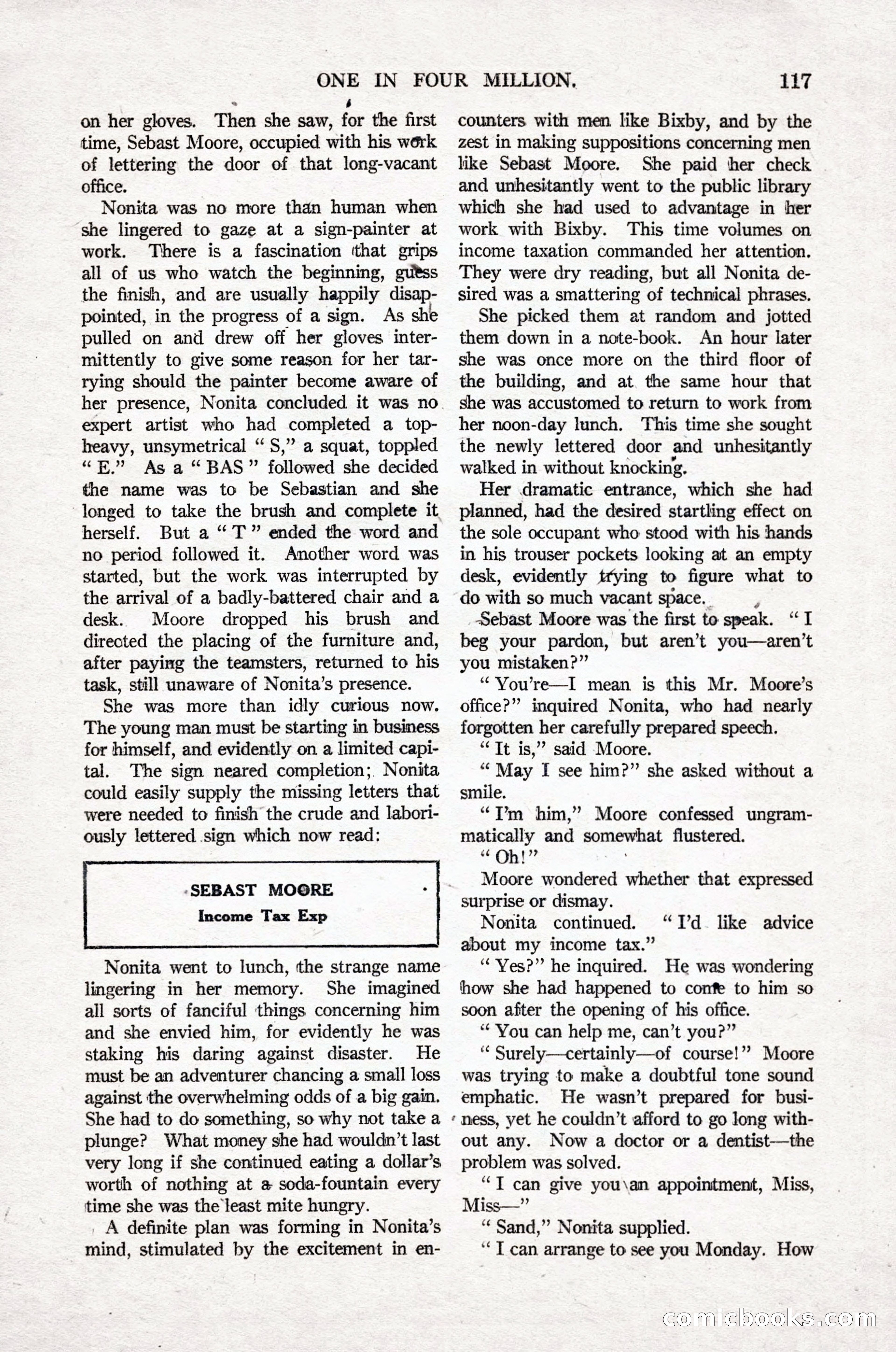
A restored page from Pulp Fiction, 1921. Page through the whole issue in the reader above.
📄 Transcribed text from this page (OCR, searchable)
Machine-transcribed from the original scan — historical spelling and the odd misread are preserved.
ONE IN FOUR MILLION. ° a on her gloves. Then she saw, for the first time, Sebast Moore, occupied with his work of lettering the door of that long-vacant office. Nonita was no more than human when she lingered to gaze at a sign-painter at work. There is a fascination ‘that grips all of us who watch the beginning, giiéss the finish, and are usually happily disap- pointed, in the progress of a sign. As she pulled on and drew off her gloves inter- mittently to give some reason for her tar- rying should the painter become aware of her presence, Nonita concluded it was no expert artist who had completed a top- heavy, unsymetrical “S$,” a squat, toppled “FE.” As a “BAS” followed she decided the name was to be Sebastian and she longed to take the brush and complete it herself. But a “T” ended the word and no period followed it. Another word was started, but the work was interrupted by the arrival of a badly-battered chair and a desk. Moore dropped his brush and directed the placing of the furniture and, after paying the teamsters, returned to his task, still unaware of Nonita’s presence. She was more than idly curious now. The young man must be starting in business for himself, and evidently on a limited capi- tal. The sign neared completion;. Nonita could easily supply the missing letters that were needed to finish the crude and labori- ously lettered sign which now read: -SEBAST MOORE Income Tax Exp Nonita went to lunch, the strange name lingering in her memory. She imagined all sorts of fanciful things concerning him and she envied him, for evidently he was staking his daring against disaster. He must be an adventurer chancing a small loss against the overwhelming odds of a big gain. She had to do something, so why not take a plunge? What money she had wouldn’t last very long if she continued eating a dollar’s worth of nothing at a soda-fountain every time she was the least mite hungry. _A definite plan was forming in Nonita’s mind, stimulated by the excitement in en- 117 counters with men like Bixby, and by the zest in making suppositions concerning men like Sebast Moore. She paid ther check and unhesitantly went to the public library which she had used to advantage in her work with Bixby. This time volumes on income taxation commanded her attention. They were dry reading, but all Nonita de- sired was a smattering of technical phrases. She picked them at random and jotted them down in a note-book. An hour later she was once more on the third floor of the building, and at. the same hour that she was accustomed to return to work from her noon-day lunch. This time she sought the newly lettered door and unhesitantly walked in without knocking. Her dramatic entrance, which she had planned, had the desired startling effect on the sole occupant who stood with his hands in his trouser pockets looking at an empty desk, evidently trying to figure what to do with so much vacant space. Sebast Moore was the first to speak. yet beg your pardon, but aren’t you—aren’t you mistaken?”’ “‘You’re—I mean is this Mr. Moore’s office?”’ inquired Nonita, who had nearly forgotten her carefully prepared speech. “It is,” said Moore. ““ May I see him?” she asked without a smile. “T’m him,” Moore confessed ungram- matically and somewhat flustered. e¢ Oh! ? Moore wondered whether that expressed surprise or dismay. Nonita continued. about my income tax.” “Yes?” he inquired. He was wondering how she had happened to confe to him so soon afiter the opening of his office. “You can help me, can’t you?” ‘¢ Surely—certainly—of course!” Moore was trying to make a doubtful tone sound emphatic. He wasn’t prepared for busi- ness, yet he couldn’t afford to go long with- out any. Now a doctor or a dentist—the problem was solved. “T can give you\an appointment, Miss, Miss—”’ “Sand,” Nonita supplied. ‘“T can arrange to see you Monday. How “T’d_ like advice CORnICLOO© S (C@ S|