
Pulp Fiction, 1921 · page 133 of 157
Argosy All-Story Weekly, April 16, 1921 — page 133: what you’re looking at
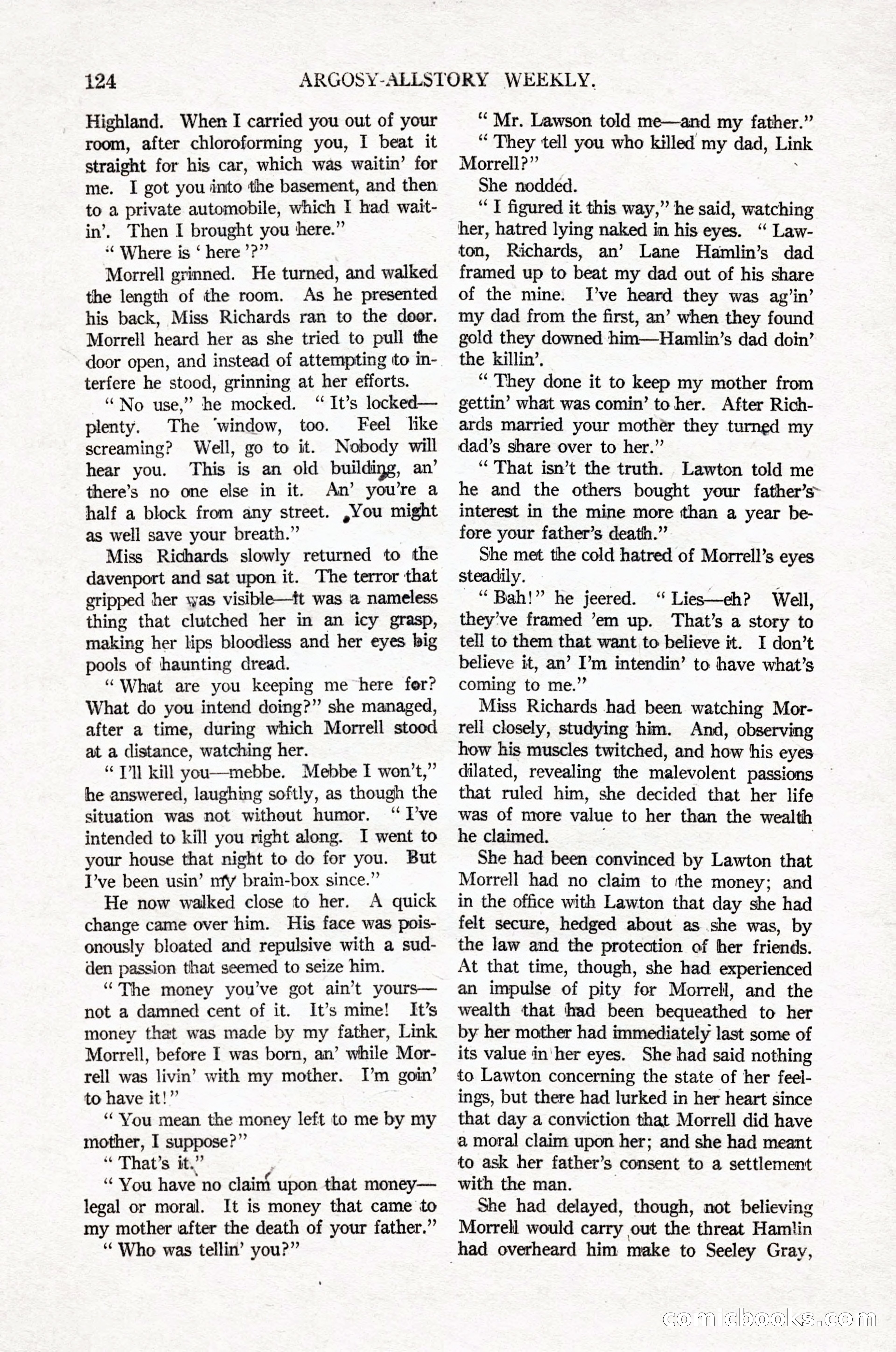
A restored page from Pulp Fiction, 1921. Page through the whole issue in the reader above.
📄 Transcribed text from this page (OCR, searchable)
Machine-transcribed from the original scan — historical spelling and the odd misread are preserved.
124 Highland. When I carried you out of your room, after chloroforming you, I beat it straight for his car, which was waitin’ for me. I got you into the basement, and then to a private automobile, which I had wait- in’. Then I brought you here.” “Where is ‘ here ’?” Morrell grinned. He turned, and walked the length of the room. As he presented his back, Miss Richards ran to the door. Morrell heard her as she tried to pull the door open, and instead of attempting to in- terfere he stood, grinning at her efforts. “No use,” he mocked. “It’s locked— plenty. The ‘window, too. Feel like screaming? Well, go to it. Nobody will hear you. This is an old building, an there’s no one else in it. An’ you're a half a block from any street. ,You might as well save your breath.” Miss Richards slowly returned to the davenport and sat upon it. The terror that gripped her was visible—tt was a nameless thing that clutched her in an icy grasp, making her lips bloodless and her eyes big pools of haunting dread. “What are you keeping me here for? What do you intend doing?” she managed, after a time, during which Morrell stood at a distance, watching her. “ Tl] kill you—mebbe. Mebbe I won’t,” he answered, laughing softly, as though the situation was not without humor. “I’ve intended to kill you right along. I went to your house that night to do for you. But I’ve been usin’ mfy brain-box since.”’ He now walked close to her. A quick change came over him. His face was pois- onously bloated and repulsive with a sud- den passion that seemed to seize him. “The money you’ve got ain’t yours— not a damned cent of it. It’s mme! It’s money that was made by my father, Link Morrell, before I was born, an’ while Mor- rell was livin’ with my mother. I’m goin’ to have it!” “You mean the money left to me by my mother, I suppose?” “That ea “ You have no claint upon that money— legal or moral. It is money that came to my mother after the death of your father.” “Who was tellin’ you?” ARGOSY-ALLSTORY WEEKLY. ‘Mr. Lawson told me—and my father.” ‘‘ They tell you who killed my dad, mies Morrell?” She nodded. ‘T figured it this way,” he said, watching her, hatred lying naked im his eyes. “ Law- ton, Richards, an’ Lane Hamlin’s dad framed up to beat my dad out of his share of the mine. I’ve heard they was ag’in’ my dad from the first, an’ when they found gold they downed him—Hamlin’s dad doin’ the killin’, “They done it to keep my mother from gettin’ what was comin’ to her. After Rich- ards married your mother they turned my dad’s share over to her.” “That isn’t the truth. Lawton told me he and the others bought your father’s interest in the mine more than a year be- fore your father’s death.” She met the cold hatred of Morrell’s eyes steadily. “Bah!” he jeered. “Lies—eh? Well, they’ve framed ’em up. That’s a story to tell to them that want to believe it. I don’t believe it, an’ I’m intendin’ to have what’s coming to me.” Miss Richards had been watching Mor- rell closely, studying him. And, observing how his muscles twitched, and how his eyes dilated, revealing the malevolent passions that ruled him, she decided that her life was of more value to her than the wealth he claimed. She had been convinced by Lawton that Morrell had no claim to the money; and in the office with Lawton that day she had felt secure, hedged about as she was, by the law and the protection of her friends. At that time, though, she had experienced an impulse of pity for Morrell, and the wealth that had been bequeathed to her by her mother had immediately last some of its value in her eyes. She had said nothing to Lawton concerning the state of her feel- ings, but there had lurked in her heart since that day a conviction that Morrell did have a moral claim upon her; and she had meant to ask her father’s consent to a settlement with the man. She had delayed, though, not believing Morrell would carry out the threat Hamlin had overheard him make to Seeley Gray, COmiclbooks C@