
Pulp Fiction, 1921 · page 152 of 157
Argosy All-Story Weekly, April 16, 1921 — page 152: what you’re looking at
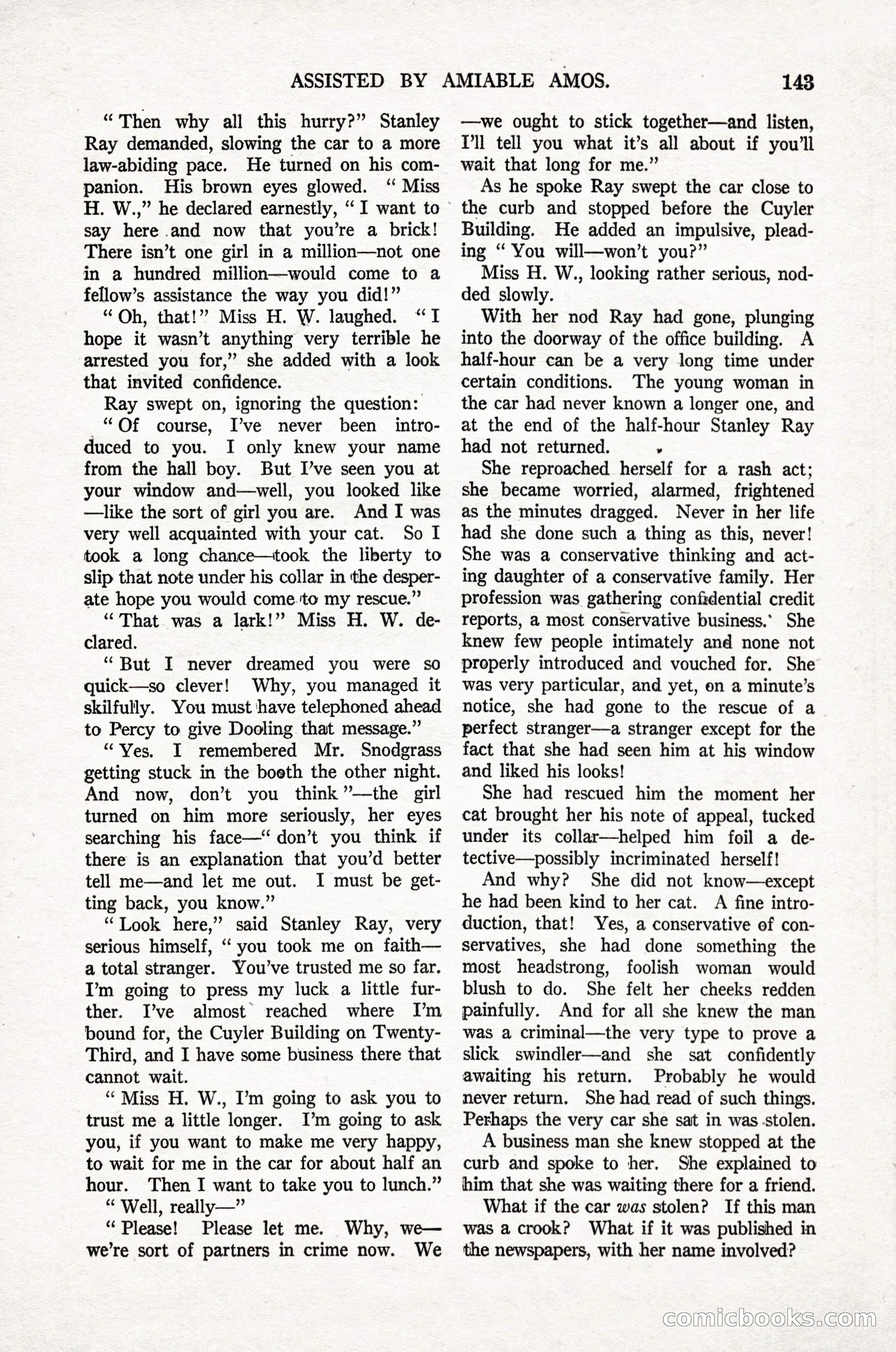
A restored page from Pulp Fiction, 1921. Page through the whole issue in the reader above.
📄 Transcribed text from this page (OCR, searchable)
Machine-transcribed from the original scan — historical spelling and the odd misread are preserved.
ASSISTED BY AMIABLE AMOS. “Then why all this hurry?” Stanley Ray demanded, slowing the car to a more law-abiding pace. He turned on his com- panion. His brown eyes glowed. ‘“ Miss H. W.,” he declared earnestly, ‘I want to say here and now that you’re a brick! There isn’t one girl in a million—not one in a hundred million—would come to a fellow’s assistance the way you did!” “ Oh, that!” Miss H. W. laughed. “I hope it wasn’t anything very terrible he arrested you for,” she added with a look that invited confidence. Ray swept on, ignoring the question: “Of course, I’ve never been intro- duced to you. I only knew your name from the hall boy. But I’ve seen you at your window and—well, you looked like —like the sort of girl you are. And I was very well acquainted with your cat. So I took a long chance—took the liberty to slip that note under his collar in ‘the desper- ate hope you would come.'to my rescue.” “That was a lark!” Miss H. W. de- clared. “But I never dreamed you were so quick—so clever! Why, you managed it skilfully. You must ‘have telephoned ahead to Percy to give Dooling that message.” “Ves. I remembered Mr. Snodgrass getting stuck in the boeth the other night. And now, don’t you think ”—the girl turned on him more seriously, her eyes searching his face—‘ don’t you think if there is an explanation that you’d better tell me—and let me out. I must be get- ting back, you know.” “Look here,’ said Stanley Ray, very serious himself, “ you took me on faith— a total stranger. You’ve trusted me so far. I’m going to press my luck a little fur- ther. I’ve almost reached where I’m bound for, the Cuyler Building on Twenty- Third, and I have some business there that cannot wait. “Miss H. W., I’m going to ask you to trust me a little longer. I’m going to ask you, if you want to make me very happy, to wait for me in the car for about half an hour. Then I want to take you to lunch.” “ Well, really—”’ “Please! Please let me. Why, we— we're sort of partners in crime now. We 148 —we ought to stick together—and listen, T’ll tell you what it’s all about if you’ll wait that long for me.” As he spoke Ray swept the car close to the curb and stopped before the Cuyler Building. He added an impulsive, plead- ing “ You will—won’t you?” Miss H. W., looking rather serious, nod- ded slowly. With her nod Ray had gone, plunging into the doorway of the office building. A half-hour can be a very long time under certain conditions. The young woman in the car had never known a longer one, and at the end of the half-hour Stanley Ray had not returned. , She reproached herself for a rash act; she became worried, alarmed, frightened as the minutes dragged. Never in her life had she done such a thing as this, never! She was a conservative thinking and act- ing daughter of a conservative family. Her profession was gathering confidential credit reports, a most conservative business.’ She knew few people intimately and none not properly introduced and vouched for. She was very particular, and yet, on a minute’s notice, she had gone to the rescue of a perfect stranger—a stranger except for the fact that she had seen him at his window and liked his looks! She had rescued him the moment her cat brought her his note of appeal, tucked under its collar—helped him foil a de- tective—possibly incriminated herself! And why? She did not know—except he had been kind to her cat. A fine intro- duction, that! Yes, a conservative of con- servatives, she had done something the most headstrong, foolish woman would blush to do. She felt her cheeks redden painfully. And for all she knew the man was a criminal—the very type to prove a slick swindler—and she sat confidently awaiting his return. Probably he would never return. She had read of such things. Perhaps the very car she sat in was stolen. A business man she knew stopped at the curb and spoke to her. She explained to him that she was waiting there for a friend. What if the car was stolen? If this man was a crook? What if it was published in the newspapers, with her name involved? CORMICLOO S (C@ S|