
Pulp Fiction, 1921 · page 17 of 157
Argosy All-Story Weekly, April 16, 1921 — page 17: what you’re looking at
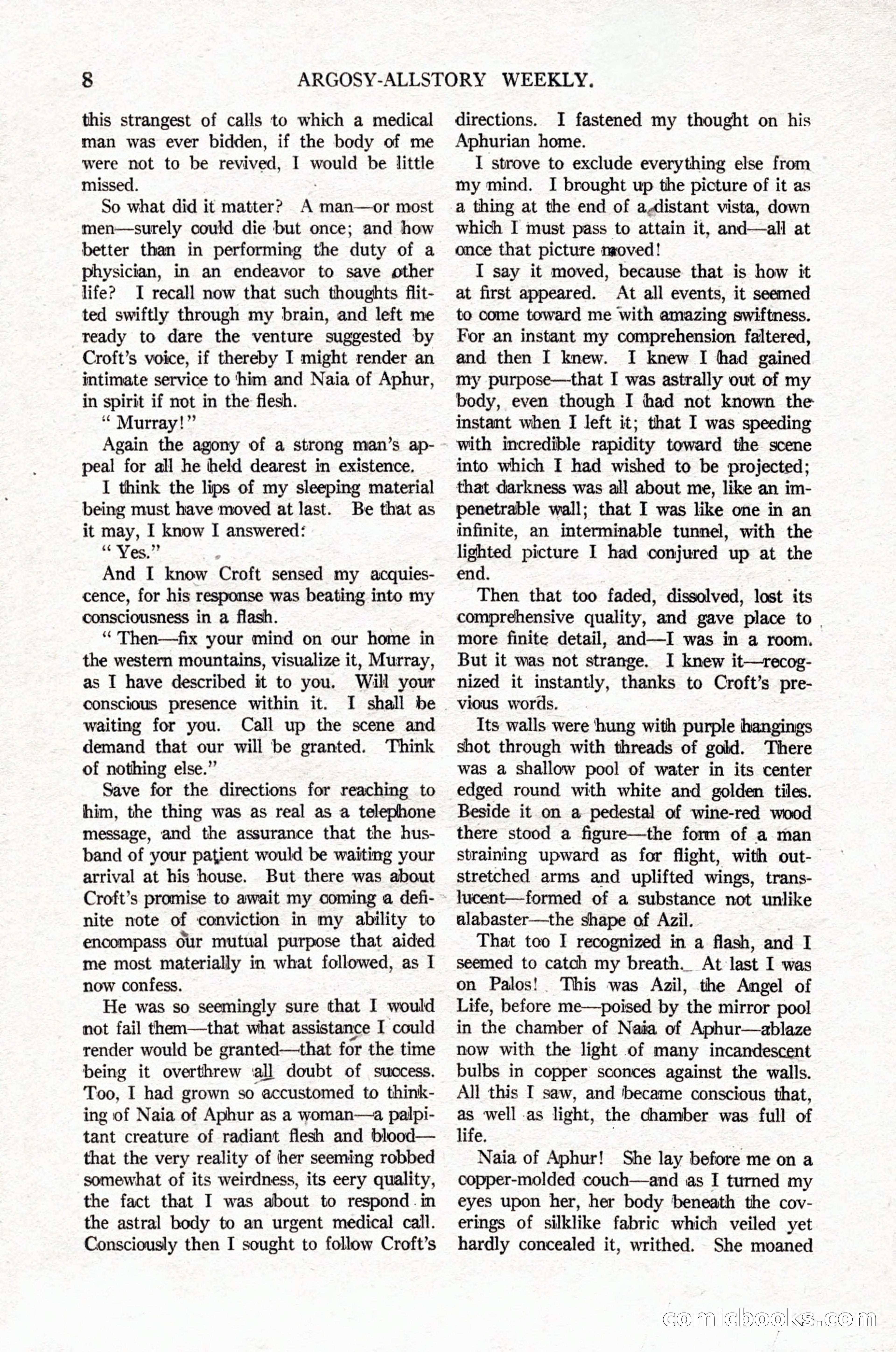
A restored page from Pulp Fiction, 1921. Page through the whole issue in the reader above.
📄 Transcribed text from this page (OCR, searchable)
Machine-transcribed from the original scan — historical spelling and the odd misread are preserved.
8 ARGOSY-ALLSTORY WEEKLY. this strangest of calls to which a medical man was ever bidden, if the body of me were not to be revived, I would be little missed. So what did it matter? A man—or most men—surely could die but once; and how better than in performing the duty of a physician, in an endeavor to save other life? I recall now that such thoughts flit- ted swiftly through my brain, and left me ready to dare the venture suggested by Croft’s voice, if thereby I might render an intimate service to ‘him and Naia of Aphur, in spirit if not in the flesh. ‘* Murray!”’ Again the agony of a strong man’s ap- peal for all he held dearest in existence. I think the lips of my sleeping material being must have moved at last. Be that as it may, I know I answered: ce Yes.”’ : And I know Croft sensed my acquies- cence, for his response was beating into my consciousness in a flash. “ Then—fix your mind on our home in the western mountains, visualize it, Murray, as I have described it to you. Will your conscious presence within it. I shall be waiting for you. Call up the scene and demand that our will be granted. Think of nothing else.” Save for the directions for reaching to him, the thing was as real as a telephone message, and the assurance that the hus- band of your patient would be waiting your arrival at his house. But there was about Croft’s promise to await my coming a defi- nite note of conviction in my ability to encompass our mutual purpose that aided me most materially in what followed, as I now confess. He was so seemingly sure that I would not fail them—that what assistance I could render would be granted—that for the time being it overthrew all doubt of suocess. Too, I had grown so accustomed to think- ing of Naia of Aphur as a woman—a palpi- tant creature of radiant flesh and blood— that the very reality of her seeming robbed somewhat of its weirdness, its eery quality, the fact that I was about to respond. in the astral body to an urgent medical call. Consciously then I sought to follow Croft’s directions. I fastened my thought on his Aphurian home. I strove to exclude everything else from my mind. I brought up the picture of it as a thing at the end of adistant vista, down which I must pass to attain it, and—all at once that picture moved! I say it moved, because that is how it at first appeared. At all events, it seemed to come toward me with amazing swiftness. For an instant my comprehension faltered, and then I knew. I knew I had gained my purpose—that I was astrally out of my body, even though I had not known the instant when I left it; that I was speeding with incredible rapidity toward the scene into which I had wished to be projected; that darkness was all about me, like an im- penetrable wall; that I was like one in an infinite, an interminable tunnel, with the lighted picture I had conjured up at the end. Then that too faded, dissolved, lost its comprehensive quality, and gave place to more finite detail, and—I was in a room. But it was not strange. I knew it—recog- nized it instantly, thanks to Croft’s pre- vious words. Its walls were hung with purple hangings shot through with threads of gold. There was a shallow pool of water in its center edged round with white and golden tiles. Beside it on a pedestal of wine-red wood there stood a figure—the form of a man straining upward as for flight, with out-— stretched arms and uplifted wings, trans- lucent—formed of a substance not unlike alabaster—the shape of Azil. That too I recognized in a flash, and I seemed to catch my breath. At last I was on Palos! This was Azil, the Angel of Life, before me—poised by the mirror pool in the chamber of Naia of Aphur—ablaze now with the light of many incandescent bulbs in copper sconces against the walls. All this I saw, and ‘became conscious that, as well as light, the chamber was full of life. : Naia of Aphur! She lay before me on a copper-molded couch—and as I turned my eyes upon her, her body beneath the cov- erings of silklike fabric which veiled yet hardly concealed it, writhed. She moaned C© = A DOO C©