
Pulp Fiction, 1921 · page 22 of 157
Argosy All-Story Weekly, April 16, 1921 — page 22: what you’re looking at
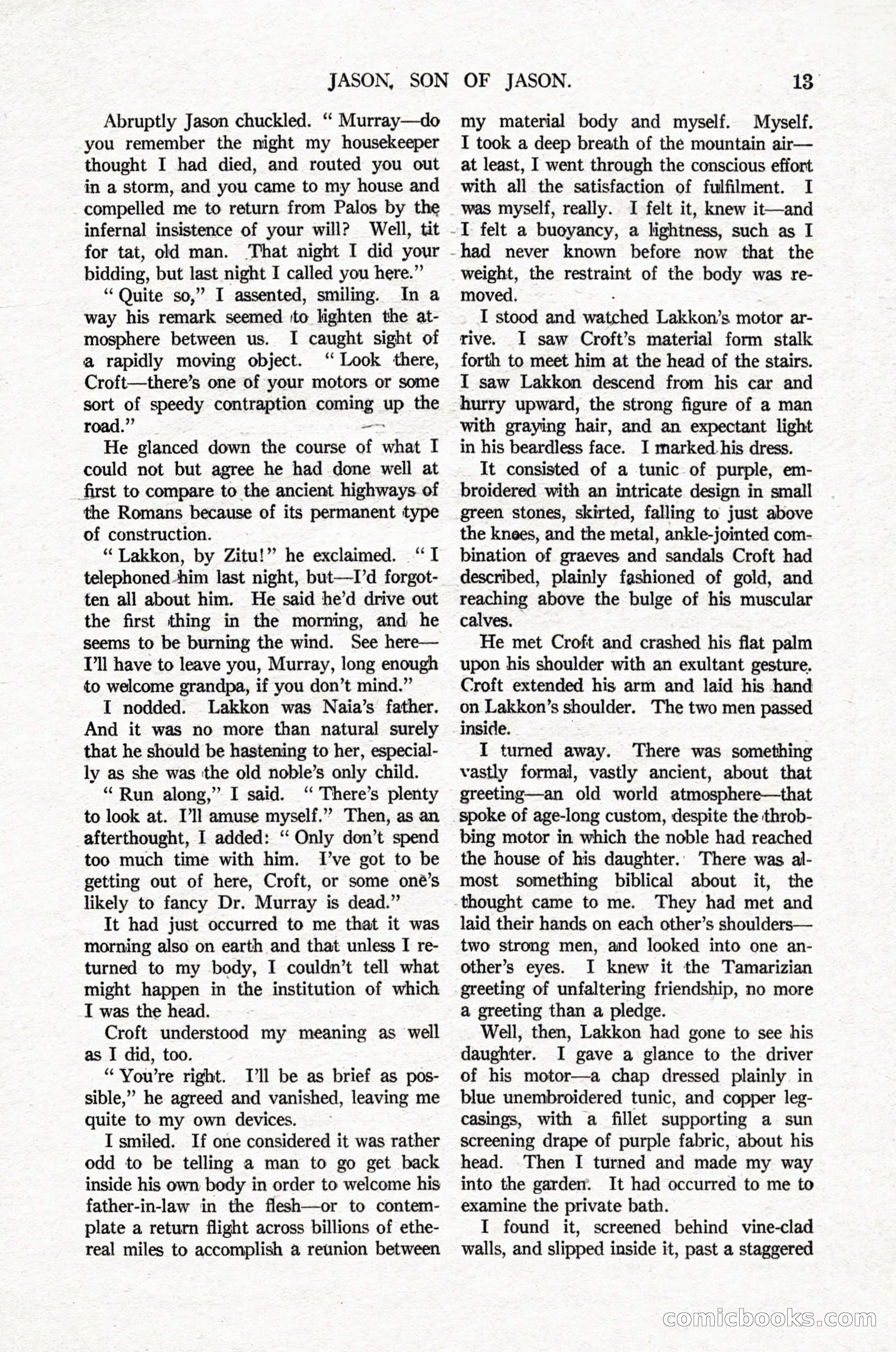
A restored page from Pulp Fiction, 1921. Page through the whole issue in the reader above.
📄 Transcribed text from this page (OCR, searchable)
Machine-transcribed from the original scan — historical spelling and the odd misread are preserved.
JASON, SON Abruptly Jason chuckled. “ Murray—do you remember the night my housekeeper thought I had died, and routed you out in a storm, and you came to my house and compelled me to return from Palos by the infernal insistence of your will? Well, tit for tat, old man. That night I did your bidding, but last night I called you here.”’ “‘ Quite so,” I assented, smiling. In a way his remark seemed ito lighten the at- mosphere between us. I caught sight of a rapidly moving object. ‘ Look there, Croft—there’s one of your motors or some sort of speedy contraption coming up the road.” -— He glanced down the course of what I could not but agree he had done well at first to compare to the ancient highways of the Romans because of its permanent type of construction. “ Lakkon, by Zitu!” he exclaimed. “I telephoned -him last night, but—I’d forgot- ten all about him. He said he’d drive out the first thing in the morning, and he seems to be burning the wind. See here— I'll have to leave you, Murray, long enough to welcome grandpa, if you don’t mind.” I nodded. Lakkon was Naia’s father. And it was no more than natural surely that he should be hastening to her, especial- ly as she was the old noble’s only child. “ Run along,” I said. “ There’s plenty to look at. I’ll amuse myself.” Then, as an afterthought, I added: ‘‘ Only don’t spend too much time with him. I’ve got to be getting out of here, Croft, or some oné’s likely to fancy Dr. Murray is dead.” It had just occurred to me that it was morning also on earth and that unless [ re- turned to my body, I couldn’t tell what might happen in the institution of which I was the head. Croft understood my meaning as well as I did, too. “'You’re right. Ill be as brief as pos- sible,” he agreed and vanished, leaving me quite to my own devices. I smiled. If one considered it was rather odd to be telling a man to go get back inside his own body in order to welcome his father-in-law in the flesh—or to contem- plate a return flight across billions of ethe- real miles to accomplish a reunion between OF JASON. my material body and myself. Myself. I took a deep breath of the mountain air— at least, I went through the conscious effort with all the satisfaction of fulfilment. I was myself, really. I felt it, knew it—and -I felt a buoyancy, a lightness, such as I -had never known before now that the weight, the restraint of the body was re- moved. I stood and watched Lakkon’s motor ar- rive. I saw Croft’s material form stalk forth to meet him at the head of the stairs. I saw Lakkon descend from his car and hurry upward, the strong figure of a man with graying hair, and an expectant light in his beardless face. I marked.his dress. It consisted of a tunic of purple, em- broidered with an intricate design in small green stones, skirted, falling to just above the knees, and the metal, ankle-jointed com- bination of graeves and sandals Croft had described, plainly fashioned of gold, and reaching above the bulge of his muscular calves. He met Croft and crashed his flat palm upon his shoulder with an exultant gesture. Croft extended his arm and laid his hand on Lakkon’s shoulder. The two men passed inside. 3 I turned away. There was something vastly formal, vastly ancient, about that greeting—an old world atmosphere—that spoke of age-long custom, despite the throb- bing motor in which the noble had reached the house of his daughter.. There was al- most something biblical about it, the thought came to me. They had met and laid their hands on each other’s shoulders— two strong men, and looked into one an- other’s eyes. I knew it the Tamarizian greeting of unfaltering friendship, no more a greeting than a pledge. Well, then, Lakkon had gone to see his daughter. I gave a glance to the driver of his motor—a chap dressed plainly in blue unembroidered tunic, and copper leg- casings, with a fillet supporting a sun screening drape of purple fabric, about his head. Then I turned and made my way into the garden. It had occurred to me to examine the private bath. I found it, screened behind vine-clad walls, and slipped inside it, past a staggered COmiclbooks 15 C@