
Pulp Fiction, 1921 · page 30 of 157
Argosy All-Story Weekly, April 16, 1921 — page 30: what you’re looking at
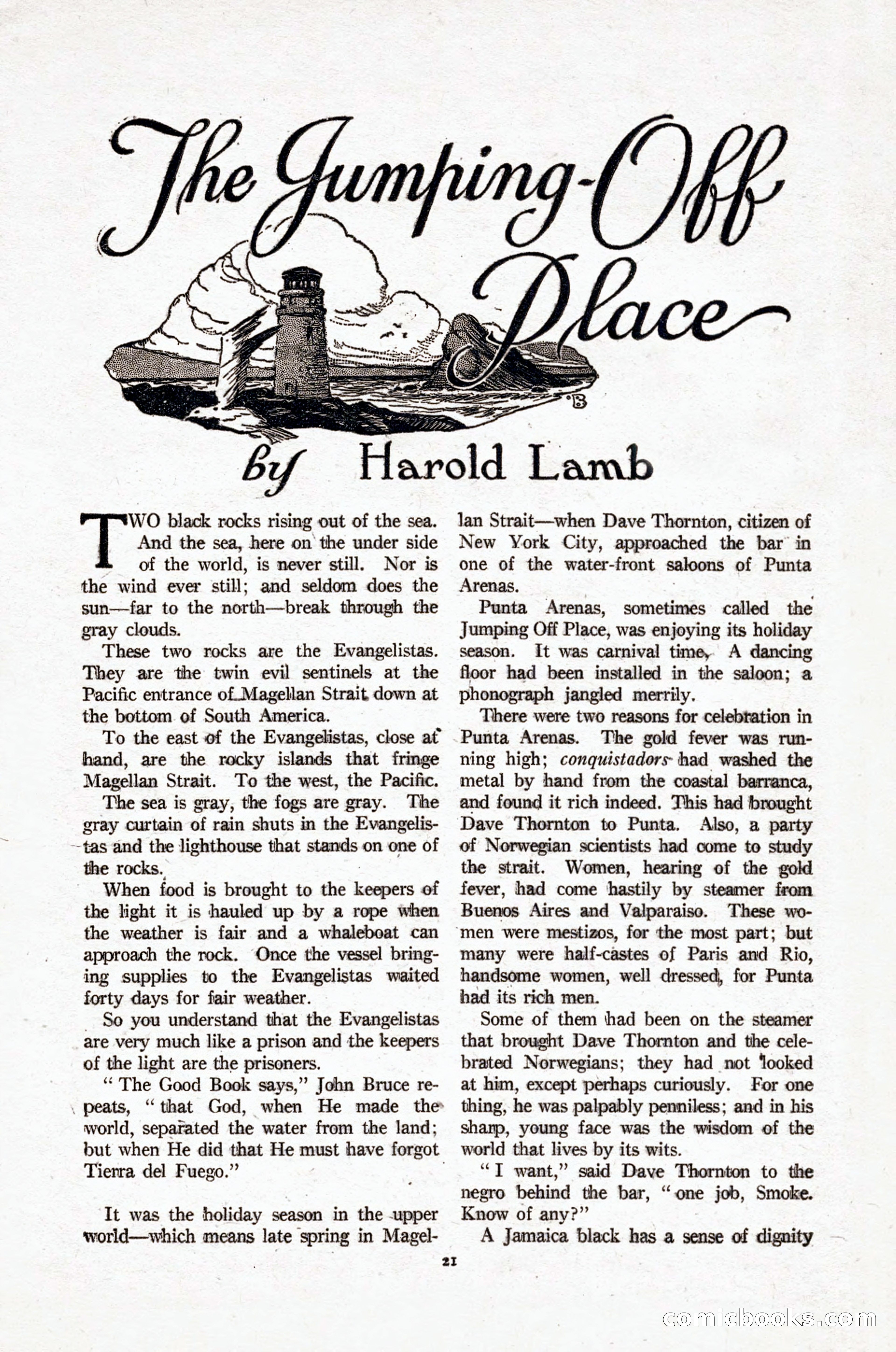
A restored page from Pulp Fiction, 1921. Page through the whole issue in the reader above.
📄 Transcribed text from this page (OCR, searchable)
Machine-transcribed from the original scan — historical spelling and the odd misread are preserved.
WO black rocks rising out of the sea. And the sea, here on the under side of the world, is never still. Nor is the wind ever still; and seldom does the sun—far to the north—break through the gray clouds. These two rocks are the Evangelistas. They are the twin evil sentinels at the Pacific entrance of Magellan Strait down at the bottom of South America. To the east of the Evangelistas, close at hand, are the rocky islands that fringe Magellan Strait. To the west, the Pacific. The sea is gray, the fogs are gray. The gray curtain of rain shuts in the Evangelis- ~tas and the lighthouse that stands on one of the rocks. When food is brought to the ee of the light it is hauled up by a rope when the weather is fair and a whaleboat can approach the rock. Once the vessel bring- ing supplies to the Evangelistas waited forty days for fair weather. _ So you understand that the Evangelistas are very much like a prison and the keepers of the light are the prisoners. “The Good Book says,” John Bruce re- . peats, “that God, when He made the world, separated the water from the land; but when He did that He must have forgot Tierra del Fuego.” | It was the holiday season in the -upper world—which means late spring in Magel- Be Hawald Gerd lan Strait—when Dave Thornton, citizen of New York City, approached the bar in one of the water-front saloons of Punta Arenas. Punta Arenas, sometimes called the Jumping Off Place, was enjoying its holiday season. It was carnival time, A dancing floor had been installed in the saloon; a phonograph jangled merrily. There were two reasons for celebtation in Punta Arenas. The gold fever was run- ning high; conquistadors had washed the metal by hand from the coastal barranca, and found it rich indeed. This had brought Dave Thornton to Punta. Also, a party of Norwegian scientists had come to study the strait. Women, hearing of the gold fever, had come hastily by steamer from Buenos Aires and Valparaiso. These wo- ‘men were mestizos, for the most part; but many were half-castes of Paris and Rio, handsome women, well dressed, for Punta had its rich men. Some of them had been on the steamer that brought Dave Thornton and the cele- brated Norwegians; they had not ‘looked at him, except perhaps curiously. For one thing, he was palpably penniless; and in his shanp, young face was the wisdom of the world that lives by its wits. ‘““T want,” said Dave Thornton to the negro behind the bar, “one job, Smoke. Know of any?” A Jamaica black has a sense of dignity 21 Go NOOK C@