
Pulp Fiction, 1921 · page 73 of 157
Argosy All-Story Weekly, April 16, 1921 — page 73: what you’re looking at
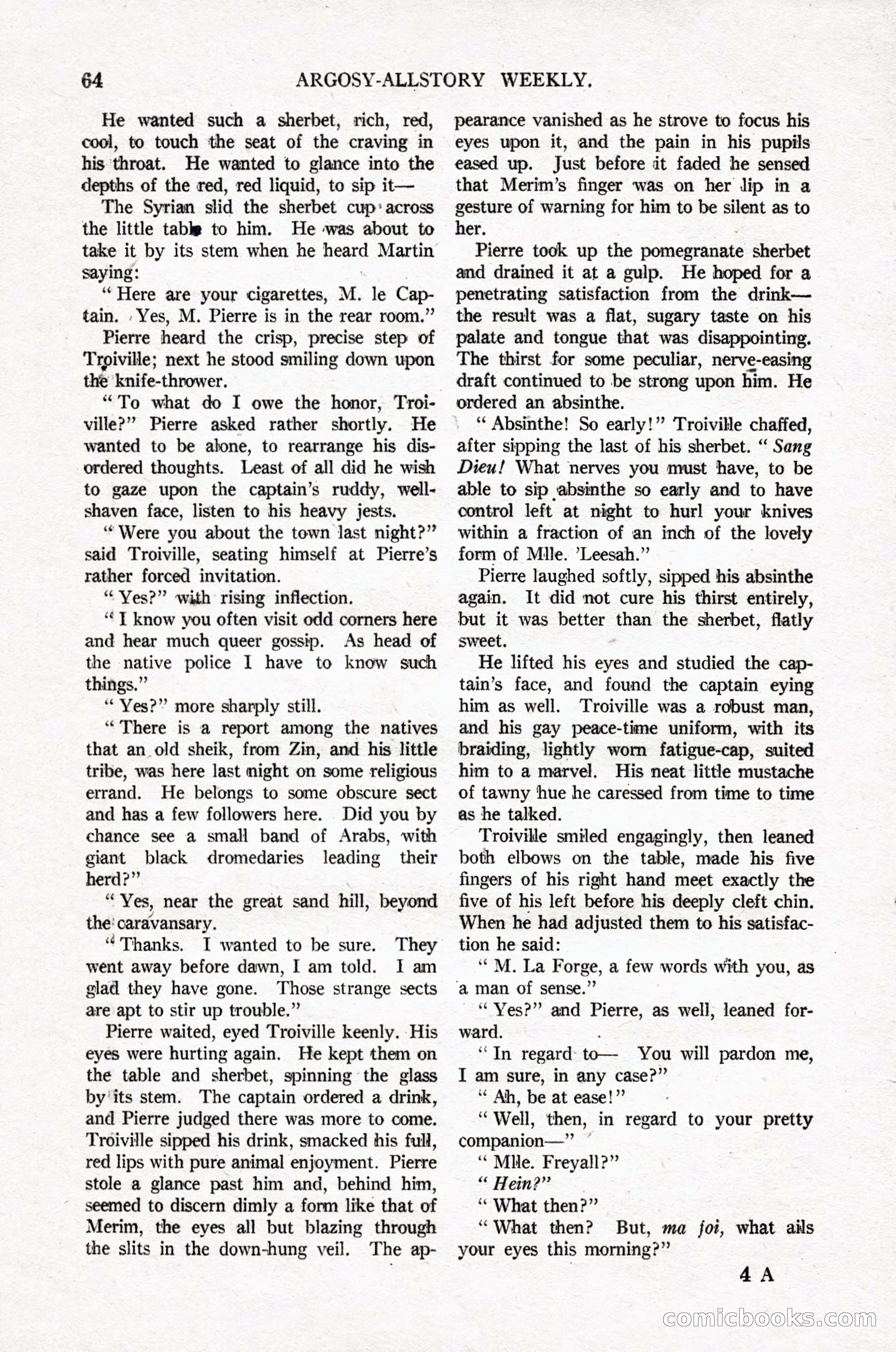
A restored page from Pulp Fiction, 1921. Page through the whole issue in the reader above.
📄 Transcribed text from this page (OCR, searchable)
Machine-transcribed from the original scan — historical spelling and the odd misread are preserved.
64 He wanted such a sherbet, rich, red, cool, to touch the seat of the craving in his throat. He wanted to glance into the depths of the red, red liquid, to sip it— The Syrian slid the sherbet cup’ across the little table to him. He was about to take it by its stem when he heard Martin saying: : ‘““Here are your cigarettes, M. le Cap- tain. Yes, M. Pierre is in the rear room.” Pierre heard the crisp, precise step of Trpiville; next he stood smiling down upon the knife-thrower. “To what do I owe the honor, Troi- ville?” Pierre asked rather shortly. He wanted to be alone, to rearrange his dis- ordered thoughts. Least of all did he wish to gaze upon the captain’s ruddy, well- shaven face, listen to his heavy jests. “Were you about the town last night?” said Troiville, seating himself at Pierre’s rather forced invitation. ““'Yes?” with rising inflection. “I know you often visit odd corners here and hear much queer gossip. As head of the native police 1 have to know such things.” “Yes?” more sharply still. “There is a report among the natives that an old sheik, from Zin, and his little tribe, was here last night on some religious errand. He belongs to some obscure sect and has a few followers here. Did you by chance see a small band of Arabs, with giant black dromedaries leading their herd?” “Yes, near the great sand hill, beyond the‘ caravansary. “Thanks. I wanted to be sure. went away before dawn, I am told. I am glad they have gone. Those strange sects are apt to stir up trouble.” Pierre waited, eyed Troiville keenly. His eyes were hurting again. He kept them on the table and sherbet, spinning the glass by'its stem. The captain ordered a drink, and Pierre judged there was more to come. Troiville sipped his drink, smacked his full, red lips with pure animal enjoyment. Pierre stole a glance past him and, behind him, seemed to discern dimly a form like that of Merim, the eyes all but blazing through the slits in the down-hung veil. The ap- They ARGOSY-ALLSTORY WEEKLY, pearance vanished as he strove to focus his eyes upon it, and the pain in his pupils eased up. Just before it faded he sensed that Merim’s finger was on her lip in a gesture of warning for him to be silent as to her. . Pierre took up the pomegranate sherbet and drained it at a gulp. He hoped for a penetrating satisfaction from the drink— the result was a flat, sugary taste on his palate and tongue that was disappointing. The thirst for some peculiar, nerve-easing draft continued to be strong upon him. He ordered an absinthe. ‘“* Absinthe! So early!” Troiville chaffed, after sipping the last of his sherbet. “‘ Sang Dieu! What nerves you must have, to be able to sip absinthe so early and to have control left at night to hurl your knives within a fraction of an inch of the lovely form of Mile. ’Leesah.” Pierre laughed softly, sipped his absinthe again. It did not cure his thirst entirely, but it was better than the sherbet, flatly sweet. He lifted his eyes and studied the cap- tain’s face, and found the captain eying him as well. ‘Troiville was a robust man, and his gay peace-time uniform, with its braiding, lightly worn fatigue-cap, suited him to a marvel. His neat little mustache of tawny hue he caressed from time to time as he talked. Troiville smiled engagingly, then leaned both elbows on the table, made his five fingers of his right hand meet exactly the five of his left before his deeply cleft chin. When he had adjusted them to his satisfac- tion he said: ‘“'M. La Forge, a few words with you, as ‘a man of sense.” “Yes?” and Pierre, as well, leaned for- ward. ; “In regard: to— You will pardon me, IT am sure, in any case?” ‘* Ah, be at ease!” ‘Well, then, in regard to your pretty companion—” ~ “Mile. Freyall?” “< Hein?” ‘“* What then?” “What then? But, ma fot, what ails your eyes this morning?” 4A COMicoOolkkS C©