
Pulp Fiction, 1921 · page 82 of 157
Argosy All-Story Weekly, April 16, 1921 — page 82: what you’re looking at
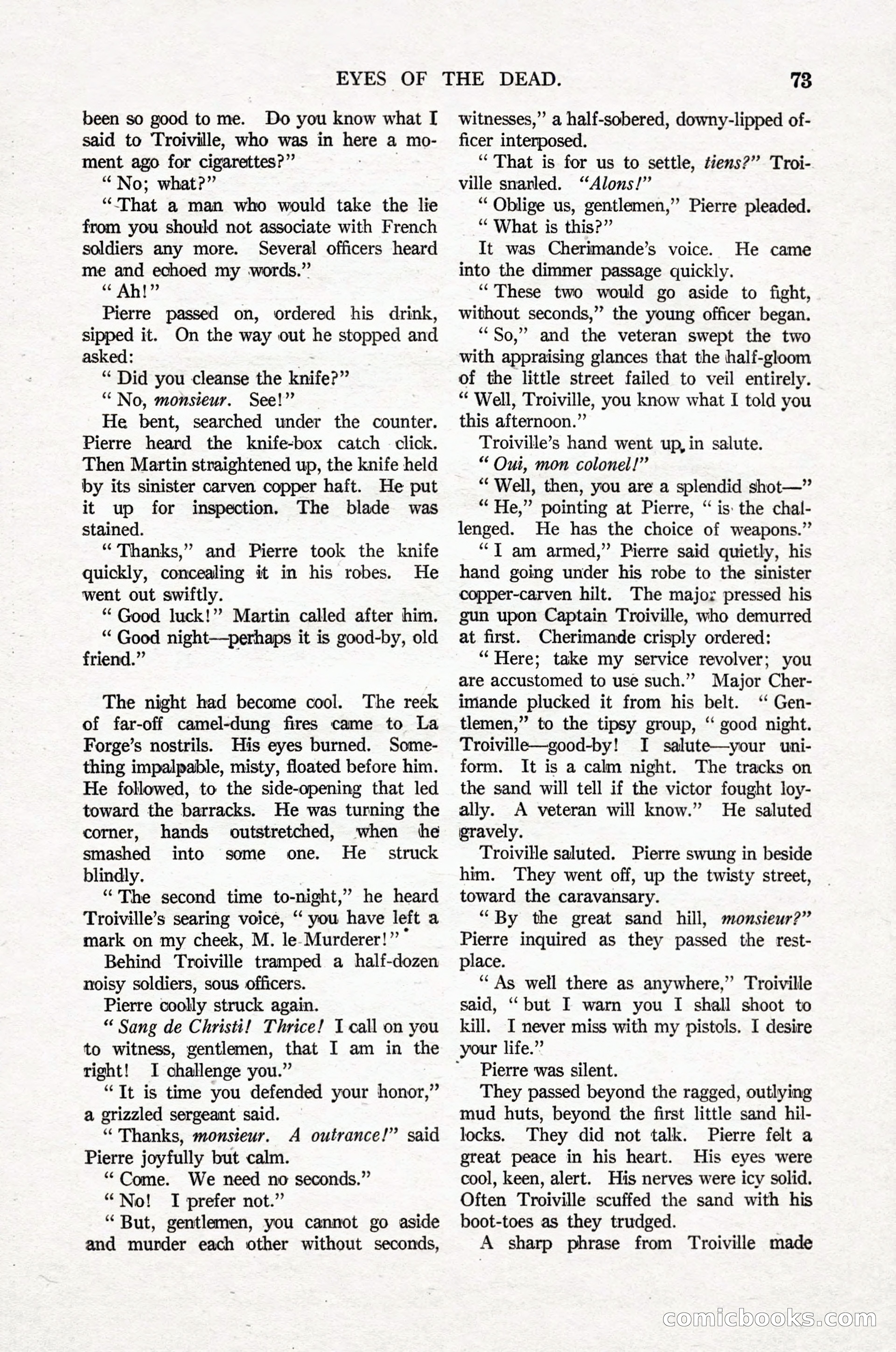
A restored page from Pulp Fiction, 1921. Page through the whole issue in the reader above.
📄 Transcribed text from this page (OCR, searchable)
Machine-transcribed from the original scan — historical spelling and the odd misread are preserved.
EYES OF THE DEAD. been so good to me. Do you know what I said to Troiville, who was in here a mo- ment ago for cigarettes?”’ 7 “No; what?” “That a man who would take the lie from you should not associate with French soldiers any more. Several officers heard me and echoed my words.” 74 Ah! 9? Pierre passed on, ordered his drink, sipped it. On the way out he stopped and asked: = | “ Did you cleanse the knife?” “No, monsieur. See!” | He bent, searched under the counter. Pierre heard the knife-box catch click. Then Martin straightened up, the knife held by its sinister carven copper haft. He put it up for inspection. The blade was stained. “Thanks,” and Pierre took the knife quickly, concealing it in his robes. He went out swiftly. “ Good luck!” Martin called after him. “ Good night—perhaps it is good-by, old friend.” The night had become cool. The reek of far-off camel-dung fires came to La Forge’s nostrils. His eyes burned. Some- thing impalpable, misty, floated before him. He followed, to the side-opening that led toward the barracks. He was turning the corner, hands outstretched, when he smashed into some one. He struck blindly. “The second time to-night,” he heard Troiville’s searing voice, ‘“‘ you have left a mark on my cheek, M. le- Murderer!” Behind Troiville tramped a half-dozen noisy soldiers, sous officers. Pierre coolly struck again. “ Sang de Christi! Thrice! I call on you to witness, gentlemen, that I am in the right! I challenge you.” “Tt is time you defended your honor,” a grizzled sergeant said. “ Thanks, monsieur. A outrance!” said Pierre joyfully but calm. “Come. We need no seconds.” “No! I prefer not.” “ But, gentlemen, you cannot go aside and murder each other without seconds, 13 witnesses,” a half-sobered, downy-lipped of- ficer interposed. “That is for us to settle, tiens?” Troi- ville snarled. ‘“Alons!” “Oblige us, gentlemen,” Pierre pleaded. “What is this?” It was Cherimande’s voice. into the dimmer passage quickly. “These two would go aside to fight, without seconds,” the young officer began. “So,” and the veteran swept the two with appraising glances that the half-gloom of the little street failed to veil entirely. “ Well, Troiville, you know what I told you this afternoon.” Troiville’s hand went up, in salute. “Oui, mon colonel!” “Well, then, you are a splendid shot—” “ He,” pointing at Pierre, “ is: the chal- lenged. He has the choice of weapons.” “IT am armed,” Pierre said quietly, his hand going under his robe to the sinister copper-carven hilt. The major pressed his gun upon Captain Troiville, who demurred at first. Cherimande crisply ordered: ‘“‘ Here; take my service revolver; you are accustomed to use such.”’ Major Cher- imande plucked it from his belt. ‘“ Gen- tlemen,” to the tipsy group, “ good night. Troiville—good-by! I salute—your uni- form. It is a calm night. The tracks on the sand will tell if the victor fought loy- ally. <A veteran will know.” He saluted gravely. Troiville saluted. Pierre swung in beside him. They went off, up the twisty street, toward the caravansary. “By the great sand hill, monsieur?” Pierre inquired as they passed the rest- place. “As well there as anywhere,” Troiville said, “but I warn you I shall shoot to kill. I never miss with my pistols. I desire He came your life.” Pierre was silent. They passed beyond the ragged, outlying mud huts, beyond the first little sand hil- locks. They did not talk. Pierre felt a great peace in his heart. His eyes were cool, keen, alert. His nerves were icy solid. Often Troiville scuffed the sand with his boot-toes as they trudged. A sharp phrase from Troiville made Go DOOK (C@ S|