
Pulp Fiction, 1921 · page 88 of 157
Argosy All-Story Weekly, April 16, 1921 — page 88: what you’re looking at
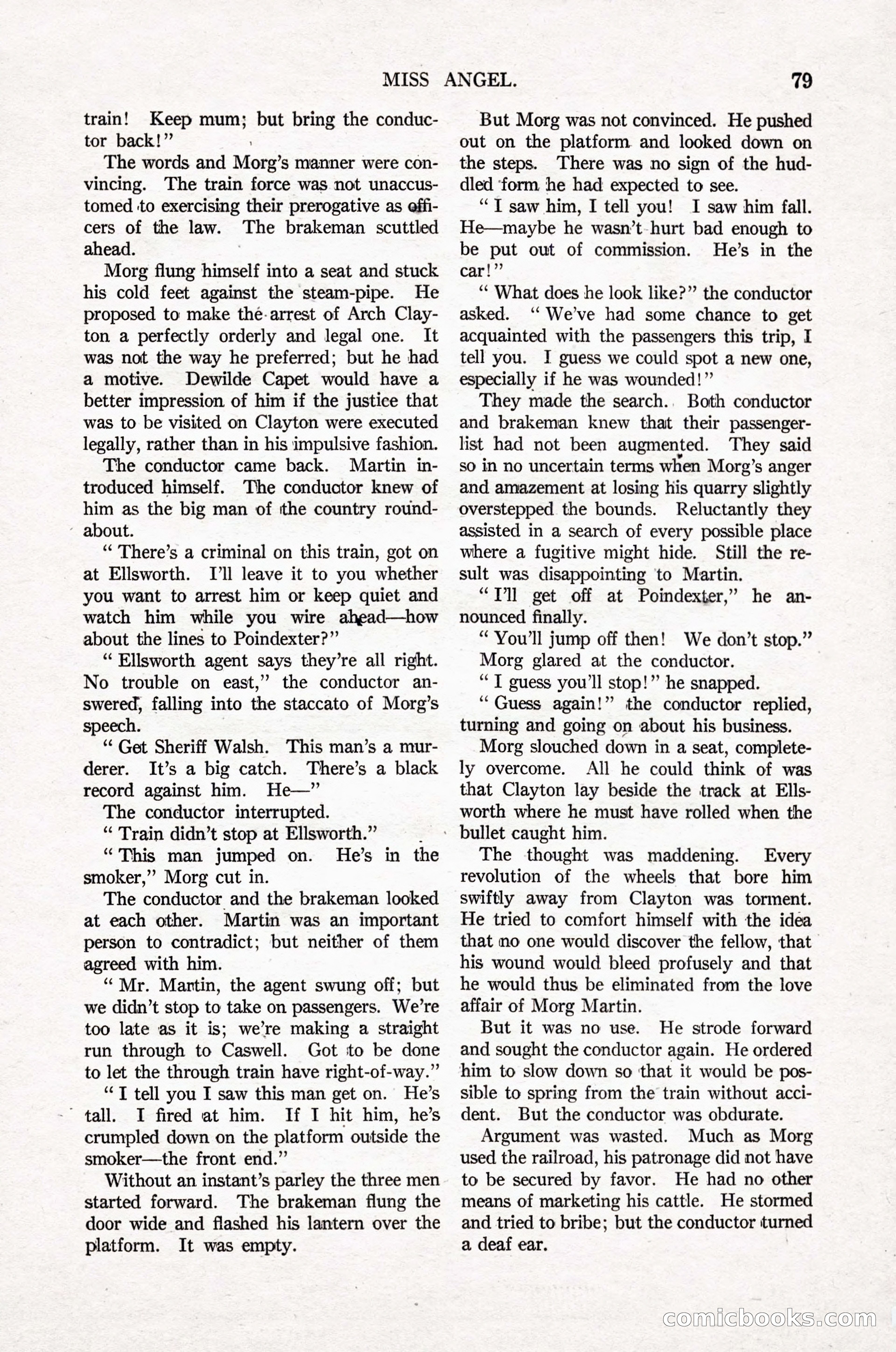
A restored page from Pulp Fiction, 1921. Page through the whole issue in the reader above.
📄 Transcribed text from this page (OCR, searchable)
Machine-transcribed from the original scan — historical spelling and the odd misread are preserved.
MISS ANGEL. train! Keep mum; but bring the conduc- tor back!” ; The words and Morg’s manner were con- vincing. The train force was not unaccus- tomed ‘to exercising their prerogative as effi- cers of the law. The brakeman scuttled ahead. 7 Morg flung himself into a seat and stuck his cold feet against the steam-pipe. He proposed to make the-arrest of Arch Clay- ton a perfectly orderly and legal one. It was not the way he preferred; but he had a motive. Dewilde Capet would have a better impression of him if the justice that was to be visited on Clayton were executed legally, rather than in his impulsive fashion. The conductor came back. Martin in- troduced himself. The conductor knew of him as the big man of ithe country round- ~ about. “ There’s a criminal on this train, got on at Ellsworth. I'll leave it to you whether you want to arrest him or keep quiet and watch him while you wire ahead—how about the lines to Poindexter?” “ Ellsworth agent says they’re all right. No trouble on east,” the conductor an- swered, falling into the staccato of Morg’s speech. “* Get Sheriff Walsh. This man’s a mur- derer. It’s a big catch. There’s a black record against him. He—” The conductor interrupted. “ Train didn’t stop at Ellsworth.” : “ This man jumped on. He’s in the smoker,’’ Morg cut in. The conductor and the brakeman looked at each other. Martin was an important person to contradict; but neither of them agreed with him. “Mr. Martin, the agent swung off; but we didn’t stop to take on passengers. We’re too late as it is; we’re making a straight run through to Caswell. Got ito be done to let the through train have right-of-way.” “T tell you I saw this man get on. He’s tall. I fired at him. If I hit him, he’s crumpled down on the platform outside the smoker—the front end.” Without an instant’s parley the three men started forward. The brakeman flung the door wide and flashed his lantern over the platform. It was empty. 79 But Morg was not convinced. He pushed out on the platform and looked down on the steps. There was no sign of the hud- dled ‘form he had expected to see. “T saw him, I tell you! I saw him fall. He—maybe he wasn’t hurt bad enough to be put out of commission. He’s in the car!” ‘‘ What does he look like?” the conductor asked. ‘‘ We’ve had some chance to get acquainted with the passengers this trip, I tell you. I guess we could spot a new one, especially if he was wounded!” They made the search.. Both conductor and brakeman knew that their passenger- list had not been augmented. They said so in no uncertain terms when Morg’s anger and amazement at losing his quarry slightly overstepped the bounds. Reluctantly they assisted in a search of every possible place where a fugitive might hide. Still the re- sult was disappointing to Martin. “Tl get off at Poindexter,” he an- nounced finally. “You'll jump off then! We don’t stop.” Morg glared at the conductor. ‘“T guess you'll stop!” he snapped. “Guess again!” the conductor replied, turning and going on about his business. Morg slouched down in a seat, complete- ly overcome. All he could think of was that Clayton lay beside the track at Ells- worth where he must have rolled when the ' bullet caught him. The thought was maddening. Every revolution of the wheels that bore him swiftly away from Clayton was torment. He tried to comfort himself with the idea that no one would discover the fellow, that his wound would bleed profusely and that he would thus be eliminated from the love affair of Morg Martin. But it was no use. He strode forward and sought the conductor again. He ordered him to slow down so that it would be pos- sible to spring from the train without acci- dent. But the conductor was obdurate. Argument was wasted. Much as Morg used the railroad, his patronage did not have to be secured by favor. He had no other means of marketing his cattle. He stormed and tried to bribe; but the conductor turned a deaf ear. Go DOOLK (C@ S|