
Pulp Fiction, 1921 · page 90 of 157
Argosy All-Story Weekly, April 16, 1921 — page 90: what you’re looking at
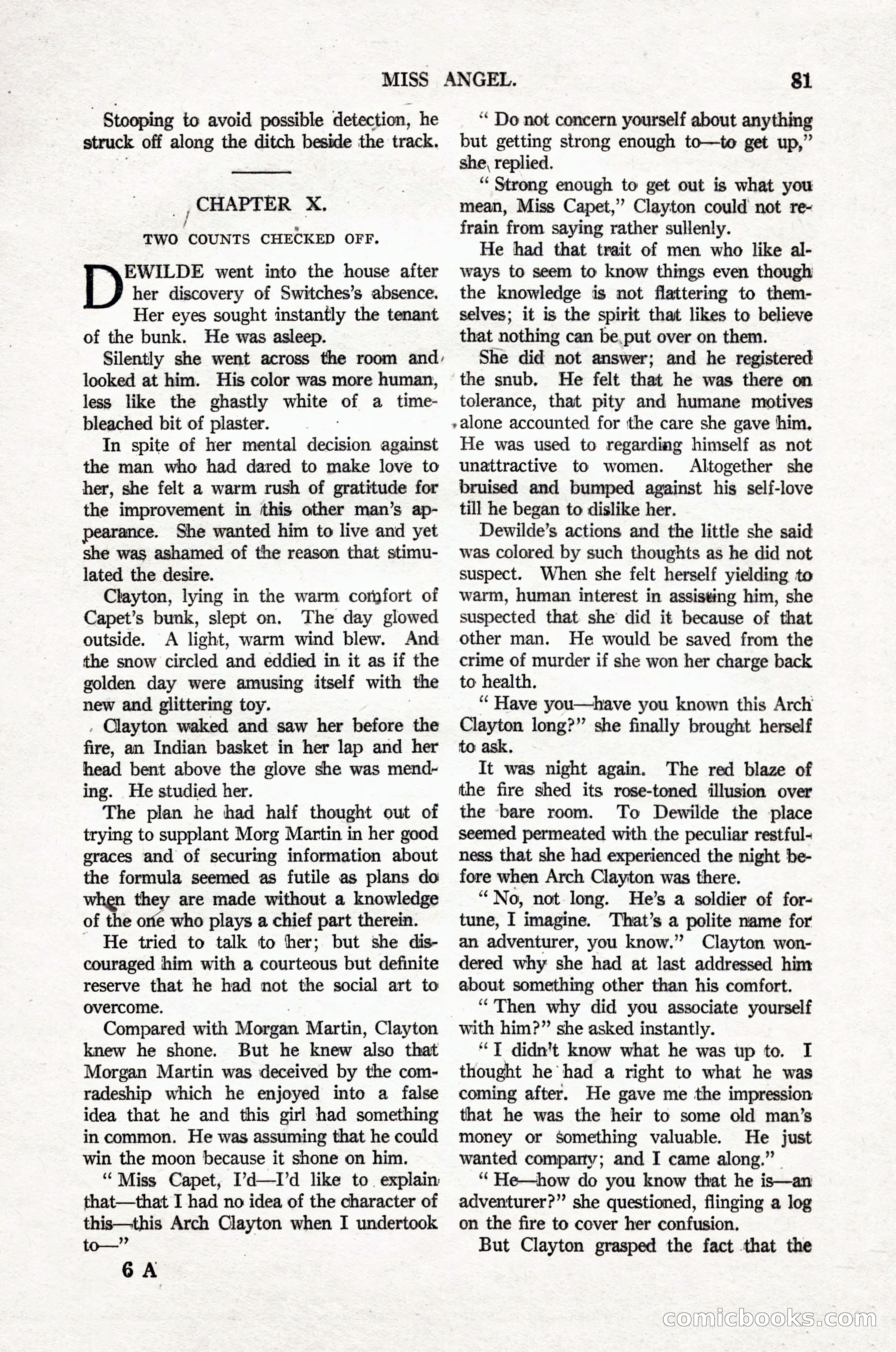
A restored page from Pulp Fiction, 1921. Page through the whole issue in the reader above.
📄 Transcribed text from this page (OCR, searchable)
Machine-transcribed from the original scan — historical spelling and the odd misread are preserved.
MISS ANGEL. : Stooping to avoid possible detection, he struck off along the ditch beside the track. | , CHAPTER X, TWO COUNTS CHECKED OFF. EWILDE went into the house after her discovery of Switches’s absence. Her eyes sought instantly the tenant of the bunk. He was asleep. Silently she went across the room and, looked at him. His color was more human, less like the ghastly white of a time- bleached bit of plaster. In spite of her mental decision against the man who had dared to make love to her, she felt a warm rush of gratitude for the improvement in this other man’s ap- pearance. She wanted him to live and yet she was ashamed of the reason that stimu- lated the desire. Clayton, lying in the warm corgfort of Capet’s bunk, slept on. The day glowed outside. A light, warm wind blew. And the snow circled and eddied in it as if the golden day were amusing itself with the new and glittering toy. : . Clayton waked and saw her before the fire, an Indian basket in her lap and her head bent above the glove she was mend- ing. He studied her. The plan he had half thought out of trying to supplant Morg Martin in her good graces and of securing information about the formula seemed as futile as plans do when they are made without a knowledge of the orie who plays a chief part therein. - He tried to talk to ther; but she dis- couraged him with a courteous but definite reserve that he had not the social art to overcome. | Compared with Morgan Martin, Clayton knew he shone. But he knew also that Morgan Martin was deceived by the com- radeship which he enjoyed into a false idea that he and this girl had something in common. He was assuming that he could win the moon because it shone on him. “Miss Capet, I’d—I’d like to. explain that—that I had no idea of the character of this—this Arch Clayton when I undertook to— ’’ 6A 81 ‘Do not concern yourself about anything but getting strong enough to—te get up,” she, replied. “Strong enough to get out is what you mean, Miss Capet,” Clayton could not re- frain from saying rather sullenly. He had that trait of men who like al- ways to seem to know things even though the knowledge is not flattering to them- selves; it is the spirit that likes to believe that nothing can be,put over on them. She did not answer; and he registered the snub. He felt that he was there on tolerance, that pity and humane motives -alone accounted for the care she gave him, He was used to regarding himself as not unattractive to women. Altogether she bruised and bumped against his self-love till he began to dislike her. Dewilde’s actions and the little she said was colored by such thoughts as he did not suspect. When she felt herself yielding to warm, human interest in assisting him, she suspected that she did it because of that other man. He would be saved from the crime of murder if she won her charge back to health. “Have you—have you known this Arch Clayton long?” she finally brought herself to ask. It was night again. The red blaze of the fire shed its rose-toned illusion over the bare room. To Dewilde the place seemed permeated with the peculiar restful- ness that she had experienced the night be- fore when Arch Clayton was there. “No, not long. He’s a soldier of for- tune, I imagine. That’s a polite name for an adventurer, you know.” Clayton won- dered why she had at last addressed him about something other than his comfort. “Then why did you associate yourself with him?” she asked instantly. “T didn't know what he was up to. I thought he had a right to what he was coming after. He gave me the impression that he was the heir to some old man’s money or Something valuable. He just wanted comparty; and I came along.” ““He—how do you know that he is—an adventurer?”’ she questioned, flinging a log on the fire to cover her confusion. But Clayton grasped the fact that the COmiclool (C@