
Pulp Fiction, 1921 · page 96 of 157
Argosy All-Story Weekly, April 16, 1921 — page 96: what you’re looking at
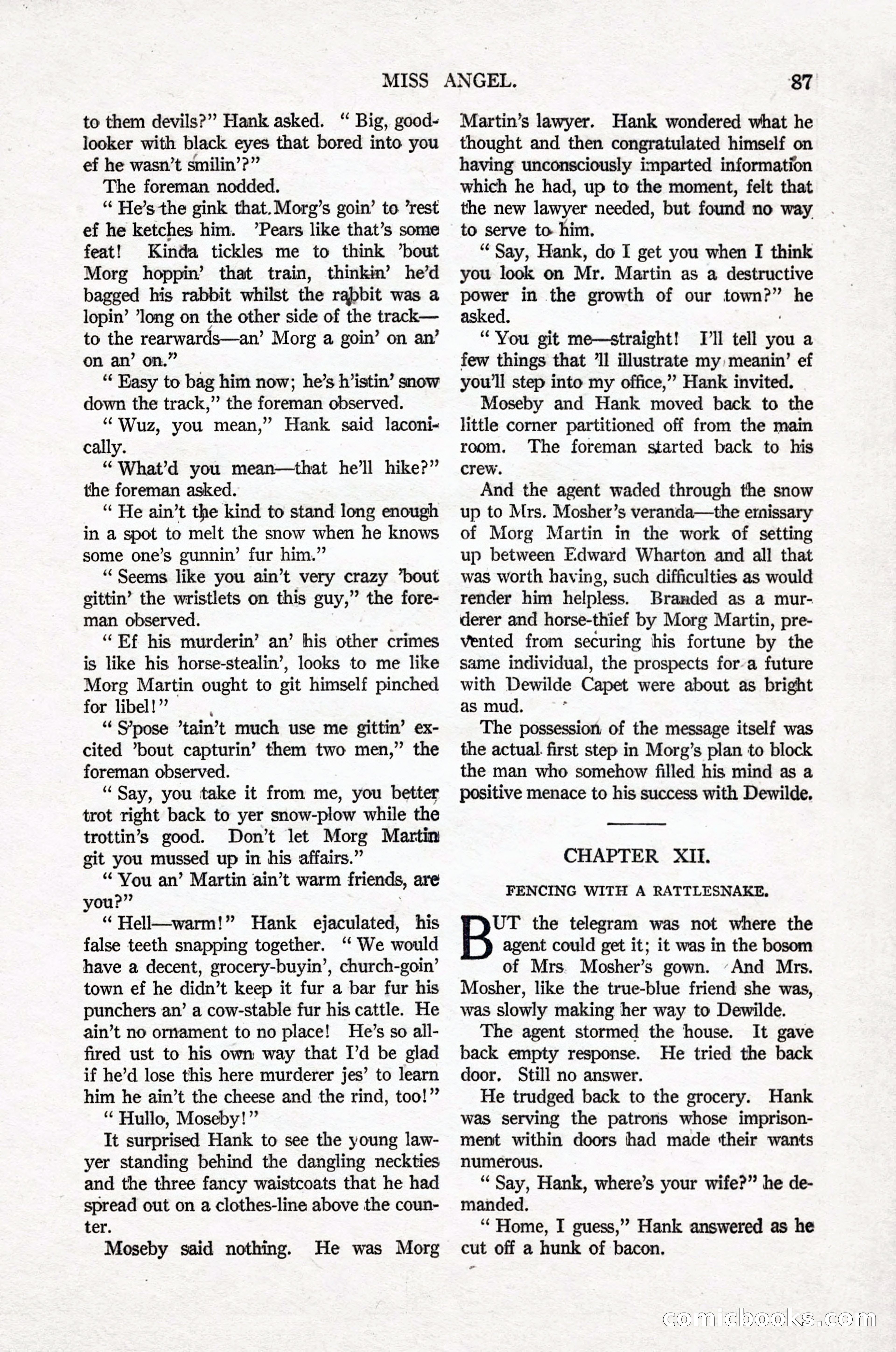
A restored page from Pulp Fiction, 1921. Page through the whole issue in the reader above.
📄 Transcribed text from this page (OCR, searchable)
Machine-transcribed from the original scan — historical spelling and the odd misread are preserved.
MISS ANGEL. to them devils?” Hank asked. “ Big, good- looker with black eyes that bored into you ef he wasn’t smilin’?” The foreman nodded. “‘ He’s the gink that. Morg’s goin’ to ’rest ef he ketches him. ’Pears like that’s some feat! Kinda tickles me to think ‘bout Morg hoppin’ that train, thinkin’ he’d bagged his rabbit whilst the rabbit was a lopin’ “long on the other side of the track— to the rearwards—an’ Morg a goin’ on an’ on an’ on.” “‘ Easy to bag him now; he’s h’istin’ snow down the track,” the foreman observed. “Wuz, you mean,” Hank said laconi- cally. “What'd you mean—that he’ll hike?” the foreman asked. “ He ain’t the kind to stand long enough in a spot to melt the snow when he knows some one’s gunnin’ fur him.” ‘“‘ Seems like you ain’t very crazy “bout gittin’ the wristlets on this guy,” the fore- man observed. ‘Ef his murderin’ an’ his other crimes is like his horse-stealin’, looks to me like Morg Martin ought to git himself pinched for libel!” “‘ S’pose ’tain’t much use me gittin’ ex- cited "bout capturin’ them two men,” the foreman observed. “ Say, you take it from me, you better trot right back to yer snow-plow while the trottin’s good. Don’t let Morg Martin git you mussed up in his affairs.” “ You an’ Martin ain’t warm friends, are you?” “¢ Hell—warm!” Hank ejaculated, his false teeth snapping together. ‘“‘ We would have a decent, grocery-buyin’, church-goin’ town ef he didn’t keep it fur a bar fur his punchers an’ a cow-stable fur his cattle. He ain’t no ornament to no place! He’s so all- fired ust to his own way that I’d be glad if he’d lose this here murderer jes’ to learn him he ain’t the cheese and the rind, too!” “ Hullo, Moseby!”’ It surprised Hank to see the young law- yer standing behind the dangling neckties and the three fancy waistcoats that he had spread out on a clothes-line above the coun- ter. Moseby said nothing. He was Morg 87 Martin’s lawyer. Hank wondered what he thought and then congratulated himself on having unconsciously imparted information which he had, up to the moment, felt that the new lawyer needed, but found no way to serve to him. “Say, Hank, do I get you when I think you look on Mr. Martin as a destructive power in the growth of our town?” he asked. “You git me—straight! Tl tell you a few things that ’ll illustrate my meanin’ ef you'll step into my office,” Hank invited. Moseby and Hank moved back to the little corner partitioned off from the main room. The foreman started back to his crew. And the agent waded through the snow up to Mrs. Mosher’s veranda—the ernissary of Morg Martin in the work of setting up between Edward Wharton and all that was worth having, such difficulties as would render him helpless. Branded as a mur- derer and horse-thief by Morg Martin, pre- vented from securing his fortune by the same individual, the prospects for a future with Dewilde Capet were about as bright as mud. : The possession of the message itself was the actual. first step in Morg’s plan to block the man who somehow filled his mind as a positive menace to his success with Dewilde. CHAPTER XII. FENCING WITH A RATTLESNAKE. UT the telegram was not where the agent could get it; it was in the bosom of Mrs. Mosher’s gown. And Mrs. Mosher, like the true-blue friend she was, was slowly making her way to Dewilde. The agent stormed the house. It gave back empty response. He tried the back door. Still no answer. He trudged back to the grocery. Hank was serving the patrons whose imprison- ment within doors had made their wants numerous. “‘ Say, Hank, where’s your wife?” he de- manded. “Home, I guess,” Hank answered as he cut off a hunk of bacon. ” CoOmicloool< (C©