
Pulp Fiction, 1922 · page 114 of 172
Argosy All-Story Weekly, January 21, 1922 — page 114: what you’re looking at
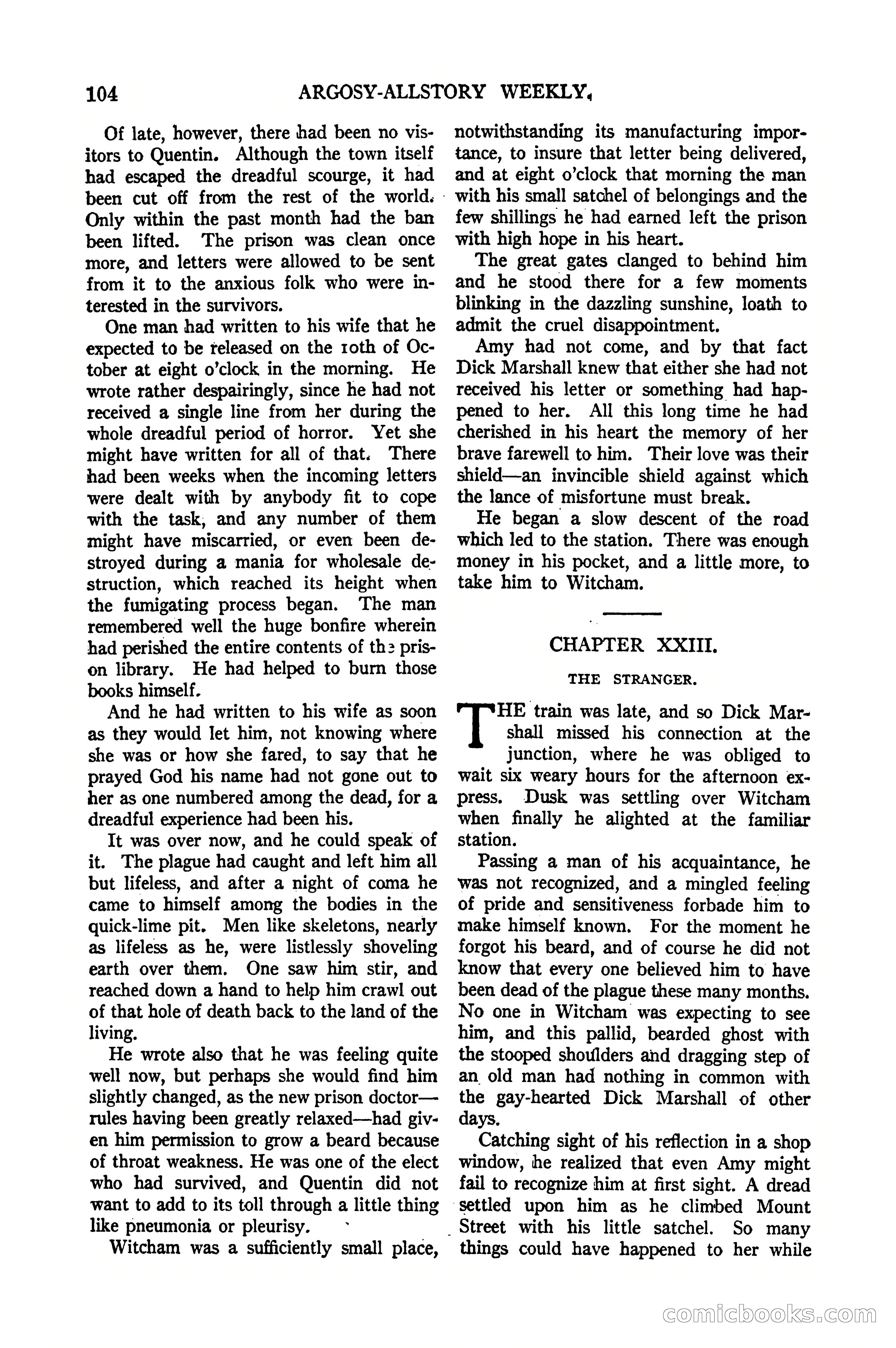
A restored page from Pulp Fiction, 1922. Page through the whole issue in the reader above.
📄 Transcribed text from this page (OCR, searchable)
Machine-transcribed from the original scan — historical spelling and the odd misread are preserved.
104 Of late, however, there had been no vis- itors to Quentin. Although the town itself had escaped the dreadful scourge, it had been cut off from the rest of the world. - Only within the past month had the ban been lifted. The prison was clean once more, and letters were allowed to be sent from it to the anxious folk who were in- terested in the survivors. One man had written to his wife that he expected to be released on the roth of Oc- tober at eight o’clock in the morning. He wrote rather despairingly, since he had not received a single line from her during the whole dreadful period of horror. Yet she might have written for all of that. There had been weeks when the incoming letters were dealt with by anybody fit to cope with the task, and any number of them might have miscarried, or even been de- stroyed during a mania for wholesale de- struction, which reached its height when the fumigating process began. The man remembered well the huge bonfire wherein had perished the entire contents of th pris- on library. He had helped to burn those books himself. And he had written to his wife as soon as they would let him, not knowing where she was or how she fared, to say that he prayed God his name had not gone out to her as one numbered among the dead, for a dreadful experience had been his. It was over now, and he could speak of it. The plague had caught and left him all but lifeless, and after a night of coma he came to himself among the bodies in the quick-lime pit. Men like skeletons, nearly as lifeless as he, were listlessly shoveling earth over them. One saw him stir, and reached down a hand to help him crawl out of that hole of death back to the land of the living. He wrote also that he was feeling quite well now, but perhaps she would find him slightly changed, as the new prison doctor— rules having been greatly relaxed—had giv- en him permission to grow a beard because of throat weakness. He was one of the elect who had survived, and Quentin did not want to add to its toll through a little thing like pneumonia or pleurisy. Witcham was a sufficiently small place, ARGOSY-ALLSTORY WEEKLY, notwithstanding its manufacturing impor- tance, to insure that letter being delivered, and at eight o’clock that morning the man with his small satchel of belongings and the few shillings he had earned left the prison with high hope in his heart. The great gates clanged to behind him and he stood there for a few moments blinking in the dazzling sunshine, loath to admit the cruel disappointment. Amy had not come, and by that fact Dick Marshall knew that either she had not received his letter or something had hap- pened to her. All this long time he had cherished in his heart the memory of her brave farewell to him. Their love was their shield—an invincible shield against which the lance of misfortune must break. He began a slow descent of the road which led to the station. There was enough money in his pocket, and a little more, to take him to Witcham. CHAPTER XXIII. THE STRANGER. HE train was late, and so Dick Mar- shall missed his connection at the junction, where he was obliged to wait six weary hours for the afternoon ex- press. Dusk was settling over Witcham when finally he alighted at the familiar station. Passing a man of his acquaintance, he was not recognized, and a mingled feeling of pride and sensitiveness forbade him to make himself known. For the moment he forgot his beard, and of course he did not know that every one believed him to have been dead of the plague these many months. No one in Witcham was expecting to see him, and this pallid, bearded ghost with the stooped shoulders and dragging step of an old man had nothing in common with the gay-hearted Dick Marshall of other days. Catching sight of his reflection in a shop window, he realized that even Amy might fail to recognize him at first sight. A dread ‘settled upon him as he climbed Mount _ Street with his little satchel. So many things could have happened to her while COMmiclboo SS C©