
Pulp Fiction, 1922 · page 12 of 172
Argosy All-Story Weekly, January 21, 1922 — page 12: what you’re looking at
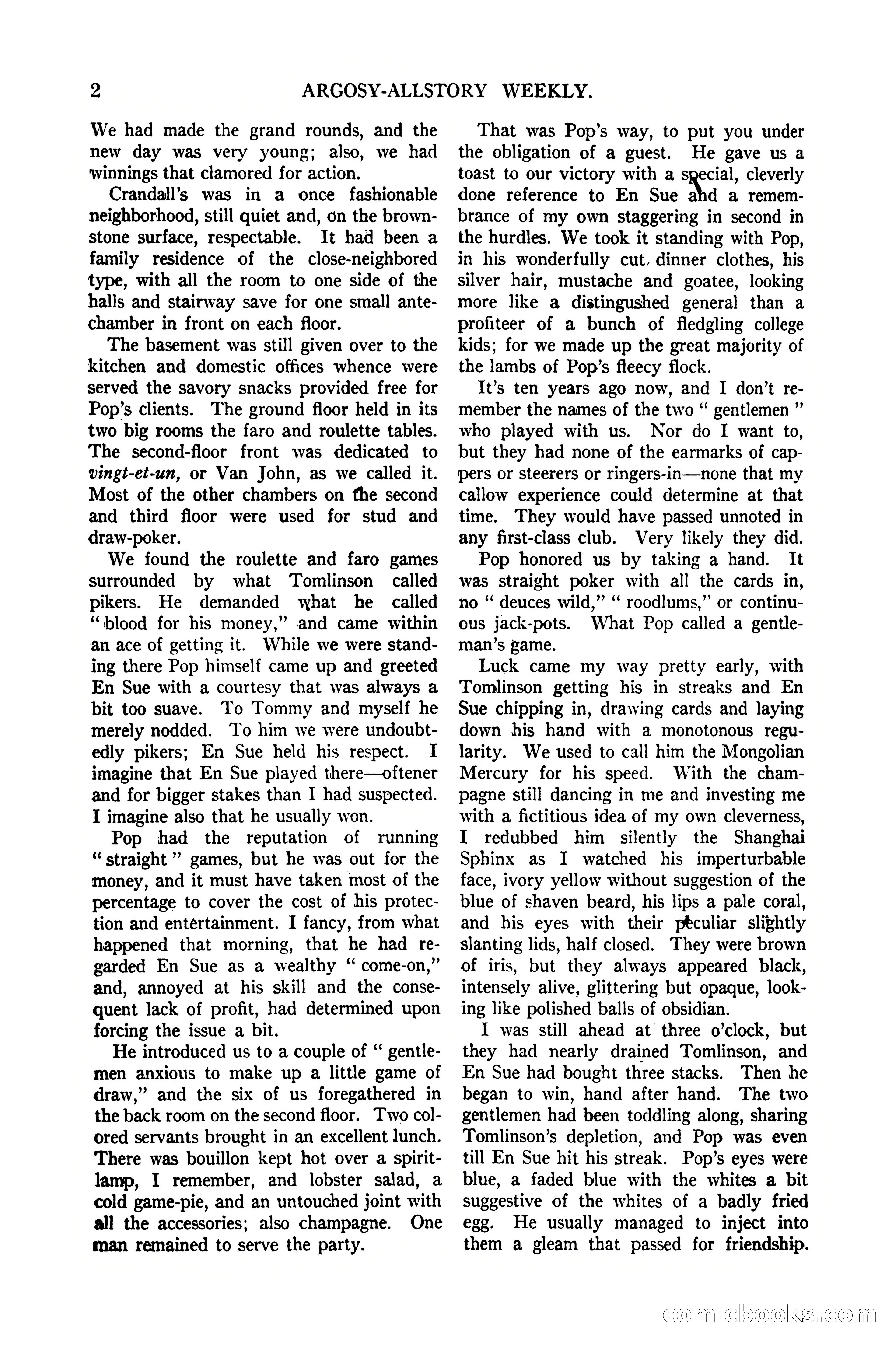
A restored page from Pulp Fiction, 1922. Page through the whole issue in the reader above.
📄 Transcribed text from this page (OCR, searchable)
Machine-transcribed from the original scan — historical spelling and the odd misread are preserved.
2 ARGOSY-ALLSTORY WEEKLY. We had made the grand rounds, and the new day was very young; also, we had winnings that clamored for action. Crandall’s was in a once fashionable neighborhood, still quiet and, on the brown- Stone surface, respectable. It had been a family residence of the close-neighbored type, with all the room to one side of the halls and stairway save for one small ante- chamber in front on each floor. The basement was still given over to the kitchen and domestic offices whence were served the savory snacks provided free for Pop’s clients. The ground floor held in its two big rooms the faro and roulette tables. The second-floor front was dedicated to vingt-et-un, or Van John, as we called it. Most of the other chambers on fhe second and third floor were used for stud and draw-poker. We found the roulette and faro games surrounded by what Tomlinson called pikers. He demanded what he called “blood for his money,” and came within an ace of getting it. While we were stand- ing there Pop himself came up and greeted En Sue with a courtesy that was always a bit too suave. To Tommy and myself he merely nodded. To him we were undoubt- edly pikers; En Sue held his respect. I imagine that En Sue played there—oftener and for bigger stakes than I had suspected. I imagine also that he usually won. Pop had the reputation of running “straight ’’ games, but he was out for the money, and it must have taken most of the percentage to cover the cost of his protec- tion and entertainment. I fancy, from what happened that morning, that he had re- garded En Sue as a wealthy “ come-on,” and, annoyed at his skill and the conse- quent lack of profit, had determined upon forcing the issue a bit. He introduced us to a couple of “ gentle- men anxious to make up a little game of draw,” and the six of us foregathered in the back room on the second floor. Two col- ored servants brought in an excellent lunch. There was bouillon kept hot over a spirit- lamp, I remember, and lobster salad, a cold game-pie, and an untouched joint with all the accessories; also champagne. One man remained to serve the party. That was Pop’s way, to put you under the obligation of a guest. He gave us a toast to our victory with a special, cleverly done reference to En Sue ahd a remem- brance of my own staggering in second in the hurdles. We took it standing with Pop, in his wonderfully cut, dinner clothes, his Silver hair, mustache and goatee, looking more like a distingushed general than a profiteer of a bunch of fledgling college kids; for we made up the great majority of the lambs of Pop’s fleecy flock. It’s ten years ago now, and I don’t re- member the names of the two “ gentlemen ”’ who played with us. Nor do I want to, but they had none of the earmarks of cap- pers or steerers or ringers-in—none that my callow experience could determine at that time. They would have passed unnoted in any first-class club. Very likely they did. Pop honored us by taking a hand. It was straight poker with all the cards in, no “ deuces wild,” ‘“‘ roodlums,” or continu- ous jack-pots. What Pop called a gentle- man’s game. Luck came my way pretty early, with Tomlinson getting his in streaks and En Sue chipping in, drawing cards and laying down his hand with a monotonous regu- larity. We used to call him the Mongolian Mercury for his speed. With the cham- pagne still dancing in me and investing me with a fictitious idea of my own cleverness, I redubbed him silently the Shanghai Sphinx as I watched his imperturbable face, ivory yellow without suggestion of the blue of shaven beard, his lips a pale coral, and his eyes with their péculiar slightly slanting lids, half closed. They were brown of iris, but they always appeared black, Intensely alive, glittering but opaque, look- ing like polished balls of obsidian. I was still ahead at three o’clock, but they had nearly drained Tomlinson, and En Sue had bought three stacks. Then he began to win, hand after hand. The two gentlemen had been toddling along, sharing Tomlinson’s depletion, and Pop was even till En Sue hit his streak. Pop’s eyes were blue, a faded blue with the whites a bit suggestive of the whites of a badly fried egg. He usually managed to inject into them a gleam that passed for friendship. comicloool C©