
Pulp Fiction, 1922 · page 121 of 172
Argosy All-Story Weekly, January 21, 1922 — page 121: what you’re looking at
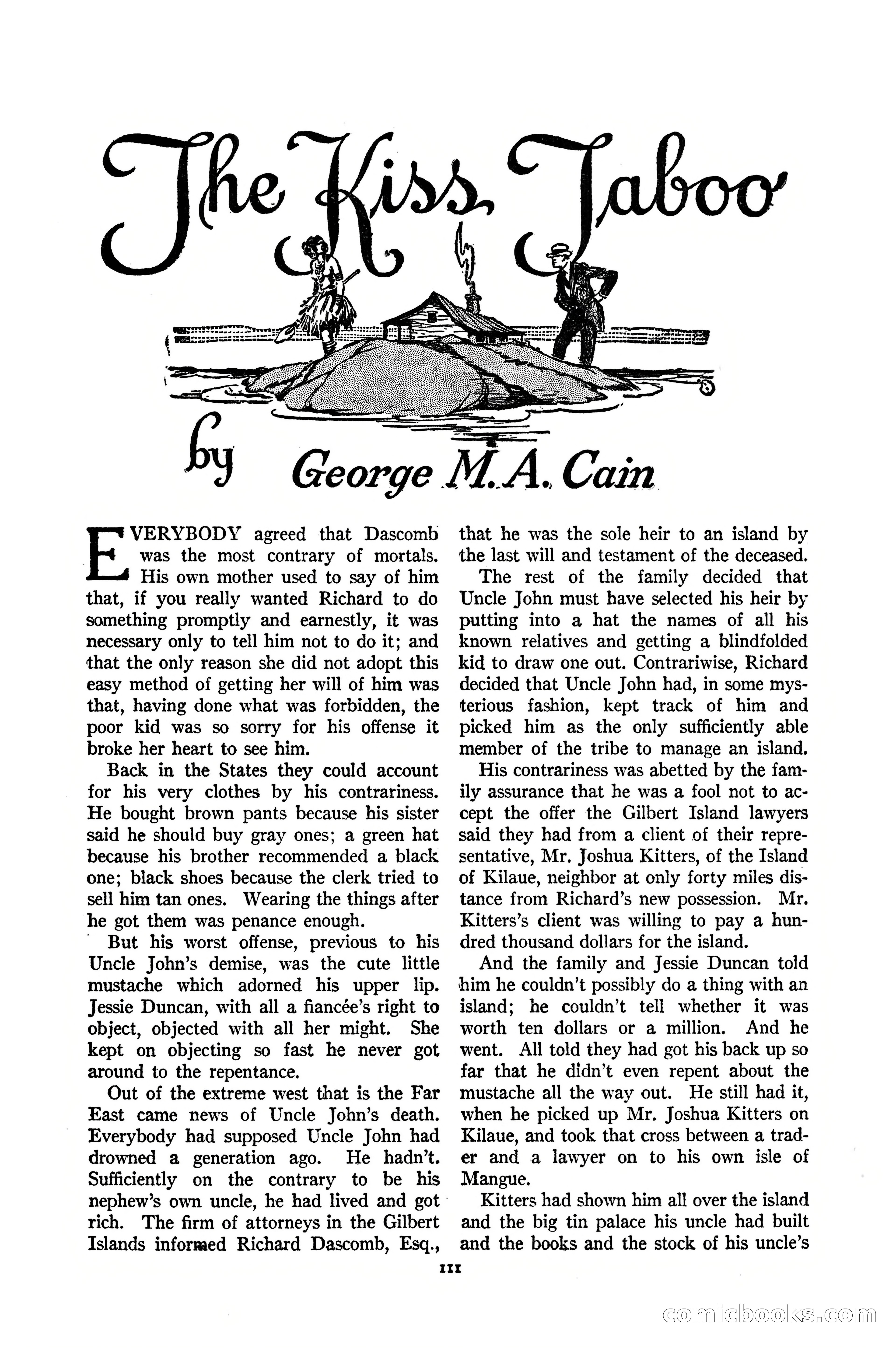
A restored page from Pulp Fiction, 1922. Page through the whole issue in the reader above.
📄 Transcribed text from this page (OCR, searchable)
Machine-transcribed from the original scan — historical spelling and the odd misread are preserved.
v by George VERYBODY agreed that Dascomb E was the most contrary of mortals. His own mother used to say of him that, if you really wanted Richard to do something promptly and earnestly, it was necessary only to tell him not to do it; and that the only reason she did not adopt this easy method of getting her will of him was that, having done what was forbidden, the poor kid was so sorry for his offense it broke her heart to see him. Back in the States they could account for his very clothes by his contrariness. He bought brown pants because his sister said he should buy gray ones; a green hat because his brother recommended a black one; black shoes because the clerk tried to sell him tan ones. Wearing the things after he got them was penance enough. ' But his worst offense, previous to his Uncle John’s demise, was the cute little mustache which adorned his upper lip. Jessie Duncan, with all a fiancée’s right to object, objected with all her might. She kept on objecting so fast he never got around to the repentance. Out of the extreme west that is the Far East came news of Uncle John’s death. Everybody had supposed Uncle John had drowned a generation ago. He hadn't. Sufficiently on the contrary to be his nephew’s own uncle, he had lived and got rich. The firm of attorneys in the Gilbert Islands informed Richard Dascomb, Esq., MA. Cain er that he was the sole heir to an island by the last will and testament of the deceased. The rest of the family decided that Uncle John must have selected his heir by putting into a hat the names of all his known relatives and getting a blindfolded kid to draw one out. Contrariwise, Richard decided that Uncle John had, in some mys- terious fashion, kept track of him and picked him as the only sufficiently able member of the tribe to manage an island. His contrariness was abetted by the fam- ily assurance that he was a fool not to ac- cept the offer the Gilbert Island lawyers said they had from a client of their repre- sentative, Mr. Joshua Kitters, of the Island of Kilaue, neighbor at only forty miles dis- tance from Richard’s new possession. Mr. Kitters’s client was willing to pay a hun- dred thousand dollars for the island. And the family and Jessie Duncan told him he couldn’t possibly do a thing with an island; he couldn’t tell whether it was worth ten dollars or a million. And he went. All told they had got his back up so far that he didn’t even repent about the mustache all the way out. He still had it, when he picked up Mr. Joshua Kitters on Kilaue, and took that cross between a trad- er and a lawyer on to his own isle of Mangue. Kitters had shown him all over the island and the big tin palace his uncle had built and the books and the stock of his uncle’s Itr MICLOOOK C©