
Pulp Fiction, 1922 · page 144 of 172
Argosy All-Story Weekly, January 21, 1922 — page 144: what you’re looking at
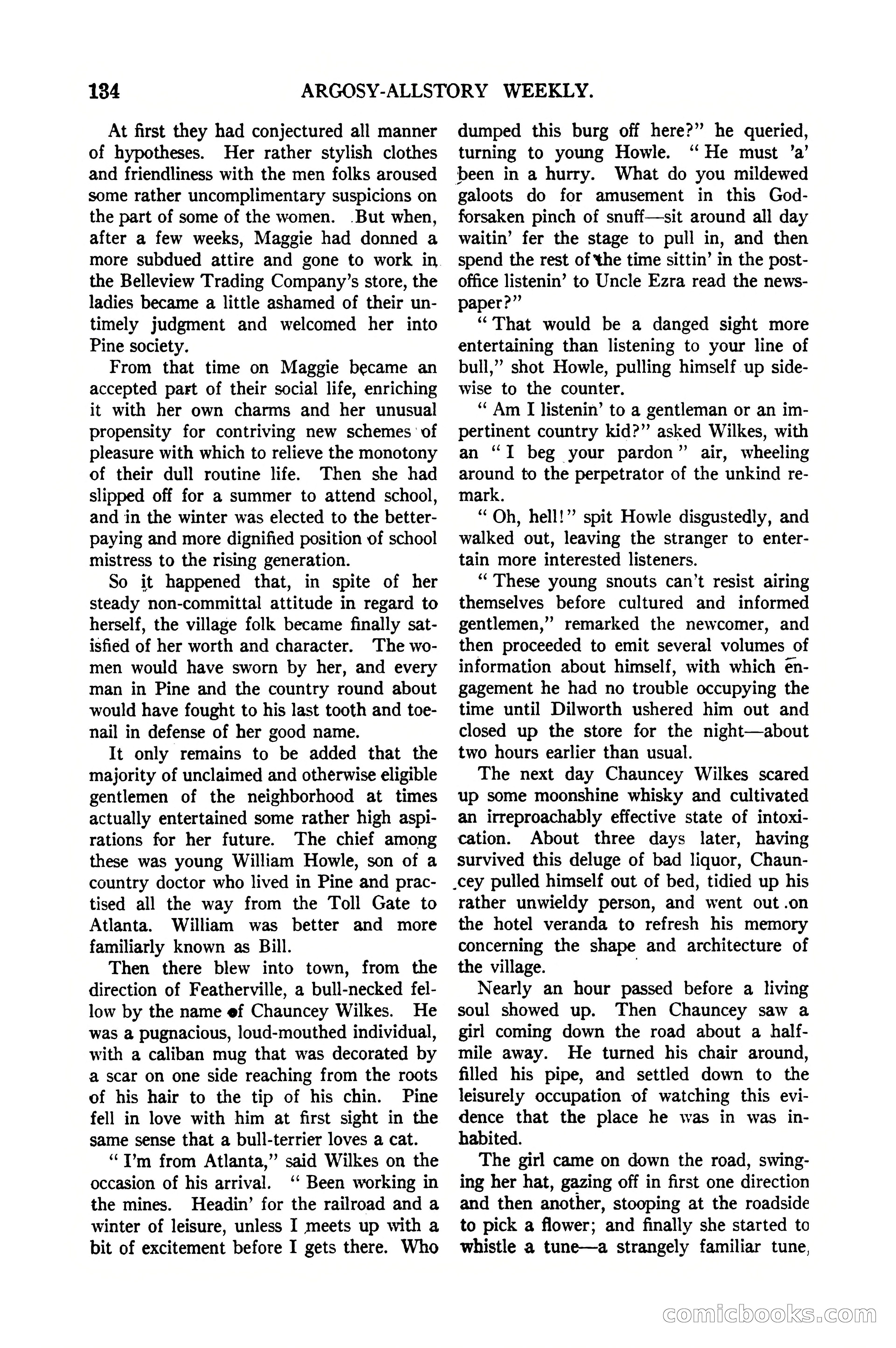
A restored page from Pulp Fiction, 1922. Page through the whole issue in the reader above.
📄 Transcribed text from this page (OCR, searchable)
Machine-transcribed from the original scan — historical spelling and the odd misread are preserved.
134 At first they had conjectured all manner of hypotheses. Her rather stylish clothes and friendliness with the men folks aroused some rather uncomplimentary suspicions on the part of some of the women. But when, after a few weeks, Maggie had donned a more subdued attire and gone to work in. the Belleview Trading Company’s store, the ladies became a little ashamed of their un- timely judgment and welcomed her into Pine society. From that time on Maggie became an accepted part of their social life, enriching it with her own charms and her unusual propensity for contriving new schemes ‘of pleasure with which to relieve the monotony of their dull routine life. Then she had slipped off for a summer to attend school, and in the winter was elected to the better- paying and more dignified position of school mistress to the rising generation. So it happened that, in spite of her steady non-committal attitude in regard to herself, the village folk became finally sat- isfied of her worth and character. The wo- men would have sworn by her, and every man in Pine and the country round about would have fought to his last tooth and toe- nail in defense of her good name. It only remains to be added that the majority of unclaimed and otherwise eligible gentlemen of the neighborhood at times actually entertained some rather high aspi- rations for her future. The chief among these was young William Howle, son of a country doctor who lived in Pine and prac- tised all the way from the Toll Gate to Atlanta. William was better and more familiarly known as Bill. Then there blew into town, from the direction of Featherville, a bull-necked fel- low by the name ef Chauncey Wilkes. He was a pugnacious, loud-mouthed individual, with a caliban mug that was decorated by a scar on one side reaching from the roots of his hair to the tip of his chin. Pine fell in love with him at first sight in the same sense that a bull-terrier loves a cat. “I’m from Atlanta,” said Wilkes on the occasion of his arrival. ‘‘ Been working in the mines. Headin’ for the railroad and a winter of leisure, unless I meets up with a bit of excitement before I gets there. Who ARGOSY-ALLSTORY WEEKLY. dumped this burg off here?” he queried, turning to young Howle. ‘‘ He must ’a’ been in a hurry. What do you mildewed galoots do for amusement in this God- forsaken pinch of snuff—sit around all day waitin’ fer the stage to pull in, and then spend the rest of the time sittin’ in the post- office listenin’ to Uncle Ezra read the news- paper?” ‘““That would be a danged sight more entertaining than listening to your line of bull,” shot Howle, pulling himself up side- wise to the counter. ‘‘ Am I listenin’ to a gentleman or an im- pertinent country kid?” asked Wilkes, with an “I beg your pardon” air, wheeling around to the perpetrator of the unkind re- mark. “‘ Oh, hell!’ spit Howle disgustedly, and walked out, leaving the stranger to enter- tain more interested listeners. “These young snouts can’t resist airing themselves before cultured and informed gentlemen,’”’ remarked the newcomer, and then proceeded to emit several volumes of information about himself, with which en- gagement he had no trouble occupying the time until Dilworth ushered him out and closed up the store for the night—about two hours earlier than usual. The next day Chauncey Wilkes scared up some moonshine whisky and cultivated an irreproachably effective state of intoxi- cation. About three days later, having survived this deluge of bad liquor, Chaun- _cey pulled himself out of bed, tidied up his rather unwieldy person, and went out .on the hotel veranda to refresh his memory concerning the shape and architecture of the village. Nearly an hour passed before a living soul showed up. Then Chauncey saw a girl coming down the road about a half- mile away. He turned his chair around, filled his pipe, and settled down to the leisurely occupation of watching this evi- dence that the place he was in was in- habited. The girl came on down the road, swing- ing her hat, gazing off in first one direction and then another, stooping at the roadside to pick a flower; and finally she started to whistle a tune—a strangely familiar tune, COMmiclboo SS C©