
Pulp Fiction, 1922 · page 16 of 172
Argosy All-Story Weekly, January 21, 1922 — page 16: what you’re looking at
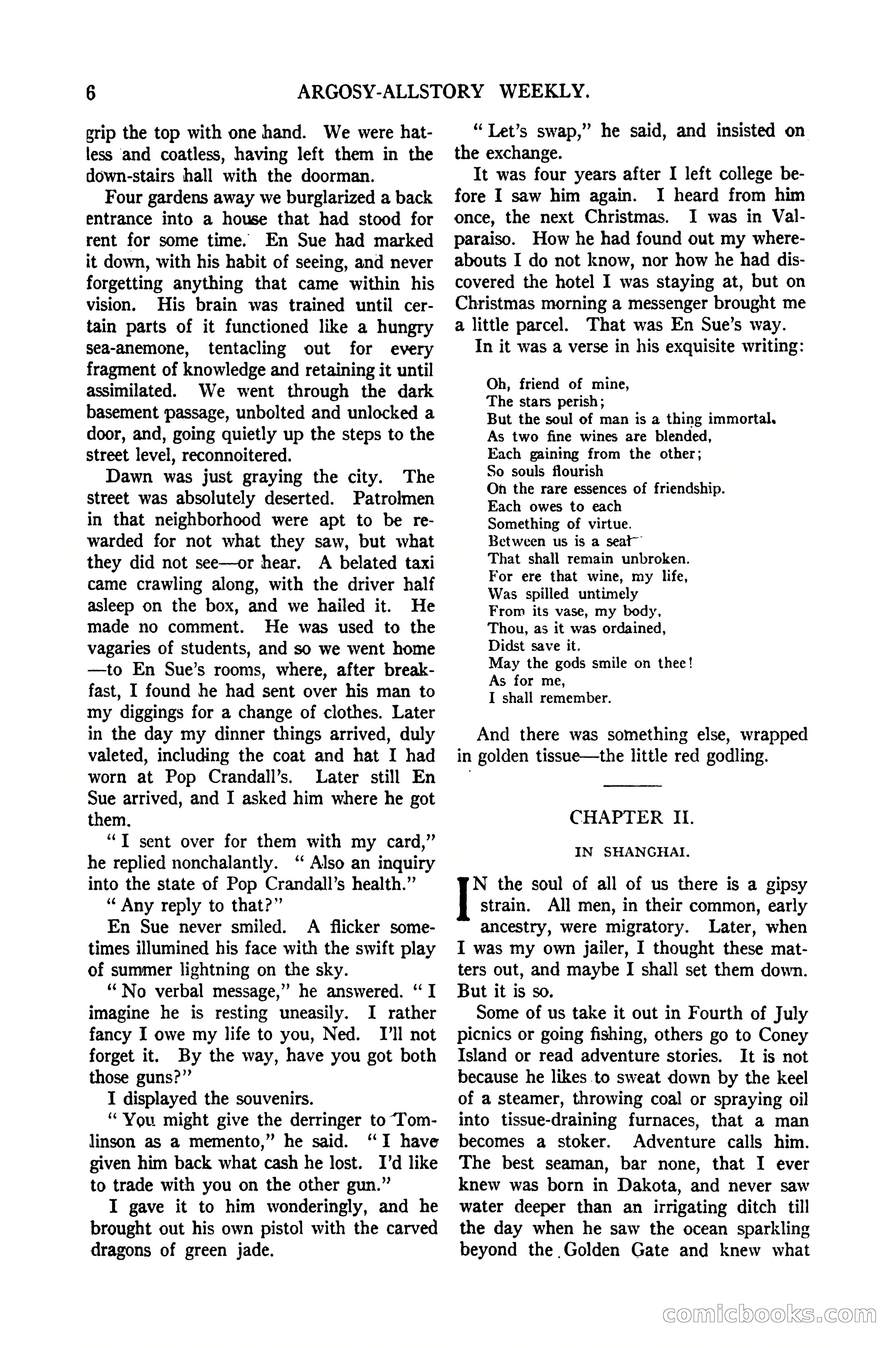
A restored page from Pulp Fiction, 1922. Page through the whole issue in the reader above.
📄 Transcribed text from this page (OCR, searchable)
Machine-transcribed from the original scan — historical spelling and the odd misread are preserved.
6 ARGOSY-ALLSTORY WEEKLY. grip the top with one hand. We were hat- less and coatless, having left them in the down-stairs hall with the doorman. Four gardens away we burglarized a back entrance into a house that had stood for rent for some time. En Sue had marked it down, with his habit of seeing, and never forgetting anything that came within his vision. His brain was trained until cer- tain parts of it functioned like a hungry sea-anemone, tentacling out for every fragment of knowledge and retaining it until assimilated. We went through the dark basement passage, unbolted and unlocked a door, and, going quietly up the steps to the street level, reconnoitered. Dawn was just graying the city. The Street was absolutely deserted. Patrolmen in that neighborhood were apt to be re- warded for not what they saw, but what they did not see—or hear. A belated taxi came crawling along, with the driver half asleep on the box, and we hailed it. He made no comment. He was used to the vagaries of students, and so we went home —to En Sue’s rooms, where, after break- fast, I found he had sent over his man to my diggings for a change of clothes. Later in the day my dinner things arrived, duly valeted, including the coat and hat I had worn at Pop Crandall’s. Later still En Sue arrived, and I asked him where he got them. “IT sent over for them with my card,” he replied nonchalantly. ‘ Also an inquiry into the state of Pop Crandall’s health.” “* Any reply to that?” En Sue never smiled. A flicker some- times illumined his face with the swift play of summer lightning on the sky. ‘“*'No verbal message,” he answered. ‘‘ I imagine he is resting uneasily. I rather fancy I owe my life to you, Ned. I'll not forget it. By the way, have you got both those guns?” I displayed the souvenirs. “You might give the derringer to Iom- linson as a memento,” he said. ‘I have given him back what cash he lost. I’d like to trade with you on the other gun.” I gave it to him wonderingly, and he brought out his own pistol with the carved dragons of green jade. “Let’s swap,” he said, and insisted on the exchange. It was four years after I left college be- fore I saw him again. I heard from him once, the next Christmas. I was in Val- paraiso. How he had found out my where- abouts I do not know, nor how he had dis- covered the hotel I was staying at, but on Christmas morning a messenger brought me a little parcel. That was En Sue’s way. In it was a verse in his exquisite writing: Oh, friend of mine, The stars perish; But the soul of man is a thing immortal. As two fine wines are blended, Each gaining from the other; So souls flourish On the rare essences of friendship. Each owes to each Something of virtue. Between us is a seat That shall remain unbroken. For ere that wine, my life, Was spilled untimely From its vase, my body, Thou, as it was ordained, Didst save it. May the gods smile on thee! As for me, I shall remember. And there was something else, wrapped in golden tissue—the little red godling. CHAPTER ILI. IN SHANGHAI. N the soul of all of us there is a gipsy strain. All men, in their common, early ancestry, were migratory. Later, when I was my own jailer, I thought these mat- ters out, and maybe I shall set them down. But it is so. Some of us take it out in Fourth of July picnics or going fishing, others go to Coney Island or read adventure stories. It is not because he likes to sweat down by the keel of a steamer, throwing coal or spraying oil into tissue-draining furnaces, that a man becomes a stoker. Adventure calls him. The best seaman, bar none, that I ever knew was born in Dakota, and never saw water deeper than an irrigating ditch till the day when he saw the ocean sparkling beyond the Golden Gate and knew what COMmiclboo SS C©