
Pulp Fiction, 1922 · page 167 of 172
Argosy All-Story Weekly, January 21, 1922 — page 167: what you’re looking at
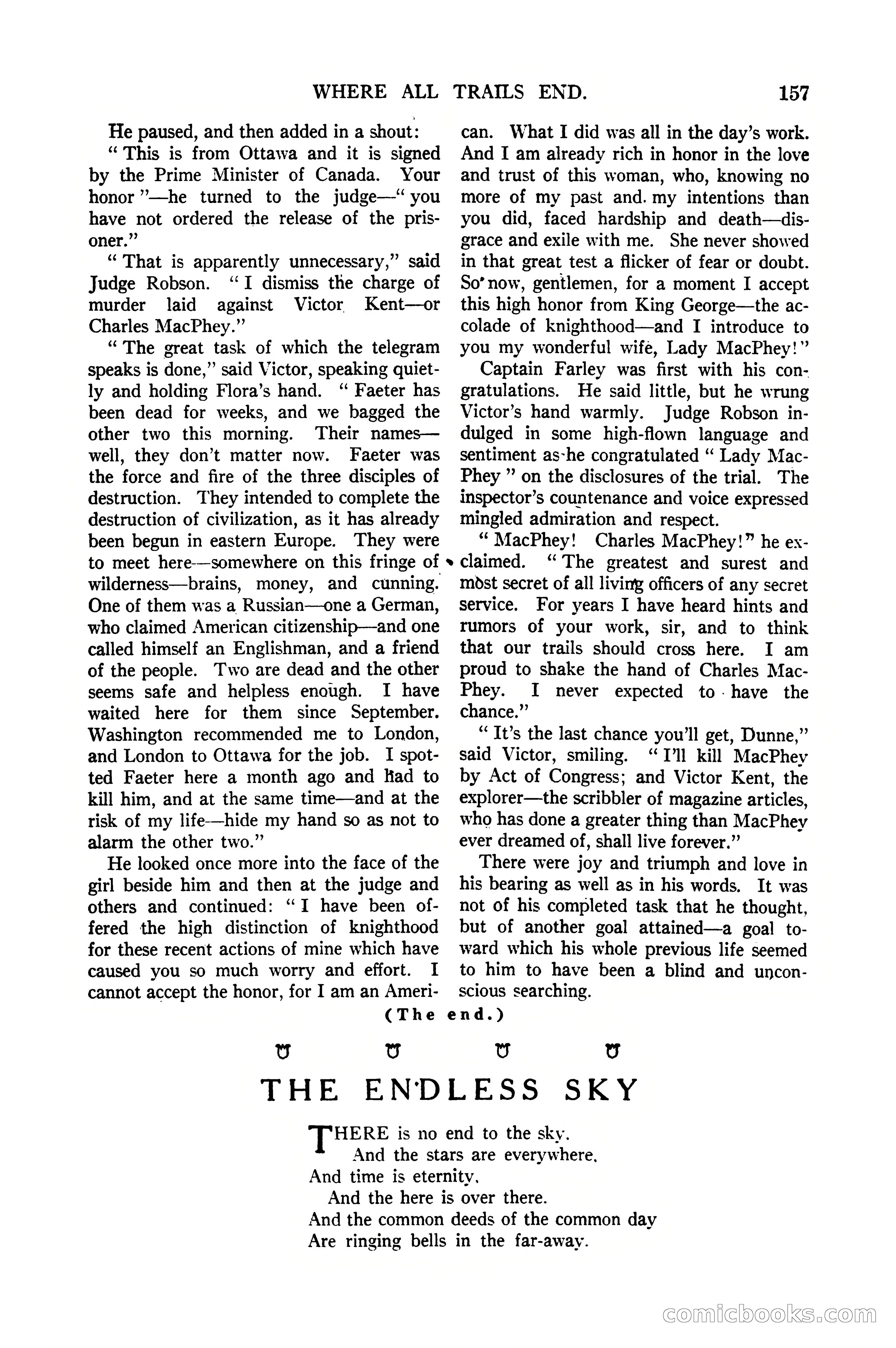
A restored page from Pulp Fiction, 1922. Page through the whole issue in the reader above.
📄 Transcribed text from this page (OCR, searchable)
Machine-transcribed from the original scan — historical spelling and the odd misread are preserved.
WHERE ALL He paused, and then added in a shout: “ This is from Ottawa and it is signed by the Prime Minister of Canada. Your honor ’”’—he turned to the judge—‘ you have not ordered the release of the pris- oner.” “ That is apparently unnecessary,” said Judge Robson. ‘I dismiss the charge of murder laid against Victor Kent—or Charles MacPhey.” “The great task of which the telegram speaks is done,” said Victor, speaking quiet- ly and holding Flora’s hand. ‘“ Faeter has been dead for weeks, and we bagged the other two this morning. Their names— well, they don’t matter now. Faeter was the force and fire of the three disciples of destruction. They intended to complete the destruction of civilization, as it has already been begun in eastern Europe. They were to meet here-—somewhere on this fringe of » wilderness—brains, money, and cunning. One of them was a Russian—one a German, who claimed American citizenship—and one called himself an Englishman, and a friend of the people. Two are dead and the other seems safe and helpless enough. I have waited here for them since September. Washington recommended me to London, and London to Ottawa for the job. I spot- ted Faeter here a month ago and Had to kill him, and at the same time—and at the risk of my life—hide my hand so as not to alarm the other two.” He looked once more into the face of the girl beside him and then at the judge and others and continued: ‘I have been of- fered the high distinction of knighthood for these recent actions of mine which have caused you so much worry and effort. I cannot accept the honor, for I am an Ameri- TRAILS END. 157 can. What I did was all in the day’s work. And I am already rich in honor in the love and trust of this woman, who, knowing no more of my past and. my intentions than you did, faced hardship and death—dis- grace and exile with me. She never showed in that great test a flicker of fear or doubt. So’ now, gentlemen, for a moment I accept this high honor from King George—the ac- colade of knighthood—and I introduce to you my wonderful wife, Lady MacPhey!” Captain Farley was first with his con- gratulations. He said little, but he wrung Victor’s hand warmly. Judge Robson in- dulged in some high-flown language and sentiment as-he congratulated “ Lady Mac- Phey ” on the disclosures of the trial. The inspector’s countenance and voice expressed mingled admiration and respect. ‘“‘MacPhey! Charles MacPhey!” he ex- claimed. ‘“ The greatest and surest and mbdst secret of all living officers of any secret service. For years I have heard hints and rumors of your work, sir, and to think that our trails should cross here. I am proud to shake the hand of Charles Mac- Phey. I never expected to-have the chance.” “It’s the last chance you’ll get, Dunne,” said Victor, smiling. ‘1’ll kill MacPhev by Act of Congress; and Victor Kent, the explorer—the scribbler of magazine articles, who has done a greater thing than MacPhev ever dreamed of, shall live forever.” There were joy and triumph and love in his bearing as well as in his words. It was not of his completed task that he thought, but of another goal attained—a goal to- ward which his whole previous life seemed to him to have been a blind and uncon- scious searching. (The end.) U U U 0 THE ENDLESS SKY HERE is no end to the sky. And the stars are everywhere, And time is eternity. And the here is over there. And the common deeds of the common day Are ringing bells in the far-away. MICLOOOK C©