
Pulp Fiction, 1922 · page 37 of 172
Argosy All-Story Weekly, January 21, 1922 — page 37: what you’re looking at
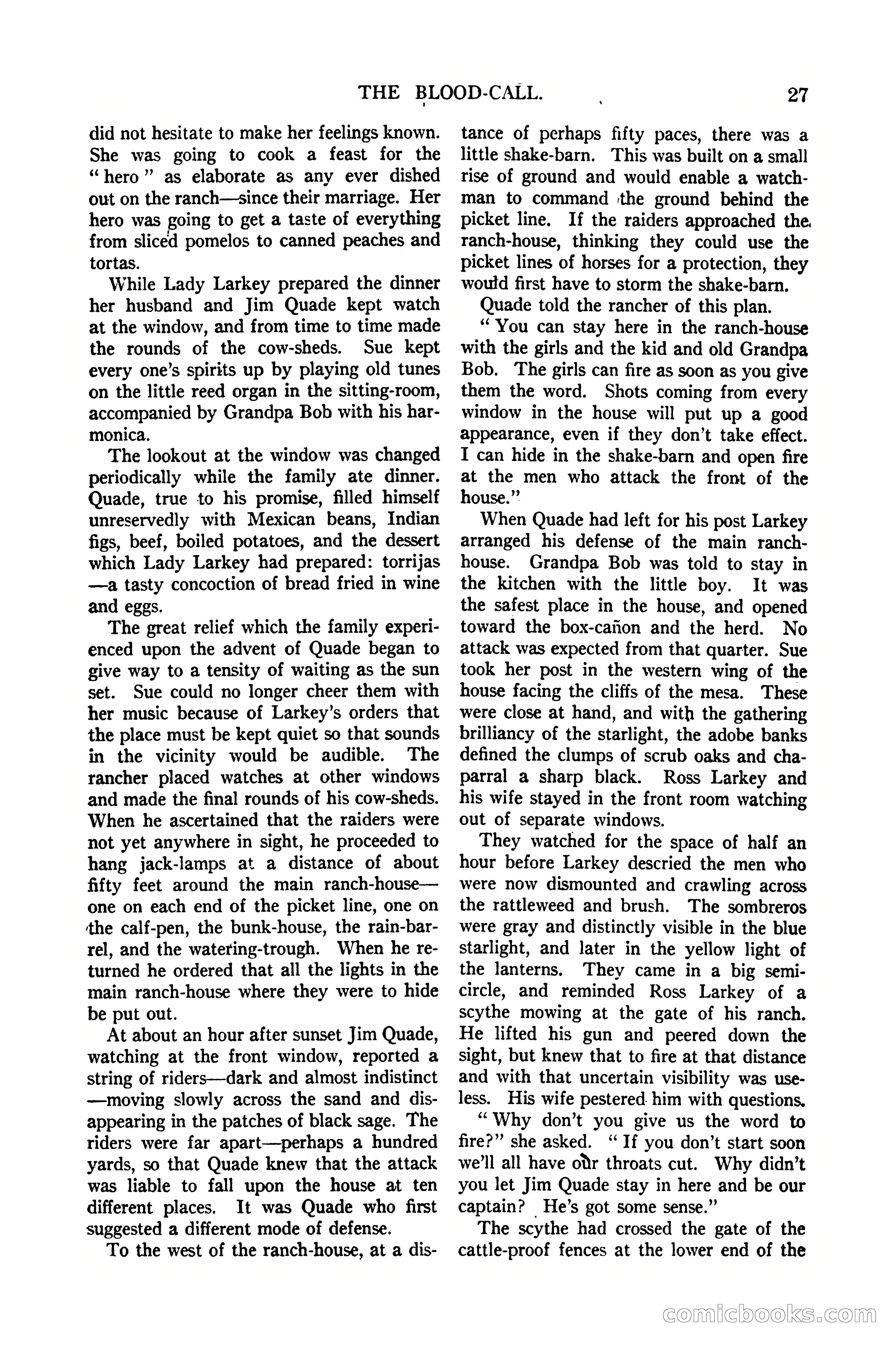
A restored page from Pulp Fiction, 1922. Page through the whole issue in the reader above.
📄 Transcribed text from this page (OCR, searchable)
Machine-transcribed from the original scan — historical spelling and the odd misread are preserved.
THE BLOOD-CALL. did not hesitate to make her feelings known. She was going to cook a feast for the “hero” as elaborate as any ever dished out on the ranch—since their marriage. Her hero was going to get a taste of everything from sliced pomelos to canned peaches and tortas. While Lady Larkey prepared the dinner her husband and Jim Quade kept watch at the window, and from time to time made the rounds of the cow-sheds. Sue kept every one’s spirits up by playing old tunes on the little reed organ in the sitting-room, accompanied by Grandpa Bob with his har- monica. The lookout at the window was changed periodically while the family ate dinner. Quade, true to his promise, filled himself unreservedly with Mexican beans, Indian figs, beef, boiled potatoes, and the dessert which Lady Larkey had prepared: torrijas —a tasty concoction of bread fried in wine and eggs. The great relief which the family experi- enced upon the advent of Quade began to give way to a tensity of waiting as the sun set. Sue could no longer cheer them with her music because of Larkey’s orders that the place must be kept quiet so that sounds in the vicinity would be audible. The rancher placed watches at other windows and made the final rounds of his cow-sheds. When he ascertained that the raiders were not yet anywhere in sight, he proceeded to hang jack-lamps at a distance of about fifty feet around the main ranch-house— one on each end of the picket line, one on ‘the calf-pen, the bunk-house, the rain-bar- rel, and the watering-trough. When he re- turned he ordered that all the lights in the main ranch-house where they were to hide be put out. At about an hour after sunset Jim Quade, watching at the front window, reported a string of riders—dark and almost indistinct —moving slowly across the sand and dis- appearing in the patches of black sage. The riders were far apart—perhaps a hundred yards, so that Quade knew that the attack was liable to fall upon the house at ten different places. It was Quade who first suggested a different mode of defense. To the west of the ranch-house, at a dis- 27 tance of perhaps fifty paces, there was a little shake-barn. This was built on a small rise of ground and would enable a watch- man to command ‘the ground behind the picket line. If the raiders approached the. ranch-house, thinking they could use the picket lines of horses for a protection, they would first have to storm the shake-barn. Quade told the rancher of this plan. “You can stay here in the ranch-house with the girls and the kid and old Grandpa Bob. The girls can fire as soon as you give them the word. Shots coming from every window in the house will put up a good appearance, even if they don’t take effect. I can hide in the shake-barn and open fire at the men who attack the front of the house.” When Quade had left for his post Larkey arranged his defense of the main ranch- house. Grandpa Bob was told to stay in the kitchen with the little boy. It was the safest place in the house, and opened toward the box-cafion and the herd. No attack was expected from that quarter. Sue took her post in the western wing of the house facing the cliffs of the mesa. These were Close at hand, and with the gathering brilliancy of the starlight, the adobe banks defined the clumps of scrub oaks and cha- parral a sharp black. Ross Larkey and his wife stayed in the front room watching out of separate windows. They watched for the space of half an hour before Larkey descried the men who were now dismounted and crawling across the rattleweed and brush. The sombreros were gray and distinctly visible in the blue starlight, and later in the yellow light of the lanterns. They came in a big semi- circle, and reminded Ross Larkey of a scythe mowing at the gate of his ranch. He lifted his gun and peered down the sight, but knew that to fire at that distance and with that uncertain visibility was use- less. His wife pestered. him with questions. “Why don’t you give us the word to fire?” she asked. ‘If you don’t start soon we'll all have otr throats cut. Why didn’t you let Jim Quade stay in here and be our captain? He’s got some sense.” The scythe had crossed the gate of the cattle-proof fences at the lower end of the comiclboooks C©