
Pulp Fiction, 1922 · page 58 of 172
Argosy All-Story Weekly, January 21, 1922 — page 58: what you’re looking at
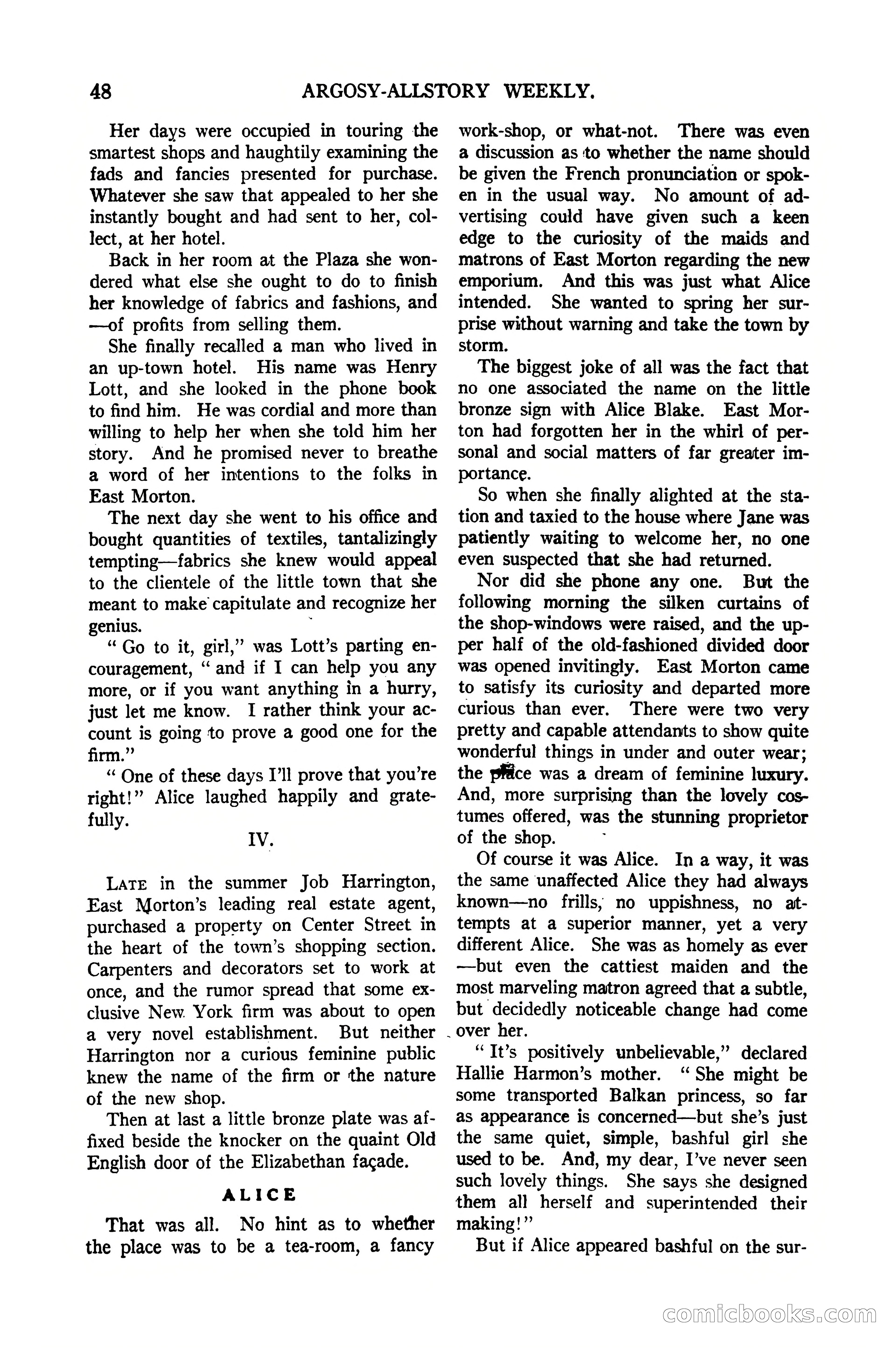
A restored page from Pulp Fiction, 1922. Page through the whole issue in the reader above.
📄 Transcribed text from this page (OCR, searchable)
Machine-transcribed from the original scan — historical spelling and the odd misread are preserved.
48 Her days were occupied in touring the smartest shops and haughtily examining the fads and fancies presented for purchase. Whatever she saw that appealed to her she instantly bought and had sent to her, col- lect, at her hotel. Back in her room at the Plaza she won- dered what else she ought to do to finish her knowledge of fabrics and fashions, and —of profits from selling them. She finally recalled a man who lived in an up-town hotel. His name was Henry Lott, and she looked in the phone book to find him. He was cordial and more than willing to help her when she told him her story. And he promised never to breathe a word of her intentions to the folks in East Morton. The next day she went to his office and bought quantities of textiles, tantalizingly tempting—fabrics she knew would appeal to the clientele of the little town that she meant to make capitulate and recognize her genius. ; “Go to it, girl,” was Lott’s parting en- couragement, ‘“ and if I can help you any more, or if you want anything in a hurry, just let me know. I rather think your ac- count is going to prove a good one for the firm.” “One of these days I’ll prove that you’re right!” Alice laughed happily and grate- fully. IV. Late in the summer Job Harrington, East Morton’s leading real estate agent, purchased a property on Center Street in the heart of the town’s shopping section. Carpenters and decorators set to work at once, and the rumor spread that some ex- clusive New. York firm was about to open a very novel establishment. But neither Harrington nor a curious feminine public knew the name of the firm or the nature of the new shop. Then at last a little bronze plate was af- fixed beside the knocker on the quaint Old English door of the Elizabethan facade. ALICE That was all. No hint as to whether the place was to be a tea-room, a fancy ARGOSY-ALLSTORY WEEKLY. work-shop, or what-not. There was even a discussion as to whether the name should be given the French pronunciation or spok- en in the usual way. No amount of ad- vertising could have given such a keen edge to the curiosity of the maids and matrons of East Morton regarding the new emporium. And this was just what Alice intended. She wanted to spring her sur- prise without warning and take the town by storm. The biggest joke of all was the fact that no one associated the name on the little bronze sign with Alice Blake. East Mor- ton had forgotten her in the whirl of per- sonal and social matters of far greater im- portance. So when she finally alighted at the sta- tion and taxied to the house where Jane was patiently waiting to welcome her, no one even suspected that she had returned. Nor did she phone any one. But the following morning the silken curtains of the shop-windows were raised, and the up- per half of the old-fashioned divided door was opened invitingly. East Morton came to satisfy its curiosity and departed more curious than ever. There were two very pretty and capable attendants to show quite wonderful things in under and outer wear; the pice was a dream of feminine luxury. And, more surprising than the lovely cos- tumes offered, was the stunning proprietor of the shop. ; Of course it was Alice. In a way, it was the same unaffected Alice they had always known—no frills; no uppishness, no at- tempts at a superior manner, yet a very different Alice. She was as homely as ever —but even the cattiest maiden and the most marveling matron agreed that a subtle, but decidedly noticeable change had come _ over her. ‘It’s positively unbelievable,” declared Hallie Harmon’s mother. ‘She might be some transported Balkan princess, so far as appearance is concerned—but she’s just the same quiet, simple, bashful girl she used to be. And, my dear, I’ve never seen such lovely things. She says she designed them all herself and superintended their making!”’ But if Alice appeared bashful on the sur- comiclboooks C©