
Pulp Fiction, 1922 · page 103 of 172
Argosy All-Story Weekly, July 1, 1922 — page 103: what you’re looking at
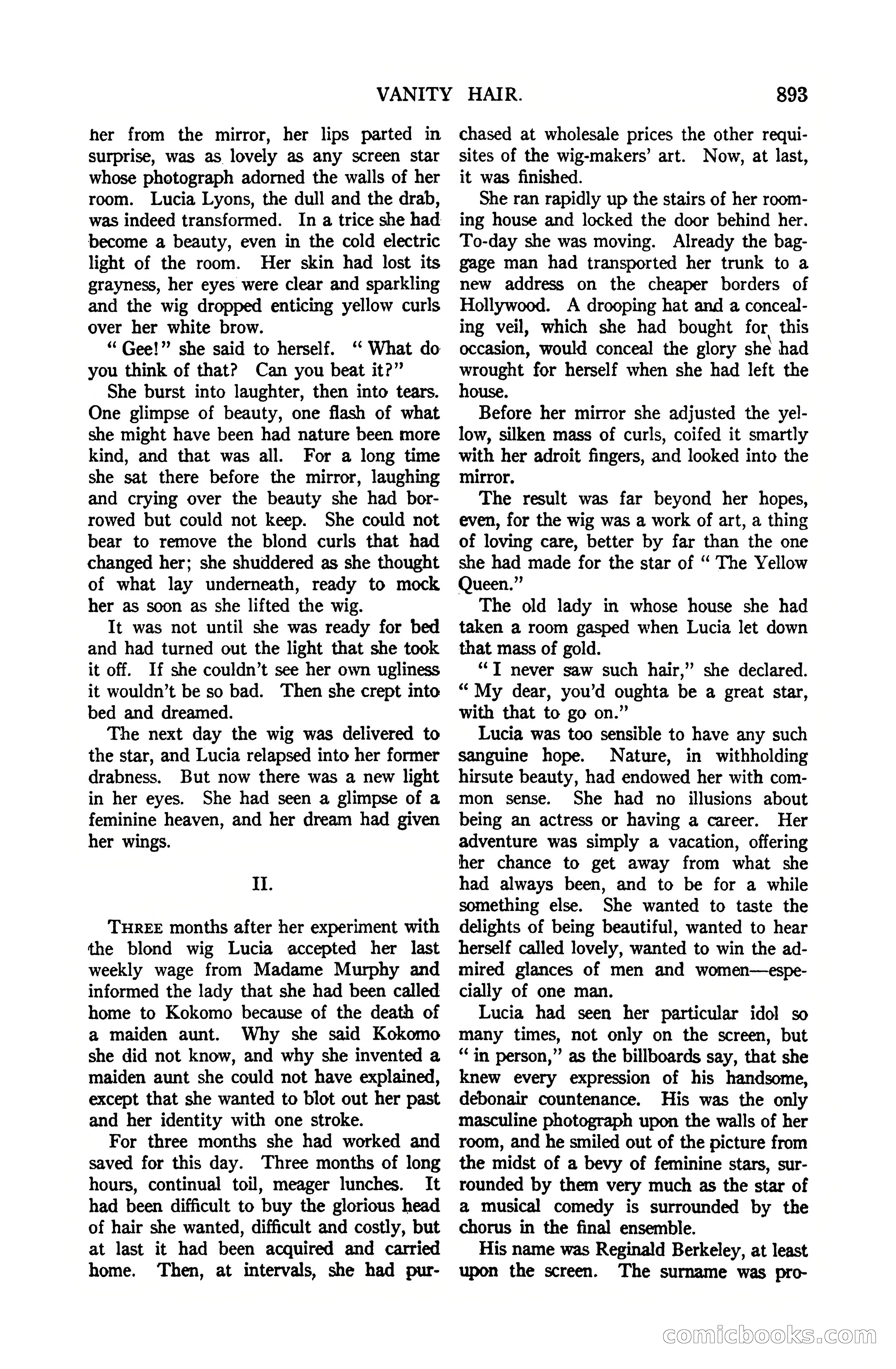
A restored page from Pulp Fiction, 1922. Page through the whole issue in the reader above.
📄 Transcribed text from this page (OCR, searchable)
Machine-transcribed from the original scan — historical spelling and the odd misread are preserved.
VANITY HAIR. her from the mirror, her lips parted in surprise, was as lovely as any screen star whose photograph adorned the walls of her room. Lucia Lyons, the dull and the drab, was indeed transformed. In a trice she had become a beauty, even in the cold electric light of the room. Her skin had lost its grayness, her eyes were clear and sparkling and the wig dropped enticing yellow curls over her white brow. “‘ Gee!” she said to herself. ‘‘ What do you think of that? Can you beat it?” She burst into laughter, then into tears. One glimpse of beauty, one flash of what she might have been had nature been more kind, and that was all. For a long time she sat there before the mirror, laughing and crying over the beauty she had bor- rowed but could not keep. She could not bear to remove the blond curls that had changed her; she shuddered as she thought of what lay underneath, ready to mock her as soon as she lifted the wig. It was not until she was ready for bed and had turned out the light that she took it off. If she couldn’t see her own ugliness it wouldn’t be so bad. Then she crept into bed and dreamed. The next day the wig was delivered to the star, and Lucia relapsed into her former drabness. But now there was a new light in her eyes. She had seen a glimpse of a feminine heaven, and her dream had given her wings. II. THREE months after her experiment with the blond wig Lucia accepted her last weekly wage from Madame Murphy and informed the lady that she had been called home to Kokomo because of the death of a maiden aunt. Why she said Kokomo she did not know, and why she invented a maiden aunt she could not have explained, except that she wanted to blot out her past and her identity with one stroke. For three months she had worked and saved for this day. ‘Three months of long hours, continual toil, meager lunches. It had been difficult to buy the glorious head of hair she wanted, difficult and costly, but at last it had been acquired and carried home. Then, at intervals, she had pur- 893 chased at wholesale prices the other requi- sites of the wig-makers’ art. Now, at last, it was finished. She ran rapidly up the stairs of her room- ing house and locked the door behind her. To-day she was moving. Already the bag- gage man had transported her trunk to a new address on the cheaper borders of Hollywood. A drooping hat and a conceal- ing veil, which she had bought for this occasion, would conceal the glory she had wrought for herself when she had left the house. Before her mirror she adjusted the yel- low, silken mass of curls, coifed it smartly with her adroit fingers, and looked into the mirror. The result was far beyond her hopes, even, for the wig was a work of art, a thing of loving care, better by far than the one she had made for the star of “ The Yellow Queen.” The old lady in whose house she had taken a room gasped when Lucia let down that mass of gold. “IT never saw such hair,” she declared. “My dear, you’d oughta be a great star, with that to go on.” Lucia was too sensible to have any such sanguine hope. Nature, in withholding hirsute beauty, had endowed her with com- mon sense. She had no illusions about being an actress or having a career. Her adventure was simply a vacation, offering her chance to get away from what she had always been, and to be for a while something else. She wanted to taste the delights of being beautiful, wanted to hear herself called lovely, wanted to win the ad- mired glances of men and women—espe- cially of one man. Lucia had seen her particular idol so many times, not only on the screen, but “in person,” as the billboards say, that she knew every expression of his handsome, debonair countenance. His was the only masculine photograph upon the walls of her room, and he smiled out of the picture from the midst of a bevy of feminine stars, sur- rounded by them very much as the star of a musical comedy is surrounded by the chorus in the final ensemble. His name was Reginald Berkeley, at least upon the screen. The surname was pro- comiclboooks C©