
Pulp Fiction, 1922 · page 114 of 172
Argosy All-Story Weekly, July 1, 1922 — page 114: what you’re looking at
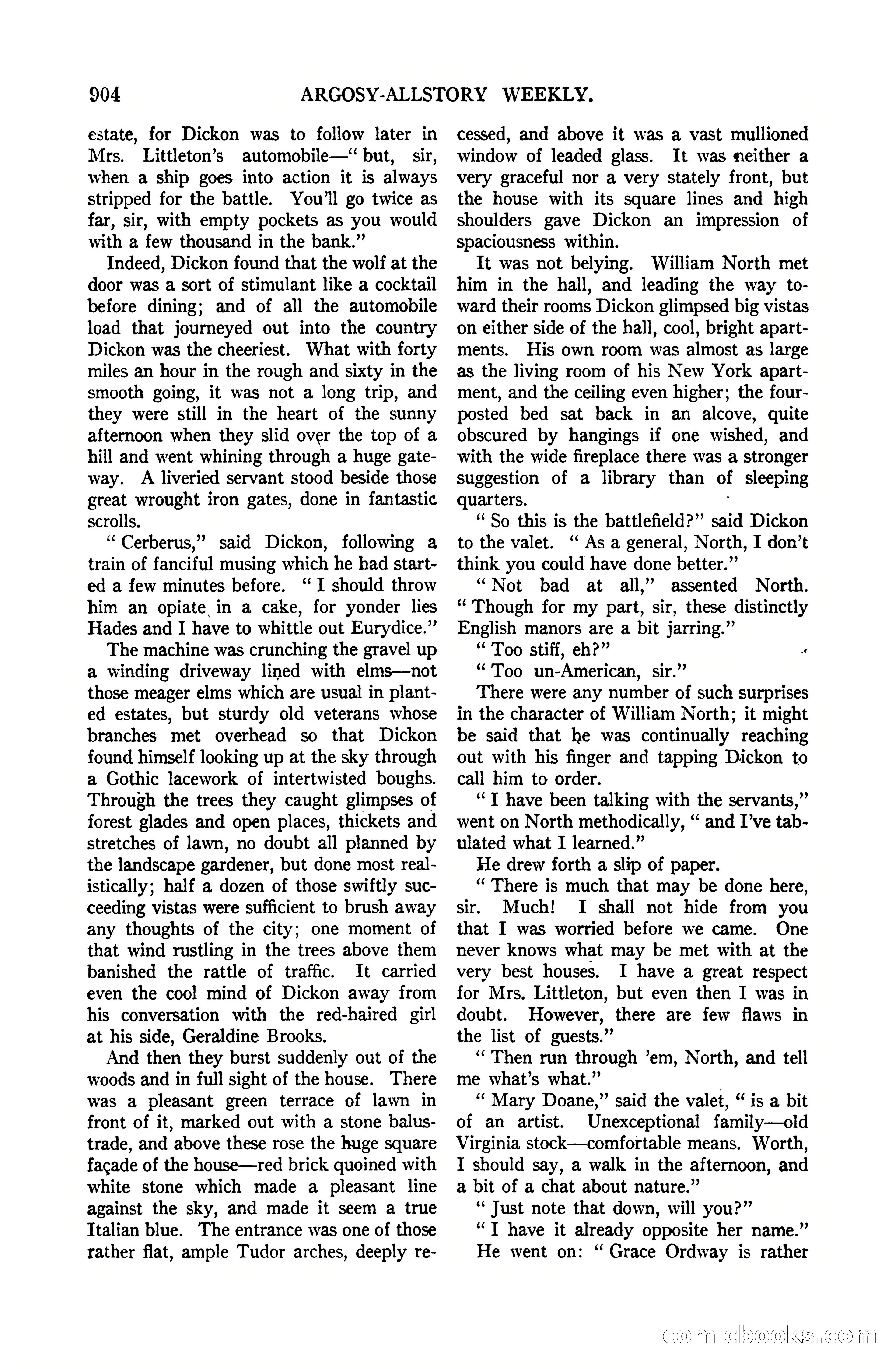
A restored page from Pulp Fiction, 1922. Page through the whole issue in the reader above.
📄 Transcribed text from this page (OCR, searchable)
Machine-transcribed from the original scan — historical spelling and the odd misread are preserved.
904 estate, for Dickon was to follow later in Mrs. Littleton’s automobile—“ but, sir, when a ship goes into action it is always stripped for the battle. Youll go twice as far, sir, with empty pockets as you would with a few thousand in the bank.” Indeed, Dickon found that the wolf at the door was a sort of stimulant like a cocktail before dining; and of all the automobile load that journeyed out into the country Dickon was the cheeriest. What with forty miles an hour in the rough and sixty in the smooth going, it was not a long trip, and they were still in the heart of the sunny afternoon when they slid over the top of a hill and went whining through a huge gate- way. A liveried servant stood beside those great wrought iron gates, done in fantastic scrolls. “Cerberus,” said Dickon, following a train of fanciful musing which he had start- ed a few minutes before. “I should throw him an opiate in a cake, for yonder lies Hades and I have to whittle out Eurydice.” The machine was crunching the gravel up a winding driveway lined with elms—not those meager elms which are usual in plant- ed estates, but sturdy old veterans whose branches met overhead so that Dickon found himself looking up at the sky through a Gothic lacework of intertwisted boughs. Through the trees they caught glimpses of forest glades and open places, thickets and stretches of lawn, no doubt all planned by the landscape gardener, but done most real- istically; half a dozen of those swiftly suc- ceeding vistas were sufficient to brush away any thoughts of the city; one moment of that wind rustling in the trees above them banished the rattle of traffic. It carried even the cool mind of Dickon away from his conversation with the red-haired girl at his side, Geraldine Brooks. And then they burst suddenly out of the woods and in full sight of the house. There was a pleasant green terrace of lawn in front of it, marked out with a stone balus- trade, and above these rose the huge square facade of the house—red brick quoined with white stone which made a pleasant line against the sky, and made it seem a true Italian blue. The entrance was one of those rather flat, ample Tudor arches, deeply re- ARGOSY-ALLSTORY WEEKLY. cessed, and above it was a vast mullioned window of leaded glass. It was neither a very graceful nor a very stately front, but the house with its square lines and high shoulders gave Dickon an impression of spaciousness within. It was not belying. William North met him in the hall, and leading the way to- ward their rooms Dickon glimpsed big vistas on either side of the hall, cool, bright apart- ments. His own room was almost as large as the living room of his New York apart- ment, and the ceiling even higher; the four- posted bed sat back in an alcove, quite obscured by hangings if one wished, and with the wide fireplace there was a stronger suggestion of a library than of sleeping quarters. “So this is the battlefield?” said Dickon to the valet. ‘ As a general, North, I don’t think you could have done better.”’ “Not bad at all,” assented North. “Though for my part, sir, these distinctly English manors are a bit jarring.” “Too stiff, eh?” “Too un-American, sir.” There were any number of such surprises in the character of William North; it might be said that he was continually reaching out with his finger and tapping Dickon to call him to order. ‘“‘T have been talking with the servants,” went on North methodically, “ and I’ve tab- ulated what I learned.” He drew forth a slip of paper. “There is much that may be done here, sir. Much! I shall not hide from you that I was worried before we came. One never knows what may be met with at the very best houses. I have a great respect for Mrs. Littleton, but even then I was in doubt. However, there are few flaws in the list of guests.” ‘Then run through ’em, North, and tell me what’s what.” | “Mary Doane,” said the valet, “ is a bit of an artist. Unexceptional family—old Virginia stock—comfortable means. Worth, T should say, a walk in the afternoon, and a bit of a chat about nature.” ‘“‘ Just note that down, will you?” ‘““T have it already opposite her name.” He went on: ‘‘ Grace Ordway is rather comicloool C©