
Pulp Fiction, 1922 · page 129 of 172
Argosy All-Story Weekly, July 1, 1922 — page 129: what you’re looking at
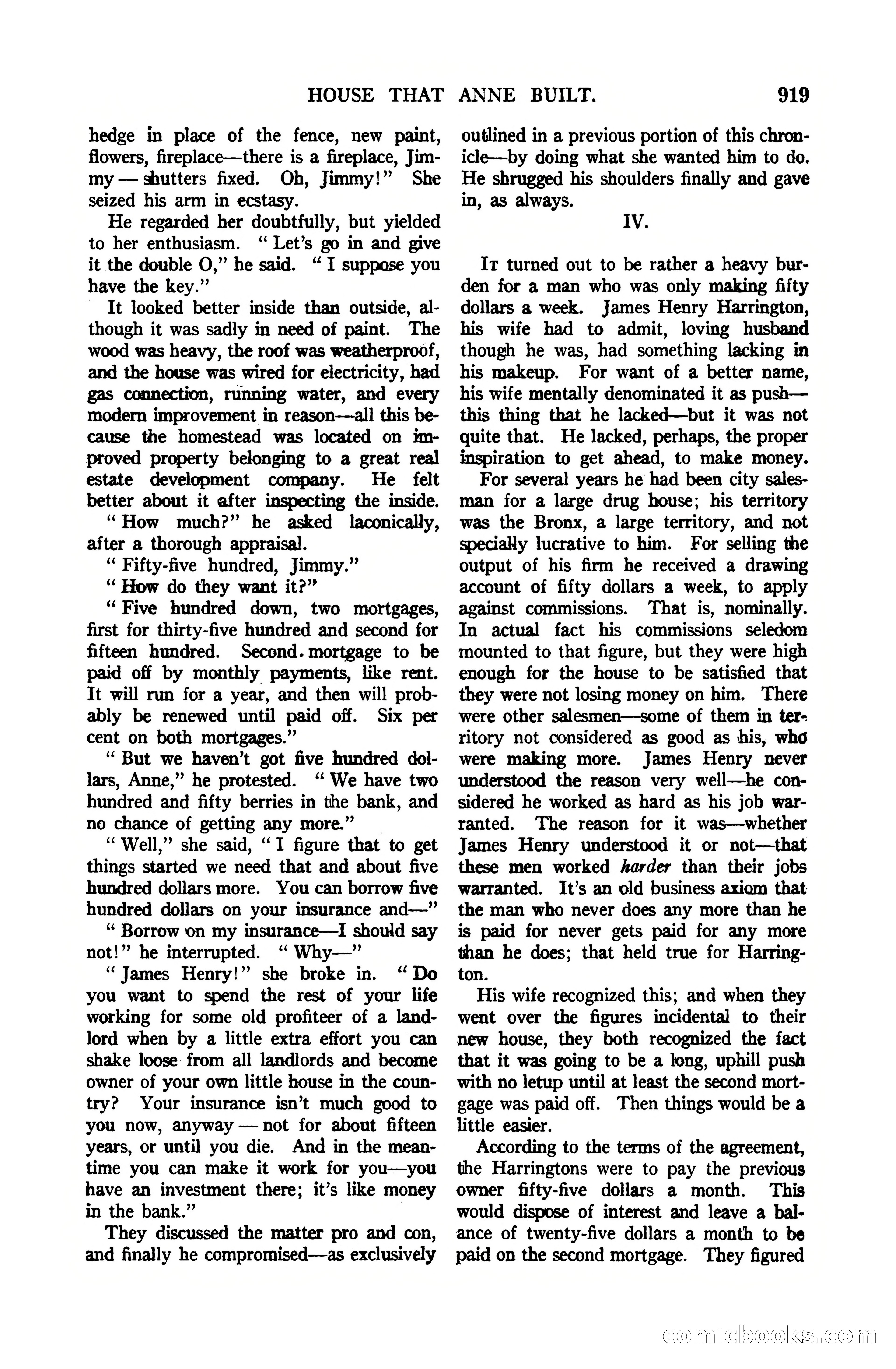
A restored page from Pulp Fiction, 1922. Page through the whole issue in the reader above.
📄 Transcribed text from this page (OCR, searchable)
Machine-transcribed from the original scan — historical spelling and the odd misread are preserved.
HOUSE THAT hedge in place of the fence, new paint, flowers, fireplace—there is a fireplace, Jim- my — shutters fixed. Oh, Jimmy!” She seized his arm in ecstasy. He regarded her doubtfully, but yielded to her enthusiasm. ‘ Let’s go in and give it the double O,” he said. “I suppose you have the key.” - It looked better inside than outside, al- though it was sadly in need of paint. The wood was heavy, the roof was weatherproof, and the house was wired for electricity, had gas connection, running water, and every modern improvement in reason—all this be- cause the homestead was located on im- proved property belonging to a great real estate development company. He felt better about it after inspecting the inside. ‘“How much?” he asked laconically, after a thorough appraisal. “ Fifty-five hundred, Jimmy.” “‘ How do they want it?” “Five hundred down, two mortgages, first for thirty-five hundred and second for fifteen hundred. Second. mortgage to be paid off by monthly payments, like rent. It will run for a year, and then will prob- ably be renewed until paid off. Six per cent on both mortgages.” “ But we haven’t got five hundred dol- lars, Anne,” he protested. “‘ We have two hundred and fifty berries in the bank, and no chance of getting any more.” ‘'Well,”’ she said, “I figure that to get things started we need that and about five hundred dollars more. You can borrow five hundred dollars on your insurance and—” “ Borrow on my insurance—I should say not!” he interrupted. ‘“ Why—”’ ‘James Henry!” she broke in. ‘“ Do you want to spend the rest of your life working for some old profiteer of a land- lord when by a little extra effort you can shake loose from all landlords and become owner of your own little house in the coun- try? Your insurance isn’t much good to you now, anyway — not for about fifteen years, or until you die. And in the mean- time you can make it work for you—you have an investment there; it’s like money in the bank.” | They discussed the matter pro and con, and finally he compromised—as exclusively ANNE BUILT. 919 outlined in a previous portion of this chron- icle—by doing what she wanted him to do. He shrugged his shoulders finally and gave in, as always. IV. It turned out to be rather a heavy bur- den for a man who was only making fifty dollars a week. James Henry Harrington, his wife had to admit, loving husband though he was, had something lacking in his makeup. For want of a better name, his wife mentally denominated it as push— this thing that he lacked—but it was not quite that. He lacked, perhaps, the proper inspiration to get ahead, to make money. For several years he had been city sales- man for a large drug house; his territory was the Bronx, a large territory, and not speciaHy lucrative to him. For selling the output of his firm he received a drawing account of fifty dollars a week, to apply against commissions. That is, nominally. In actual fact his commissions seledom mounted to that figure, but they were high enough for the house to be satisfied that they were not losing money on him. There were other salesmen—some of them in ter- ritory not considered as good as his, who were making more. James Henry never understood the reason very well—he con- sidered he worked as hard as his job war- ranted. The reason for it was—whether James Henry understood it or not—that these men worked arder than their jobs warranted. It’s an old business axiom that the man who never does any more than he is paid for never gets paid for any more than he does; that held true for Harring- ton. His wife recognized this; and when they went over the figures incidental to their new house, they both recognized the fact that it was going to be a long, uphill push with no letup until at least the second mort- gage was paid off. Then things would be a little easier. According to the terms of the agreement, the Harringtons were to pay the previous owner fifty-five dollars a month. This would dispose of interest and leave a bal- ance of twenty-five dollars a month to be paid on the second mortgage. They figured comicloool C©