
Pulp Fiction, 1922 · page 166 of 172
Argosy All-Story Weekly, July 1, 1922 — page 166: what you’re looking at
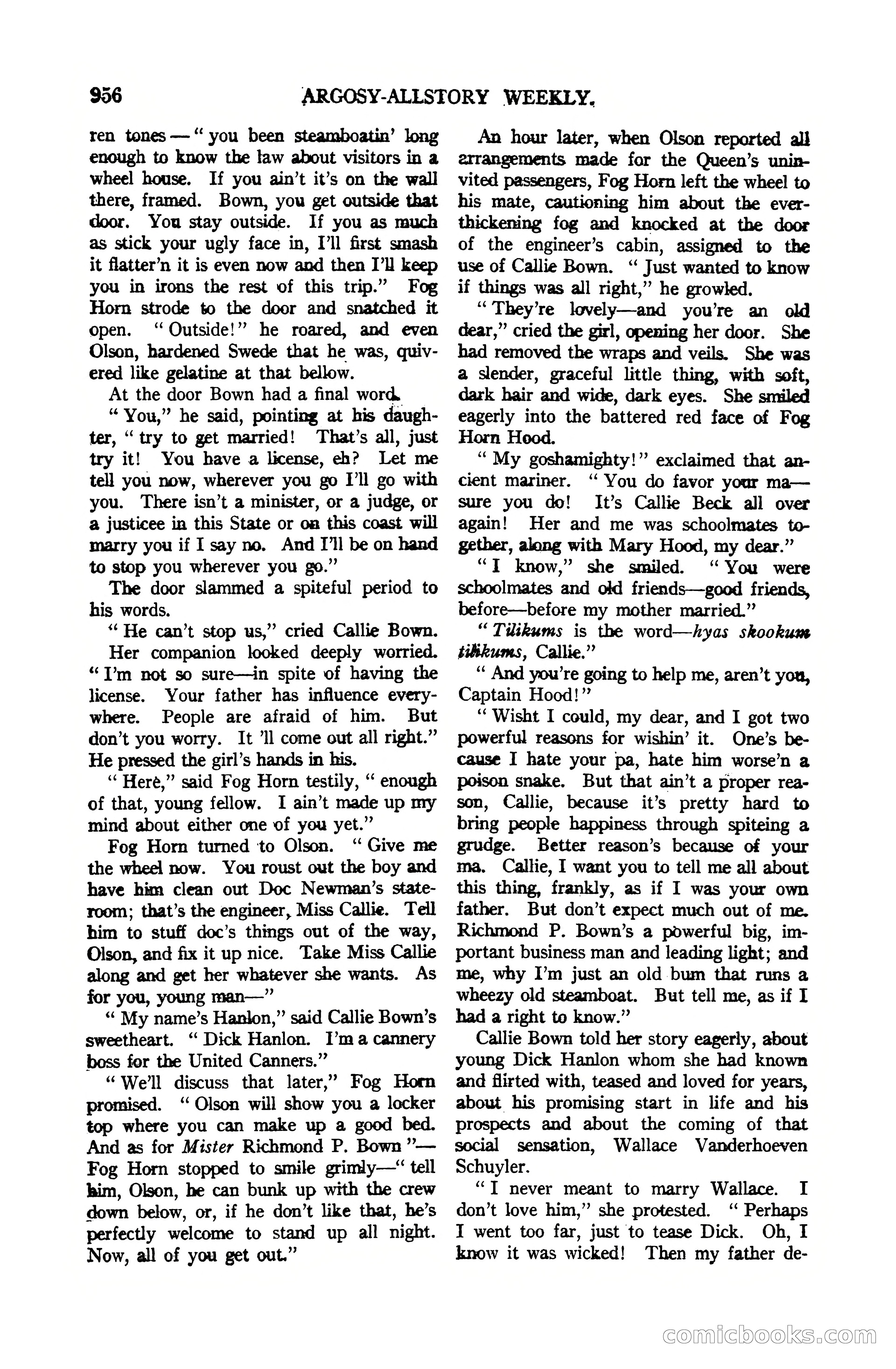
A restored page from Pulp Fiction, 1922. Page through the whole issue in the reader above.
📄 Transcribed text from this page (OCR, searchable)
Machine-transcribed from the original scan — historical spelling and the odd misread are preserved.
956 ren tones — “‘ you been steamboatin’ long enough to know the law about visitors in a wheel house. If you ain’t it’s on the wall there, framed. Bown, you get outside that door. You stay outside. If you as much as stick your ugly face in, I’ll first smash it flatter’n it is even now and then I’ keep you in irons the rest of this trip.” Fog Horn strode to the door and snatched it open. ‘“‘ Outside!”’ he roared, and even Olson, hardened Swede that he was, quiv- ered like gelatine at that bellow. At the door Bown had a final word. “You,” he said, pointing at his daugh- ter, ‘try to get married! That’s all, just try it! You have a license, eh? Let me tell you now, wherever you go Ill go with you. There isn’t a minister, or a judge, or a justicee in this State or on this coast will marry you if I say no. And I'll be on hand to stop you wherever you go.” The door slammed a spiteful period to his words. ““ He can’t stop us,” cried Callie Bown. Her companion looked deeply worried. “Tm not so sure—in spite of having the license. Your father has influence every- where. People are afraid of him. But don’t you worry. It ’ll come out all right.” He pressed the girl’s hands in his. ‘ Here,” said Fog Horn testily, ‘‘ enough of that, young fellow. I ain’t made up my mind about either one of you yet.” Fog Horn turned to Olson. ‘ Give me the wheel now. You roust out the boy and have him clean out Doc Newman’s state- room; that’s the engineer, Miss Callie. Tell him to stuff doc’s things out of the way, Olson, and fix it up nice. Take Miss Callie along and get her whatever she wants. As for you, young man—”’ “ My name’s Hanlon,” said Callie Bown’s sweetheart. ‘“ Dick Hanlon. I’m a cannery boss for the United Canners.” “We'll discuss that later,” Fog Horn promised. ‘Olson will show you a locker top where you can make up a good bed. And as for Mister Richmond P. Bown ”— Fog Horn stopped to smile grimly— tell him, Olson, he can bunk up with the crew down below, or, if he don’t like that, he’s perfectly welcome to stand up all night. Now, all of you get out.” ARGOSY-ALLSTORY WEEKLY. An hour later, when Olson reported all arrangements made for the Queen’s unin- vited passengers, Fog Horn left the wheel to his mate, cautioning him about the ever- thickening fog and knocked at the door of the engineer’s cabin, assigned to the use of Callie Bown. “ Just wanted to know if things was all right,” he growled. ‘“They’re lovely—and you're an old dear,” cried the girl, opening her door. She had removed the wraps and veils. She was a slender, graceful little thing, with soft, dark hair and wide, dark eyes. She smiled eagerly into the battered red face of Fog Horn Hood. ““My goshamighty!” exclaimed that an- cient mariner. ‘“‘ You do favor your ma— sure you do! It’s Callie Beck all over again! Her and me was schoolmates to- gether, along with Mary Hood, my dear.” “I know,” she smiled. “You were schoolmates and old friends—good friends, before—before my mother married.” “Tiuikums is the word—hyas skookum titkums, Callie.” ‘And you’re going to help me, aren’t you, Captain Hood!” ‘Wisht I could, my dear, and I got two powerful reasons for wishin’ it. One’s be- cause I hate your pa, hate him worse’n a poison snake. But that ain’t a proper rea- son, Callie, because it’s pretty hard to bring people happiness through spiteing a grudge. Better reason’s because of your ma. Callie, I want you to tell me all about this thing, frankly, as if I was your own father. But don’t expect much out of me. Richmond P. Bown’s a powerful big, im- portant business man and leading light; and me, why I’m just an old bum that runs a wheezy old steamboat. But tell me, as if I had a right to know.” Callie Bown told her story eagerly, about young Dick Hanlon whom she had known and flirted with, teased and loved for years, about his promising start in life and his prospects and about the coming of that social sensation, Wallace Vanderhoeven Schuyler. ‘““T never meant to marry Wallace. I don’t love him,” she protested. ‘‘ Perhaps I went too far, just to tease Dick. Oh, I know it was wicked! Then my father de- comicloool C©