
Pulp Fiction, 1922 · page 169 of 172
Argosy All-Story Weekly, July 1, 1922 — page 169: what you’re looking at
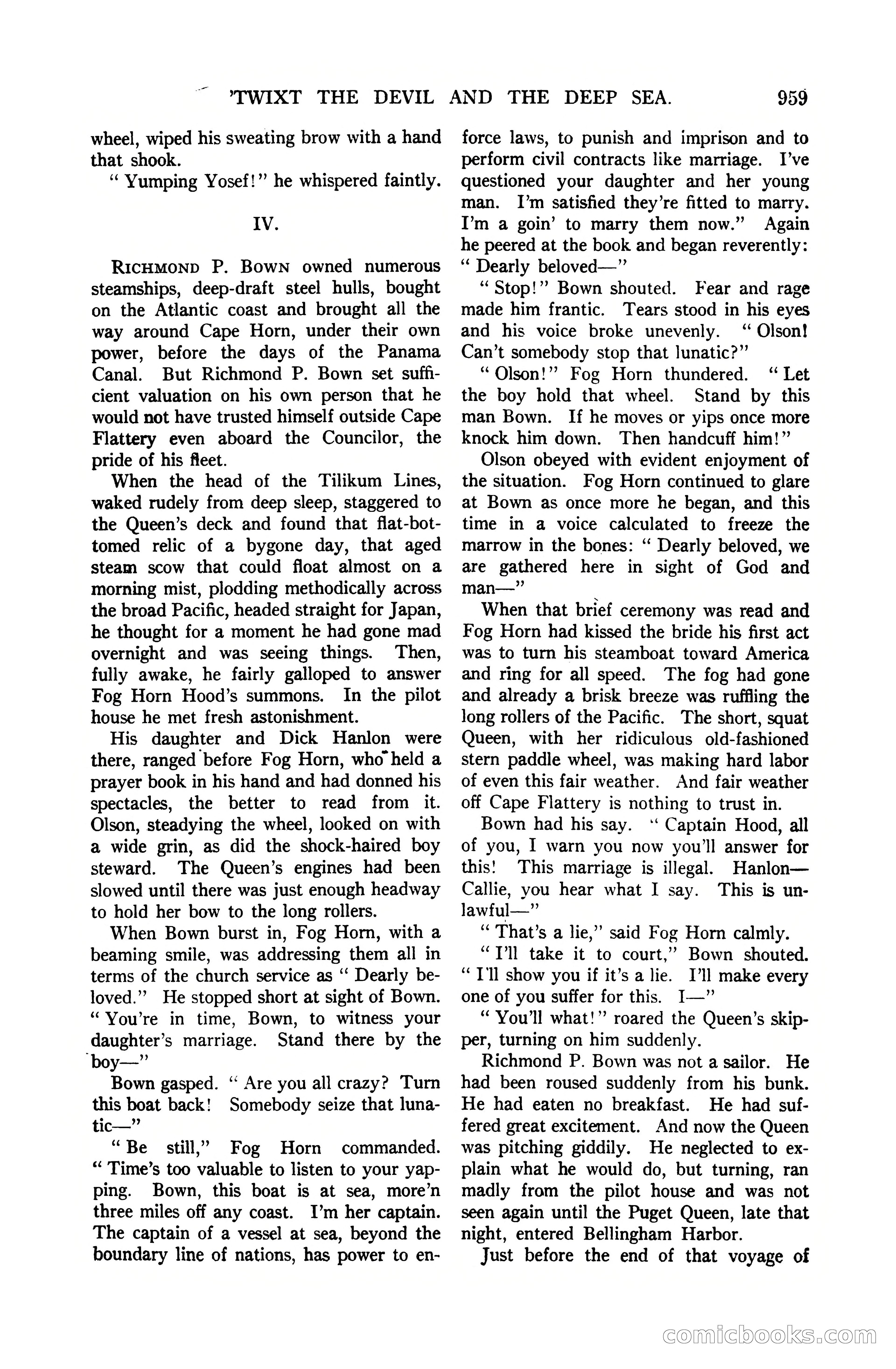
A restored page from Pulp Fiction, 1922. Page through the whole issue in the reader above.
📄 Transcribed text from this page (OCR, searchable)
Machine-transcribed from the original scan — historical spelling and the odd misread are preserved.
"TWIXT THE DEVIL AND THE DEEP SEA. 959 wheel, wiped his sweating brow with a hand that shook. ‘“Yumping Yosef!” he whispered faintly. IV. RICHMOND P. Bown owned numerous steamships, deep-draft steel hulls, bought on the Atlantic coast and brought all the way around Cape Horn, under their own power, before the days of the Panama Canal. But Richmond P. Bown set suff- cient valuation on his own person that he would not have trusted himself outside Cape Flattery even aboard the Councilor, the pride of his fleet. When the head of the Tilikum Lines, waked rudely from deep sleep, staggered to the Queen’s deck and found that flat-bot- tomed relic of a bygone day, that aged steam scow that could float almost on a morning mist, plodding methodically across the broad Pacific, headed straight for Japan, he thought for a moment he had gone mad overnight and was seeing things. Then, fully awake, he fairly galloped to answer Fog Horn Hood’s summons. In the pilot house he met fresh astonishment. His daughter and Dick Hanlon were there, ranged before Fog Horn, who held a prayer book in his hand and had donned his spectacles, the better to read from it. Olson, steadying the wheel, looked on with a wide grin, as did the shock-haired boy steward. The Queen’s engines had been slowed until there was just enough headway to hold her bow to the long rollers. When Bown burst in, Fog Horn, with a beaming smile, was addressing them all in terms of the church service as “‘ Dearly be- loved.”’ He stopped short at sight of Bown. “You’re in time, Bown, to witness your daughter’s marriage. Stand there by the Bown gasped. “ Are you all crazy? Turn this boat back! Somebody seize that luna- tic—” “Be = still,” Fog Horn commanded. “ Time’s too valuable to listen to your yap- ping. Bown, this boat is at sea, more’n three miles off any coast. I’m her captain. The captain of a vessel at sea, beyond the boundary line of nations, has power to en- force laws, to punish and imprison and to perform civil contracts like marriage. I’ve questioned your daughter and her young man. I’m satisfied they’re fitted to marry. I’m a goin’ to marry them now.” Again he peered at the book and began reverently: ‘* Dearly beloved—” ‘““ Stop!”? Bown shouted. made him frantic. Fear and rage Tears stood in his eyes and his voice broke unevenly. ‘Olson! Can’t somebody stop that lunatic?”’ “ Olson!” Fog Horn thundered. ‘“ Let the boy hold that wheel. Stand by this man Bown. If he moves or yips once more knock him down. Then handcuff him!” Olson obeyed with evident enjoyment of the situation. Fog Horn continued to glare at Bown as once more he began, and this time in a voice calculated to freeze the marrow in the bones: “ Dearly beloved, we are gathered here in sight of God and man—”’ ; When that brief ceremony was read and Fog Horn had kissed the bride his first act was to turn his steamboat toward America and ring for all speed. The fog had gone and already a brisk breeze was ruffling the long rollers of the Pacific. The short, squat Queen, with her ridiculous old-fashioned stern paddle wheel, was making hard labor of even this fair weather. And fair weather off Cape Flattery is nothing to trust in. Bown had his say. ‘‘ Captain Hood, all of you, I warn you now you’ll answer for this! This marriage is illegal. Hanlon— Callie, you hear what I say. This is un- lawful—”’ ‘“That’s a lie,’ said Fog Horn calmly. “Tl take it to court,” Bown shouted. “Tl show you if it’s a lie. I'll make every one of you suffer for this. I—” “You'll what!” roared the Queen’s skip- per, turning on him suddenly. Richmond P. Bown was not a sailor. He had been roused suddenly from his bunk. He had eaten no breakfast. He had suf- fered great excitement. And now the Queen was pitching giddily. He neglected to ex- plain what he would do, but turning, ran madly from the pilot house and was not seen again until the Puget Queen, late that night, entered Bellingham Harbor. Just before the end of that voyage of comicloool C©