
Pulp Fiction, 1922 · page 43 of 172
Argosy All-Story Weekly, July 1, 1922 — page 43: what you’re looking at
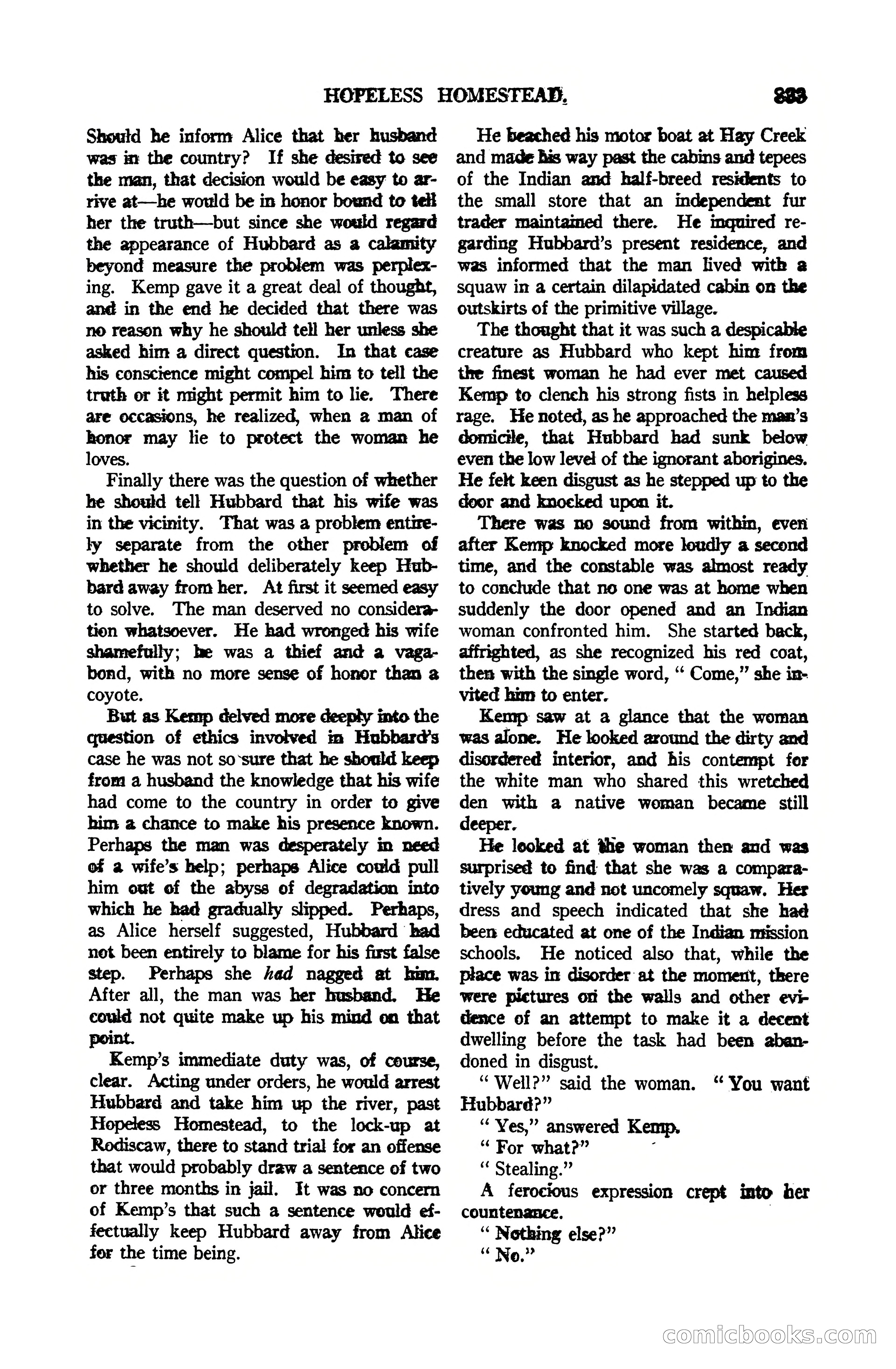
A restored page from Pulp Fiction, 1922. Page through the whole issue in the reader above.
📄 Transcribed text from this page (OCR, searchable)
Machine-transcribed from the original scan — historical spelling and the odd misread are preserved.
HOPELESS HOMESTEAD. Should he inform Alice that her husband was in the country? If she desired to see the man, that decision would be easy to ar- rive at—he would be in honor bound to tell her the truth—but since she would regard the appearance of Hubbard as a calamity beyond measure the problem was perplex- ing. Kemp gave it a great deal of thought, and in the end he decided that there was no reason why he should tell her unless she asked him a direct question. In that case his conscience might compel him to tell the truth or it might permit him to lie. There are occasions, he realized, when a man of konor may lie to protect the woman he loves. Finally there was the question of whether he should tell Hubbard that his wife was in the vicinity. That was a problem entire- ly separate from the other problem of whether he should deliberately keep Hub- bard away from her. At first it seemed easy to solve. The man deserved no considera- tion whatsoever. He had wronged his wife shamefully; be was a thief and a vaga- bond, with no more sense of honor than a coyote. But as Kemp delved more deepty into the question of ethics involved in Hubbard's case he was not so‘sure that he should keep from a husband the knowledge that his wife had come to the country in order to give him a chance to make his presence known. Perhaps the man was desperately in need of a wife’s help; perhaps Alice could pull him out of the abyss of degradation into which he had gradually slipped. Perhaps, as Alice herself suggested, Hubbard had not been entirely to blame for his first false step. Perhaps she fad nagged at him. After all, the man was her husband. He could not quite make up his mind on that Kemp’s immediate duty was, of course, clear. Acting under orders, he would arrest Hubbard and take him up the river, past Hopeless Homestead, to the lock-up at Rodiscaw, there to stand trial for an offense that would probably draw a sentence of two or three months in jail. It was no concern of Kemp’s that such a sentence would ef- fectually keep Hubbard away from Alice for the time being. He beached his motor boat at Hay Creek and made his way past the cabins and tepees of the Indian and half-breed residents to the small store that an independent fur trader maintained there. He inquired re- garding Hubbard’s present residence, and was informed that the man lived with a squaw in a certain dilapidated cabin on the outskirts of the primitive village. The thought that it was such a despicable creature as Hubbard who kept him from the finest woman he had ever met caused Kemp to clench his strong fists in helpless rage. He noted, as he approached the man’s domicite, that Hubbard had sunk below even the low level of the ignorant aborigines. He felt keen disgust as he stepped up to the door and knocked upon it. There was no sound from within, even after Kemp knocked more loudly a second time, and the constable was almost ready to conclude that no one was at home when suddenly the door opened and an Indian woman confronted him. She started back, affrighted, as she recognized his red coat, then with the single word, “ Come,” she in- vited hin to enter. Kemp saw at a glance that the woman was alone. He looked around the dirty and disordered interior, and his contempt for the white man who shared this wretched den with a native woman became still deeper. He leoked at the woman then and was surprised to find that she was a compara- tively young and not uncomely squaw. Her dress and speech indicated that she had been educated at one of the Indian miission schools. He noticed also that, while the place was in disorder at the moment, there were pictures ori the walls and other evi- dence of an attempt to make it a decent dwelling before the task had been aban- doned in disgust. “Well?” said the woman. Hubbard?” “Yes,” answered Kemp. “ For what?” ; “ Stealing.” A ferocious expression crept into ber countenance. ‘“ Nothing else?” éc No.” “You want comicloool C©